Mexico City, Dec 30 (Prensa Latina) Mexican President Claudia Sheinbaum today reiterated her rejection of any intervention in Venezuela and called on the UN to play a more prominent role in the face of US threats to the South American nation.
“What we have to say is that we do not agree with interventions, especially military ones. That is the Constitution in our country and that is what we will continue to defend,” the president said in response to a question about US pressure against Caracas.
When asked whether there should be a call in the region to support Venezuela, the head of the Executive Branch considered that “the United Nations has to take a much more leading role in these cases.”
The combination of attacks on vessels allegedly linked to drug trafficking and the hijacking of oil tankers near the Venezuelan coast has intensified Washington’s campaign in its undeclared war against that South American nation.
Added to this is the massive military presence in the area of the Southern Command, where the northern country deployed warships, marines, fighter jets and spy planes, in a show of power.
Caracas has denounced that Trump assumed on his social media that Venezuelan oil and other resources are his property, and reaffirmed sovereignty over all natural wealth, as well as the right to free navigation and free trade.
This year we produced Health Under Sanction, a 25-minute documentary for Al Jazeeraabout the impact of U.S. sanctions on Cuba’s public healthcare. With exclusive access to Cuban hospitals, the film follows the patients feeling the brunt of the U.S. government’s economic war on Cuba — and the doctors fighting to keep them alive.
Also, we released a video report this month looking at how a mosquito-borne epidemic has strained Cuba’s once vaunted healthcare system in part due to the impact of U.S. sanctions.
Cuban flags, people, and historic buildings in Old Havana. Photo by kmiragaya via Adobe Stock
Farm-Level Takeaway:Cuba remains a small but dependable, cash-only outlet for U.S. grain and food products.
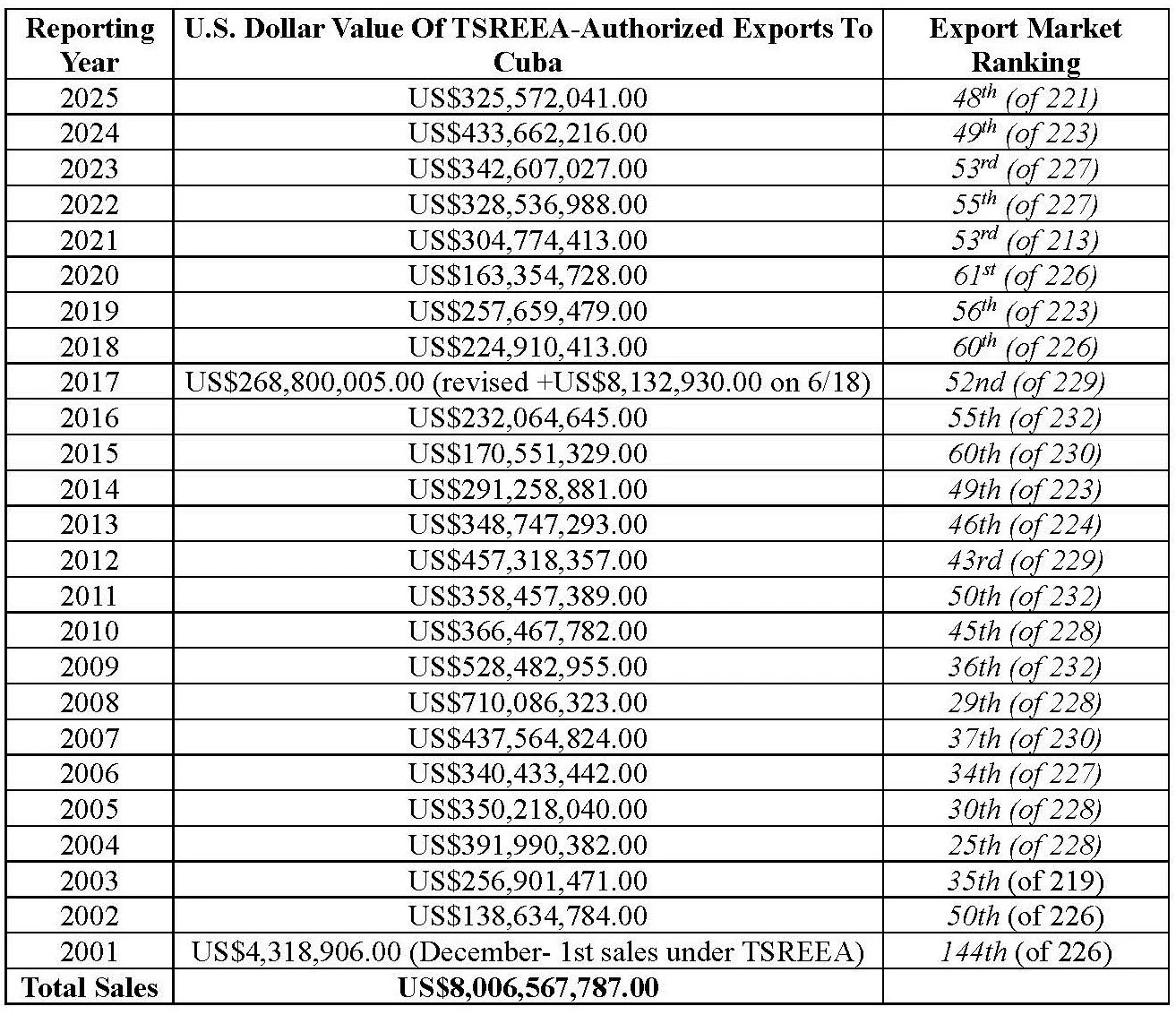
NASHVILLE, TENN. (RFD-TV) — U.S. agricultural and food exports to Cuba continue to grow under long-standing trade law, reaching a cumulative milestone of more than $8 billion since shipments resumed in late 2001. Recent data show that trade is accelerating modestly, even without changes to U.S. sanctions or financing rules.
Exports of U.S. ag and food products to Cuba totaled nearly $34 million in September 2025, up almost 9 percent from a year earlier. For the first nine months of 2025, shipments reached about $359 million, roughly 18 percent higher year over year, placing Cuba among the top 50 U.S. ag export destinations worldwide.
Trade is governed primarily by the Trade Sanctions Reform and Export Enhancement Act of 2000, which allows direct commercial exports of food and agricultural commodities on a cash-only basis. That structure limits volume growth while making Cuba a reliable buyer with minimal credit risk. Historically, products have included poultry, feed grains, wheat, rice, soy products, and processed foods, with shipments to Cuba’s re-emerging private sector.
Despite political constraints, proximity to U.S. ports and consistent food demand continue to support steady trade.
Farm-Level Takeaway: Cuba remains a small but dependable, cash-only outlet for U.S. grain and food products.
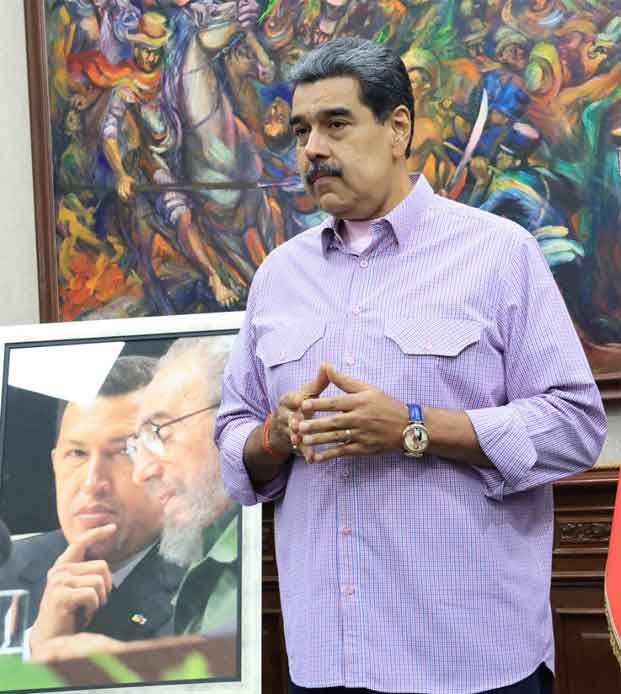
Caracas, Dec 27 (Prensa Latina) President Nicolás Maduro affirmed that the people of Cuba and Venezuela are the most solid foundation for the reunification of all of Latin America and the Caribbean, it was learned here today.
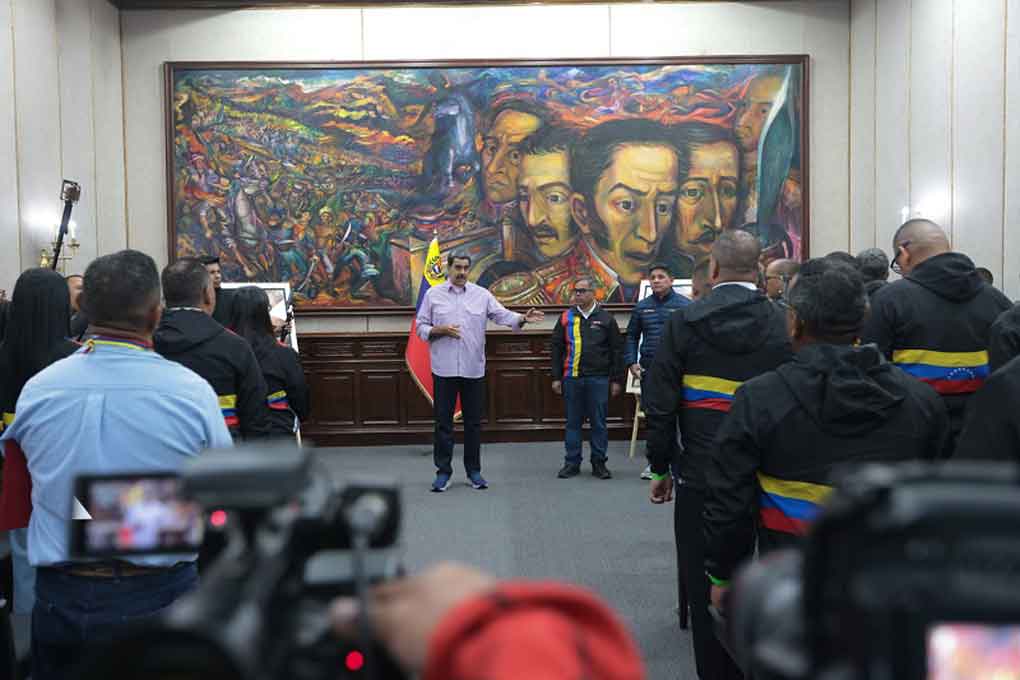
In a solemn ceremony last night at Miraflores Palace, the seat of government, the head of state decorated the Cuba-Venezuela International Brigade, which for several weeks helped to repair the damage in the island’s provinces that were hit at the end of October by Hurricane Melissa.
Venezuelan men and women specialists in the electrical, transportation and public works sectors received the Antonio José de Sucre Order of Merit for Builders of the Homeland.
Maduro said the brigade did a “very inspiring” job and praised the brotherhood between Caracas and Havana, saying it “is beyond question,” the Presidency published.
He also emphasized that both countries are driven by the power of solidarity, and in the Cuban case, it is the “world champion of solidarity” because “for more than 60 years, Cuba has gone to Africa, Asia, all of Latin America and the Caribbean, to demonstrate that mutual support is the future of humanity.”
The dignitary emphasized that both nations have the task of demonstrating that the future of our hemisphere and the continent “cannot be war, military threats, colonialism, or slavery.”
The brotherhood between Cuba and Venezuela is a brotherhood that can withstand any test, capable of overcoming all adversities so that victory always prevails, he asserted.
Maduro praised the Venezuelan people for also forging themselves in the spirit of solidarity and recognized as significant that a group of “our boys” went to express their solidarity with the island.
“Long live Cuba and Venezuela! Ever onward to victory!” the ruler declared.
The deep ties of cooperation and brotherhood between Havana and Caracas are based on the Comprehensive Cooperation Agreement signed in 2000 by Commanders Fidel Castro (1926-2016) and Hugo Chávez (1954-2013), which promoted a strategic alliance never before seen in the world.
Celebrating the 25th anniversary of the signing of that Agreement on October 25, Maduro stated that “this living testimony of brotherhood reflects our decision to be free, rebelliously sovereign, above any obstacle, threat or imperialist aggression.”
The leader declared that while others promote war and division, Cuba and Venezuela “reaffirmed that it is possible to move forward together, putting human dignity at the center, bringing health, education and development to our people.”
He emphasized that the signing of the agreements of the Convention took the fundamental step to “advance in the process of deep union, spiritual union and cultural union” of the Cuban and Venezuelan people.
Havana, Dec 25 (Prensa Latina) The Ministry of Agriculture of the Republic of Korea donated 24,600 tons of rice to Cuba, delivered through the World Food Programme (WFP), the United Nations System in Cuba reported.
The rest of the shipment will arrive through Havana, with the purpose of doubling deliveries to the prioritized population of the other provinces, in a bimonthly distribution modality that will extend for a year.
“This international collaboration strengthens food security and ensures national coverage for the most vulnerable sectors,” the WFP noted.
The agency also stated that the assistance will allow for an expanded emergency response and support for the recovery of communities affected by recent weather events, such as Hurricane Melissa.
Mexican President Claudia Sheinbaum highlighted today the historical relationship between her country and Cuba and emphasized that agreements with the island in the energy sector are conducted within a legal framework.
“The Mexico-Cuba relationship is historical. Mexico was the only country that opposed the blockade (imposed by the United States) from the very beginning. Therefore, regardless of the political party, there has always been a Mexico-Cuba relationship,” she emphasized.
Sheinbaum was responding to a question regarding oil shipments to the island nation, which has been under an economic, commercial, and financial siege imposed by Washington for over 60 years—a policy experts consider the main obstacle to Cuba’s development.
Mentioning energy cooperation and the decades of visits by Cuban leaders to Mexico and vice versa, regardless of the political affiliation of the North American nation’s leaders, the head of the executive branch stressed that ties with the Caribbean country are not new.
“It is not a new situation, and everything is done within the framework of the law and also for humanitarian reasons for the people of Cuba,” she stated, reiterating Mexico’s sovereignty and noting that this continues a series of supports historically provided by her nation to the island.
Last Thursday, Sheinbaum affirmed that Mexico’s position regarding Cuba will remain, *”as it has been maintained since (former President Adolfo) López Mateos (1958-1964).”
The dignitary pointed out that this has been a permanent topic in Mexico-U.S. relations since the triumph of the Cuban Revolution in 1959 and noted that the link with the island “has always been a point of difference” between the administrations of the two neighboring countries.
“Therefore, it should not influence Mexico-U.S. relations. And our position is sovereign, it is a sovereign decision, and it has much to do with the humanitarianism we represent. People should not have to suffer,” she said in relation to the blockade.
According to the most recent data, the U.S. siege against the Caribbean nation caused estimated damages of $7,556.1 million between March 2024 and last February, a 49 percent increase compared to the previous period.
In the health sector alone, this policy resulted in losses of nearly $300 million in one year, while the impact in the energy sector exceeded $496 million due to restrictions on importing fuel and spare parts.
On October 29 of this year, Cuba achieved another victory at the United Nations General Assembly, obtaining 165 votes in favor of the resolution calling for an end to this blockade.
Mexican President Claudia Sheinbaum speaks during a press conference at the National Palace in Mexico City, Mexico, March 4, 2025. (PHOTO / XINHUA)
December 22, 2025 — By Xinhua
MEXICO CITY — Mexico’s President Claudia Sheinbaum on Monday said that shipping Mexican oil to Cuba was carried out in accordance with the principles of sovereignty and humanitarianism.
The energy and financial collaboration between the two countries is transparent and legitimate, and deeply rooted in their bilateral history, she stressed during a morning press conference.
The Mexican president made the remarks despite repeated criticism from the US government, which has asked Mexico to reconsider its relationship with Cuba.
“First, we are doing this within a legal framework as a sovereign country, and second, we are continuing a series of support measures that our country has historically provided Cuba,” she said.
Sheinbaum added that she asked state-owned oil company Petroleos Mexicanos to submit a report on oil shipments to the Caribbean nation during her administration, noting the measure is lawful and conforms to the “humanitarian” principles that guide her government’s policies.
The oil agreements between Mexico and Cuba date back decades and have endured despite changes in the Mexican government, she said.
A file photo of buildings in the skyline of Caracas, Venezuela. /VCG
21-Dec-2025
CGTN— 21-Dec-2025
Several Latin American countries and regional organizations have denounced the U.S. actions against Venezuela, calling for dialogue and urging the United Nations and the international community to act.
Earlier this week, the Trump administration blocked oil tankers sailing to or from Venezuela and designated the government of Venezuelan President Nicolas Maduro as “a foreign terrorist organization.”
Cuban Foreign Minister Bruno Rodriguez Parrilla said Saturday that the U.S. government’s designation of the legitimate government of Venezuela as a “foreign terrorist organization” is a politically motivated act.
“It is a new, arbitrary, fraudulent, unilateral, and politically motivated act. It shows, once again, the lack of credibility of these decisions and the manipulation of terrorism as a political weapon, which also weakens international efforts against that scourge,” Rodriguez said on X.
Earlier this week, U.S. President Donald Trump announced the designation of Venezuela as a “foreign terrorist organization.”
Rodriguez said the United States intends to impose international isolation, increase pressure, and escalate an aggression that would have unpredictable consequences for peace, security and stability in Latin America and the Caribbean.
He also emphasized Cuba’s full solidarity and support for the people and government of Venezuela in the face of “this infamous barbarism.”
Brazilian President Luiz Inacio Lula da Silva also said Saturday that an armed intervention in Venezuela would be “a humanitarian catastrophe” for the region and set a dangerous precedent for the world.
Speaking at the 67th Summit of Heads of State of Mercosur and Associated States, Lula referred to U.S. threats and actions against Venezuela, including a naval blockade and military pressure on the Caribbean nation.
Latin America is shocked by “the military presence of an extra-regional power,” Lula said, stressing that “building a prosperous and peaceful South America is the only doctrine that suits us.”
“The limits of international law are being tested. An armed intervention in Venezuela would be a humanitarian catastrophe for the hemisphere and a dangerous precedent for the world,” he said.
Lula said he told Trump in a recent phone call that negotiation is a more effective and less costly path than military confrontation.
The data contains information on exports from the United States to the Republic of Cuba- products within the Trade Sanctions Reform and Export Enhancement Act (TSREEA) of 2000, Cuban Democracy Act (CDA) of 1992, and regulations implemented (1992 to present) for other products by the Office of Foreign Assets Control (OFAC) of the United States Department of the Treasury, Bureau of Industry and Security (BIS) of the United States Department of Commerce, and United States Department of State.
The TSREEA re-authorized the direct commercial (on a cash basis) export of food products (including branded food products) and agricultural commodities from the United States to the Republic of Cuba, irrespective of purpose. The TSREEA does not include healthcare products, which remain authorized and regulated by the CDA.
The data represents the U.S. Dollar value of product exported from the United States to the Republic of Cuba under the TSREEA, CDA, and other regulations, specifically including products exported from the United States to the re-emerging private sector in the Republic of Cuba.
The data does not include transportation charges, bank charges, or other costs associated with exports; the government of the Republic of Cuba reports unverifiable data that includes transportation charges, bank charges, and other costs.
The Department of Homeland Security announced last week the end of the Family Reunification Parole (FRP) program for nationals from Cuba, Colombia, Ecuador, El Salvador, Guatemala, Haiti and Honduras.
People from those countries who are currently in the U.S. under Family Reunification Parole and had not applied for residency or a change of status by December 15 will have their legal status and work permits revoked.
“The desire to reunite families does not overcome the government’s responsibility to prevent fraud and abuse and to uphold national security and public safety,” the Department of Homeland Security said in a statement.
Family Reunification Parole joins the list of programs under which Cubans could legally enter the U.S. that have been dismantled by the Trump administration. These include Biden’s CBP One and Humanitarian Parole programs, whose termination put many of the over half million Cubans who entered the U.S. through them at risk of deportation.
A partial travel ban on Cubans has been in place since June. Trump earlier this month also suspended pending citizenship, green card and asylum applications for immigrants from countries “of concern,” including Cuba. More than a thousand Cubans have been deported to the island this year.