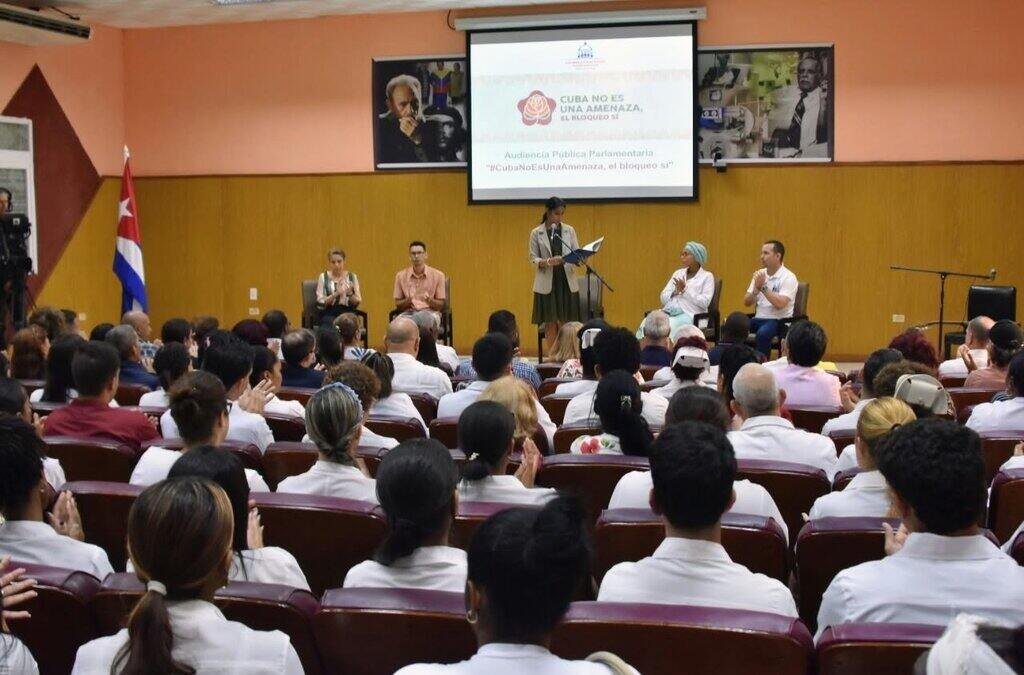
Havana, Oct 24 (Prensa Latina) The Vice President of the National Assembly of People’s Power in Cuba, Ana María Mari, highlighted here the greatness and resilience of the Cuban people.
These statements to Prensa Latina took place in connection with the recent Public Parliamentary Hearing “Cuba is not a threat, the blockade is”, held at the National Institute of Oncology and Radiobiology.
“Today I am speaking on behalf of millions of Cubans because there is not a single one of us who can say that we are not affected by the blockade within our homes, in our daily lives, in our personal fulfillment, in our dreams or in our plans,” he said.
“The economic, financial, commercial and energy blockade imposed by the United States on the island is a collective punishment, and it is the cost of having made the decision to defend our sovereignty, to build a society under our own rules and to want to live the self-determination of a people,” he added.
The lawyer also spoke of the greatness of the Cuban people and their daily capacity for reinvention. She also expressed particular admiration for healthcare workers.
“Doctors have the task every morning of holding life in their hands, and they do so leaving behind at home the same problems as any Cuban today. They have long sleepless nights, often struggle to cook food for their children, and feel frustrated because they know they have a critically ill patient waiting for them, but transportation is lacking because there isn’t enough fuel. They carry within them this need to arrive on time, with an immense sense of responsibility because there is a human being, a person, waiting for them,” Mari expressed.
“What the Cuban people have done during these years of Revolution has been a constant act of heroism, above all because of their perseverance, resistance, strength, resilience, and desire to get things done. Even so, the price we pay is extremely high,” he said.
“There is no sensitivity in those people who promote the blockade. They lack what should be beating inside their chests. They are not human, they have no heart,” he asserted.
He also referred to attempts to downplay the blockade and the campaigns that deny its existence. “If the blockade is a fallacy, then why so much pressure to vote against Cuba, as our main leaders have denounced in recent days?” he reflected.
Ana María expressed gratitude for the international support the island has received despite US pressure and declared that, although solidarity is a duty, the world is reciprocating all the great, good, and beautiful things Cuba has done.
He also noted that our truth cannot be hidden and assured that our fight for sovereignty protects the autonomy of all countries on the planet.
“That is why we reiterate in every forum that we are not and will never be a threat to any nation, and that the real threat is the collective punishment against a people who long ago made the decision to be free and who will not change that decision under any circumstances or under any blockade,” he concluded.
rc/bbb