
https://www.agweb.com/news/neighbor-need-why-cubas-energy-collapse-could-spark-u-s-ag-export-surge
With domestic production at record lows and private sector taking the lead, the island nation could leaning on U.S. producers more than ever.
March 30, 2026 02:38 PM
Cuba looks the worst Paul Johnson has seen it in the 20 years he’s spent traveling to the country. The Chair of the United States Agriculture Coalition for Cuba landed back in Miami, after a week in Havana. He experienced blackouts in the city, sometimes 24 hours at a time.
Humanitarian aid arrived on shore in Havanna on March 24. The country has begun restoring power after its third nationwide power outage in the last month. Johnson says Cuban’s are without refrigerators and few cars are running.
“That has a tremendous impact on people’s psyche,but also the daily life and how things get done not only in the cities, but in rural Cuba as well where the conditions are even worse,” Johnson says. “A lack of fuel impacts everything– the entire system is dependent on electricity, the entire grid.”
$40-a-Gallon Gas and a Grid in Collapse
Johnson says gas costs about $40 a gallon on the black market in Cuba. “In the fields where production is happening, or not happening, tractors aren’t running,” he says. “We’re seeing a real challenge of getting food from the fields to markets.”
USDA reports, the U.S. exported $476.74 million in agricultural goods to Cuba in 2025. Poultry was the top commodity, accounting for about 62% of the sales. Johnson expects overall exports to drop this year, because the energy crisis is making it difficult to transport food. However, he believes there are many opportunities to expand U.S. exports in the future because food production is low.
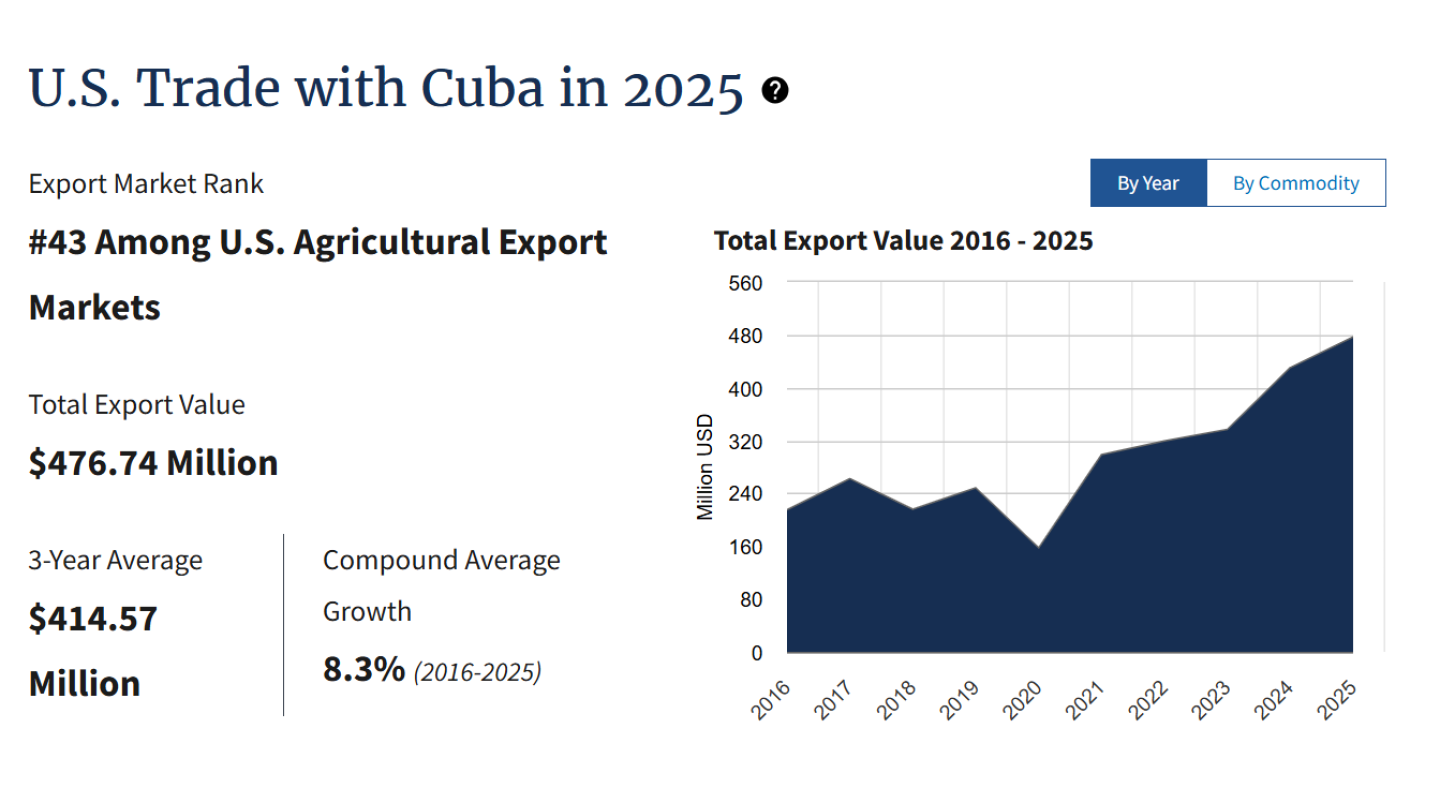
““Because we are so close, because we’re building this relationship with the private sector, and because production in Cuba is so low that creates a need for U.S. exports,” he says.
In 2021, Cuba opened over 2,000 industries up to the private sector. The shift has opened the doors for U.S. agricultural exports. Johnson says today about 70% of agricultural sales are going to the private sector. “Why? Because they have money and the Cuban government does not,” Johnson says. “We’re also finding that this private sector reacts quicker as you can imagine. They’re much more dynamic and they’re filling in the gaps as they go along.”
Rice: A Massive Deficit for U.S. Growers to Fill
In 2024, a report by U.S. Department of Agriculture’s Economic Research Service says between marketing years 2016/17 and 2023/24 rice production in Cuba fell from 335,000 metric tons to 140,000 metric tons. USDA reported in 2025, Cuba imported about $16 million dollars of rice from the U.S.
“Cubans depend on rice in every meal. But production in Cuba is down to about 10%,” Johson says. “They consume around 700,000 tons of rice a year and they’re only producing about 75,000 times today. That is one example of the opportunities for our U.S. Rice producers to export more rice to Cubans.”
Looking Toward a Two-Way Future
Johnson says he believes two-way trade between the U.S. and the Caribbean country is incredibly important. “In my experience with American farmers, when they go down to Cuba, they’re really most interested in helping out their neighbors. They see Cuban farmers as their neighbors, and they want to help them,” he says.
He also believes collaboration between U.S Department of Agriculture’s Animal and Plant Inspection Service and Cuba needs to improve in order to keep disease contained and increase Cuba’s food production.
“I think everyone I spoke to from the street to the government, the top of the government. Everyone says the same thing, ‘something’s got to change,” he says. “Everyone recognizes the need for change. What that change looks like? Is what we’re all trying to guess at.”
