Fernando Paneque, 84, is a regular at Havana’s Juventud Acumulada (Forever Young) swimming club (YAMIL LAGE)
By Jordane BERTRAND – Barron’s
June 03, 2025
It’s never too late to make a splash, as Orestes Quintana, one of the doyens of the Juventud Acumulada (Forever Young) swimming club in Cuba’s capital Havana discovered.
The 87-year-old former revolutionary, who helped Fidel Castro fight his way to victory over a dictatorship in 1959, took up swimming relatively late in life, in his sixties.
Before that, “I knew how to float, I used to bob about in the water like everyone else but I didn’t know the different strokes,” the silver-haired ex-soldier said.
Cuban seniors take the plunge to fight the effects of ageing with Havana’s Juventud Acumulada (Forever Young) club Photo: YAMIL LAGE
Now, he spends a full two hours a day cleaving through the aquamarine waters of the Caribbean and has a bunch of amateur swimming titles to his name.
Advertisement – Scroll to Continue
“I have almost no challengers. In my age category, very few people know how to swim,” he confided with a smile.
Lazaro Diaz, 75, was also a pensioner when he learned to swim as a panacea for a weak heart and recurring back pain.
“I was starting to feel the effects of aging,” said Diaz, who undertakes a six-kilometer (3.7-mile) round trip from home every day to get in his vivifying 400-meter (1,300-foot) swim.
Advertisement – Scroll to Continue
“In the water I don’t feel (any pain),” he added.
Juventud Acumulada operates out of one of a string of leisure centers built for the Cuban elite along the coast west of Havana between the 1930s and 1950s.
A group of Cubans in their seventies and eighties keep fit by swimming every day in the Caribbean Photo: YAMIL LAGE
The centers were later nationalized by Castro’s communist government and transformed into “workers’ social circles” or CSOs.
The glamor of the Otto Parellada CSO — named after a young rebel killed fighting the Fulgencio Batista dictatorship — has long since been eroded by the elements and successive economic crises.
The pale green paint on the club house is peeling.
And the ladder that once led from the pier to the water was swept away by a hurricane, meaning swimmers now have to negotiate a slippery sea wall.
Photo: YAMIL LAGE
But the bronzed elder statesmen and -women of swimming remain undaunted.
Havana, June 3 (Prensa Latina) President Miguel Díaz-Canel today thanked Iran for its support of Cuba’s struggle to end the U.S. blockade and its exclusion from the list of countries allegedly sponsoring terrorism.
Upon receiving the president of Iran’s Islamic Consultative Assembly, Mohammad Baqer Qalibaf, at the Havana Palace of the Revolution, the Cuban leader emphasized the need for unity among nations and peoples subjected to coercive measures and sanctions imposed by U.S. imperialism.
He also condemned the escalating US interference in Iran’s internal affairs and recognized Iran’s right to the peaceful use of nuclear energy.
He noted that the Iranian parliamentary leader’s visit continues the existing agreements on economic cooperation signed during former President Ebrahim Raisi’s visit to Cuba in 2023.
According to national television, the Cuban president took advantage of the meeting to extend greetings from Army General Raúl Castro and himself to Iranian Supreme Leader Ayatollah Seyed Ali Khamenei and to Iranian President Masoud Pezeshkian, inviting him to visit the island when his schedule allows.
Mohammad Baqer Qalibaf, for his part, expressed his honor to be in a friendly and allied country with which, he said, his homeland has many things in common.
He stressed the importance of working together to counter aggression against independent countries and condemned the United States’ support for the Zionist regime of Israel in its aggression against Palestine.
The president of Iran’s Islamic Consultative Assembly heads a large parliamentary delegation.
During his stay in Havana, he will hold talks with Cuban officials, including his counterpart Esteban Lazo, and carry out other activities.
According to the National Assembly of People’s Power (parliament), Mohammad Baqer Qalibaf’s visit will contribute to strengthening relations between Cuba and Iran, especially between the two legislative bodies.
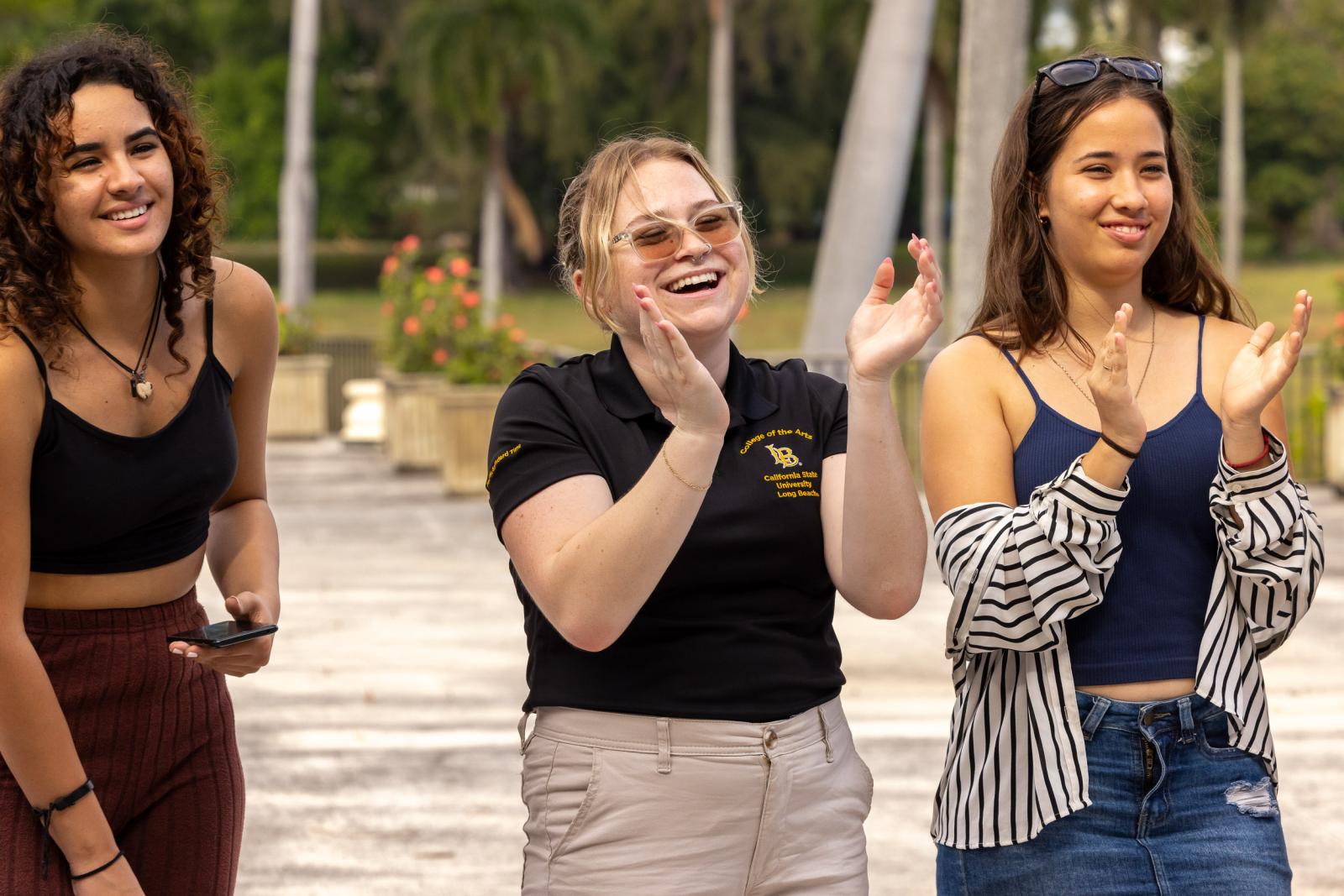
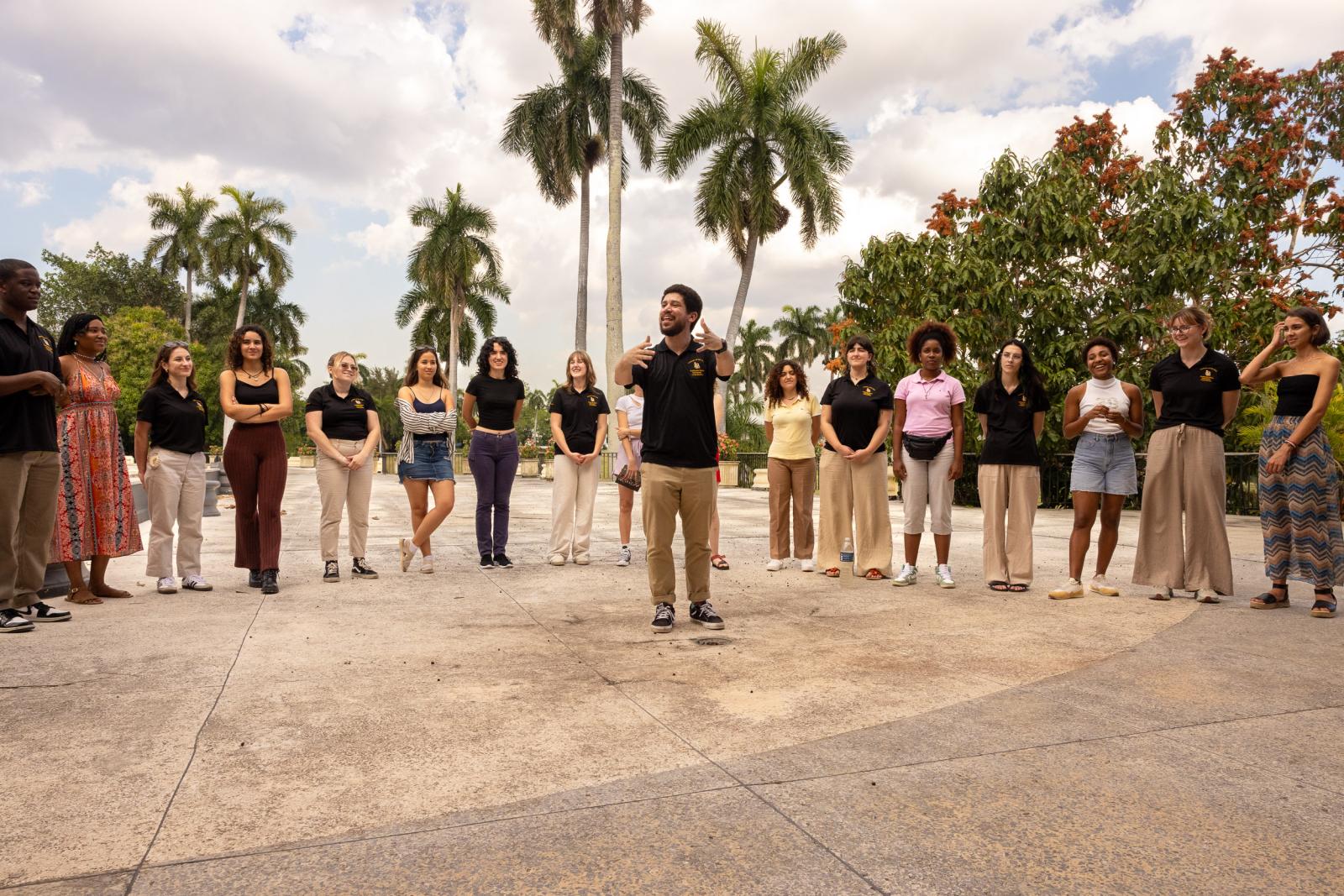
Cal State Long Beach’s Pacific Standard Time vocal jazz ensemble recently took the trip of a lifetime, traveling to Cuba during spring break. The journey dramatically changed the students’ perspectives on life abroad and here in the U.S
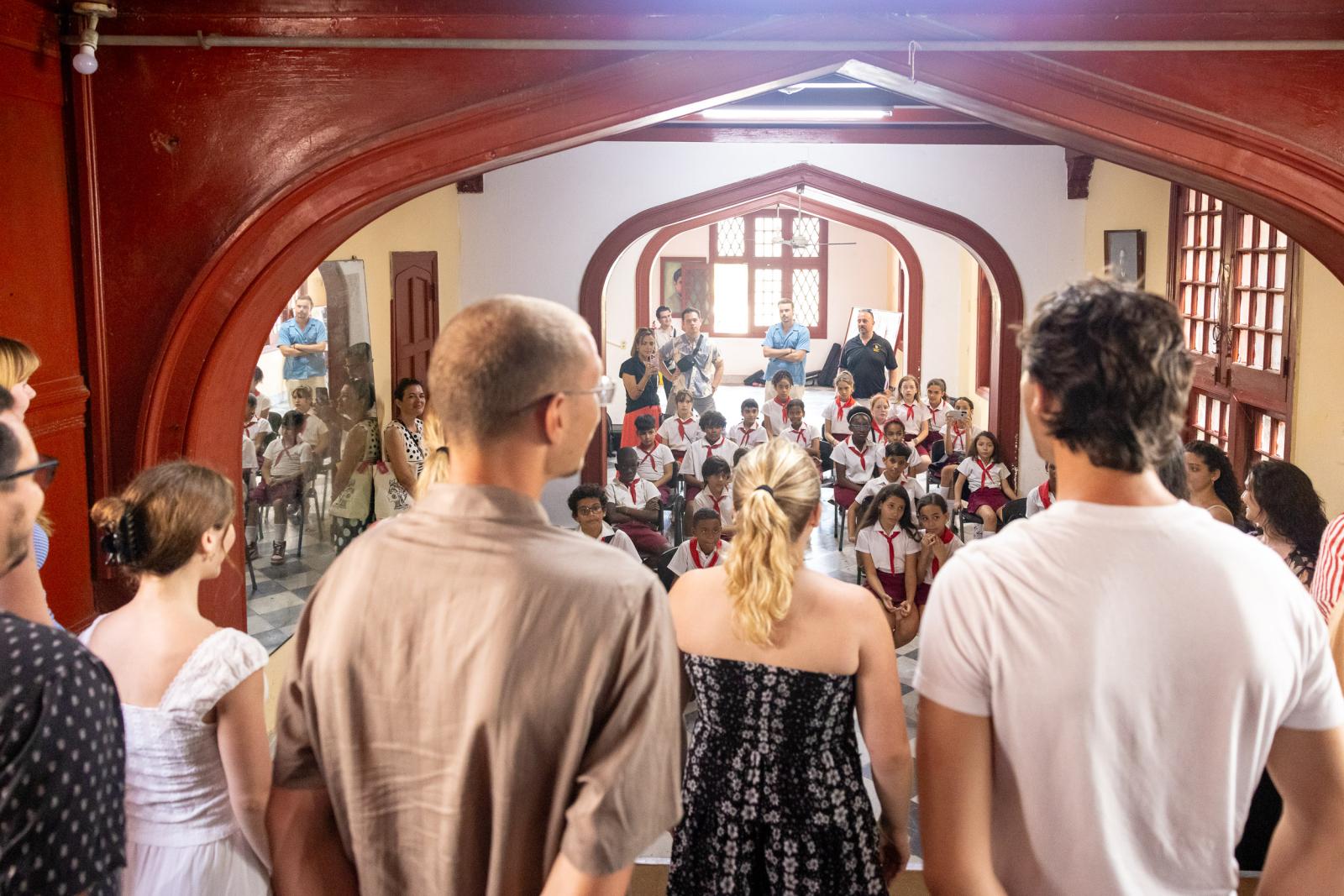
During their eight-day visit, the 16-member singing and instrumental group performed at Fábrica de Arte Cubano, the Claxon Hotel, the National Art Museum and the Universidad de las Artes. They also had musical exchanges with the Cuban National Chorus and legendary Latin jazz band Los Van Van, and engaged in several less formal performances in a jazz club, at schools and other venues.
Pacific Standard Time singers perform at the Manuel Saumell Elementary Music School in Cuba.
The PST visit was part of a cultural exchange organized by College of the Arts Dean Royce W. Smith, who lived in Cuba for six months and taught at the Instituto Superior de Arte in Havana in 2013.
Few Americans ever get to visit Cuba, even those who have Cuban ancestry. Tourist visas are not currently allowed, and only certain official visits are permitted.
“It was a cultural exchange of significant magnitude, as Cuban audiences gained exposure to vocal jazz repertoire that is rarely performed there, and CSULB students gained valuable insights into musical genres and practices (particularly in their master class with Los Van Van) that were new to them,” Smith said. “These kinds of interactions are critical in helping our students broaden their knowledge of musical styles and techniques that are formative to their growth as musicians.”
Here are some voices from the PST jazz ensemble of their time in Cuba:
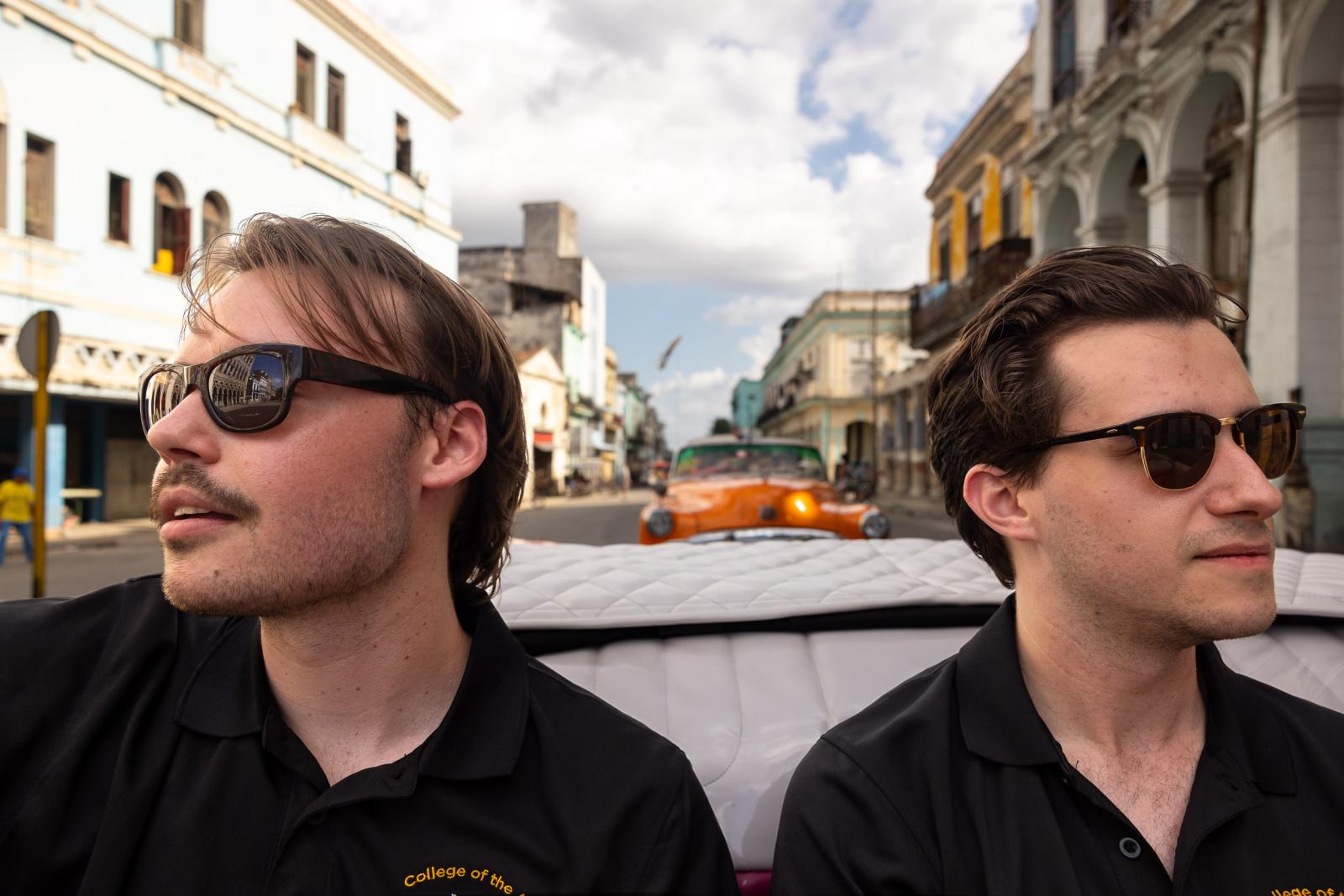
Brandon Whitehurst, left, sits next to Michael Parchaiski, bass player for the PST band, as they ride along the streets of Havana.
Brandon Whitehurst
First-year graduate student in music performance
“It was such a profound experience; it’s so different than just leaving out of state for something like a festival. It’s a chance to view a different culture.
“For me, it was the first time being out of the country – that was an experience I’ll never forget. It’s one thing to be in a hotel room and wait for the next gig. It’s another thing to have eight days in an apartment when you’re living in another culture.”
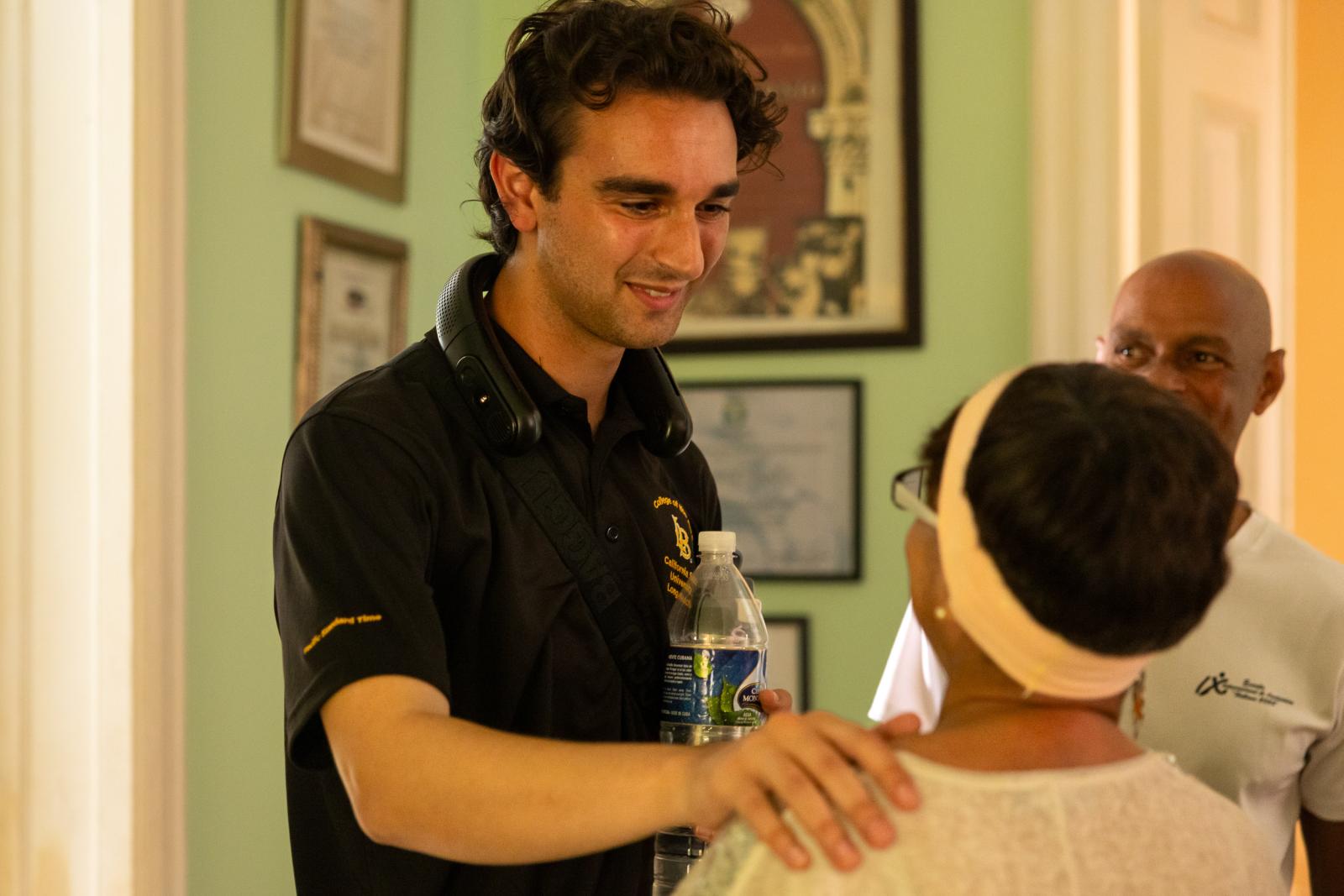
Alexander “Ace” Homami talks with a woman from the Cuba National Choir.
Alexander ‘Ace’ Homami
Fourth-year music composition major
“We were lucky enough to visit the university and do a performance there. We also had a translator from the university. They were incredibly knowledgeable. And we were able to ask as many questions as we wanted.
“We were able to discuss what a lot of people from our generation are feeling about a lot of the politics and relations between Cuba and the U.S.
“It was just really interesting. We got to speak with people from an older generation about their experiences growing up in Cuba, and we were able get in touch with voices and minds from our generation, to see what their opinions were, their perspectives were, their stories were.”
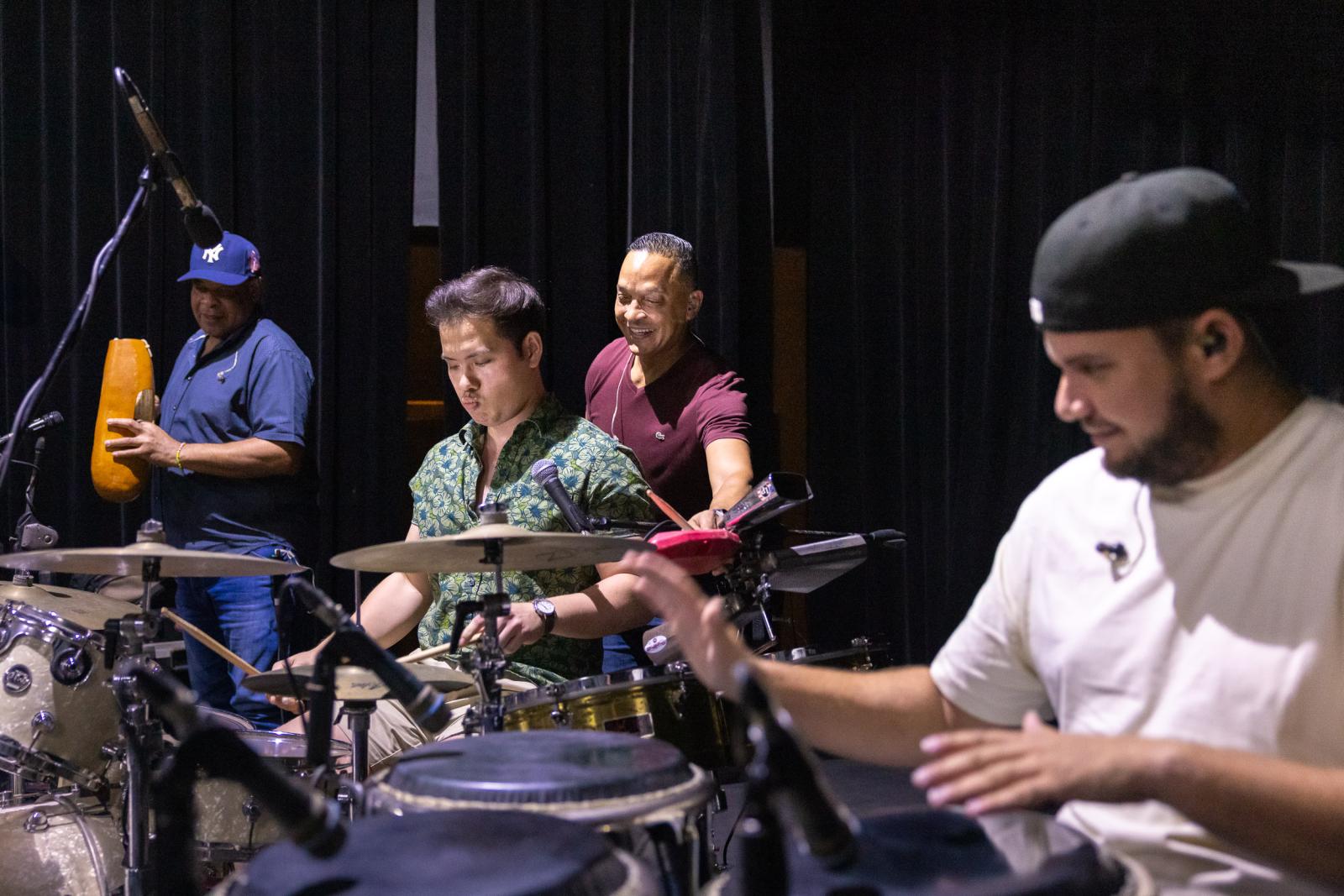
Ryan Dong at the drums plays with the Cuban band Los Van Van.
Ryan Dong ‘23
Second-year graduate student, jazz studies
“I got to play with Los Van Van. I asked nicely to play with them, and they were really nice and cool. I basically got a private lesson. I got to play with the top Afro-Cuban percussionist in the country.”
Maggie Robertson, center, surrounded by students from the National School of Arts in Havana, Cuba.
Maggie Robertson
Fourth-year jazz voice major
“We have come back from this experience changed people – completely different people than we were before. When you spend eight days with people in a very hot and sticky climate … you never thought … you’d be performing in jazz clubs in Havana, Cuba.
“It changes you to see a perspective of a country that you’ve never been to, you’ve never really experienced, with some of the people that you’re closest to. I think that it’s changed us all, not only socially, musically, but it’s changed us all as friends and a group.”
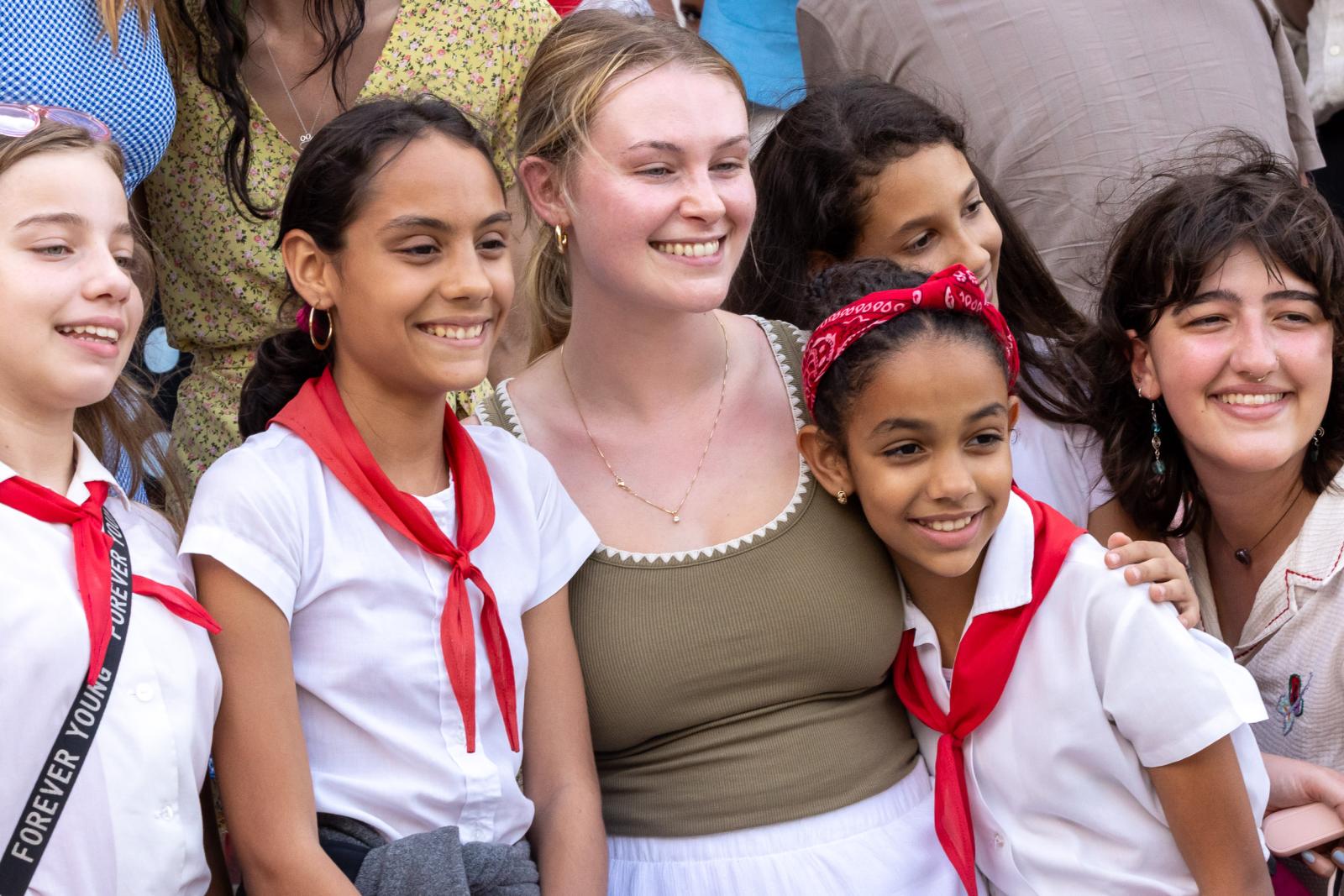
Alex Baird (center) and girls from the Manuel Saumell Elementary Music School in Havana. On the far right is Chloe Swanson.
Alex Baird
First-year graduate student, jazz studies voice
“My biggest takeaways: I came home, and I just felt incredibly grateful for everything that we have …. Just because we happen to be born in the U.S., we get to experience the riches that we just do in our everyday life.
“We think of Cuba as a crazy place to go visit, and everybody in Cuba would just like laugh in your face. Like what do you mean? It feels very safe. The people are just very kind and welcoming. I think we’ve got a misguided perspective.”
Max Smith, center, with Maggie Robertson to his right, being interviewed by OnCuba News.
Max Smith
First-year jazz studies graduate student; his mother is of Cuban descent
“The biggest thing that struck me about the trip was just how generous the people were there, and how receptive they were to us, whether it was performing, or eating at a restaurant, or eating at someone’s home.
“They were so open to us, and so willing to take us in — literally into their homes —and feed us. And they were just so, so generous. We came in with this apprehension about how we would be received. But we were family with these people, really.
“I sort of had that apprehension (about his Cuban background). I didn’t know how they were going to receive somebody who — my family escaped. I don’t know what their perspective is on people who come back. But they were so, so open. Every time we did a show, I would tell them I’m Cuban, and people were cheering and coming up to me after and wanting to meet me and exchange social media. That was so unexpected, and it really filled me up.”
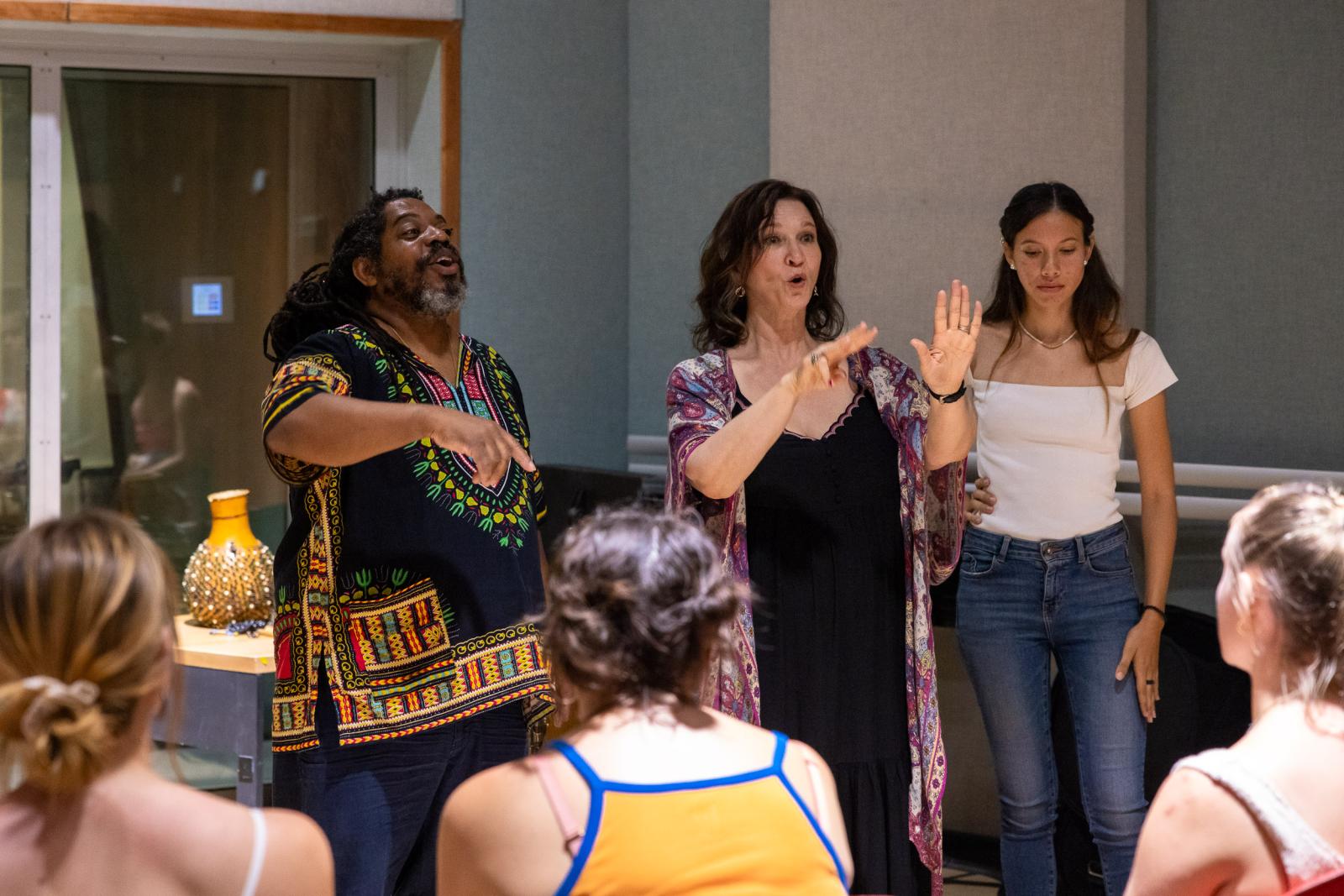
Christine Guter, center, is flanked by percussionist Yaroldy Abreu Robles on her left, and a translator on her right, during a percussion clinic at Abdala Studios in Havana.
Christine Guter
Director, vocal jazz at CSULB
“The students gained so much. Being able to connect with the Cuban people, just being scooped up, loved and immediately accepted. They were immersed in the culture, the music, the arts, the lifestyle. It was absolutely transformational for them.”
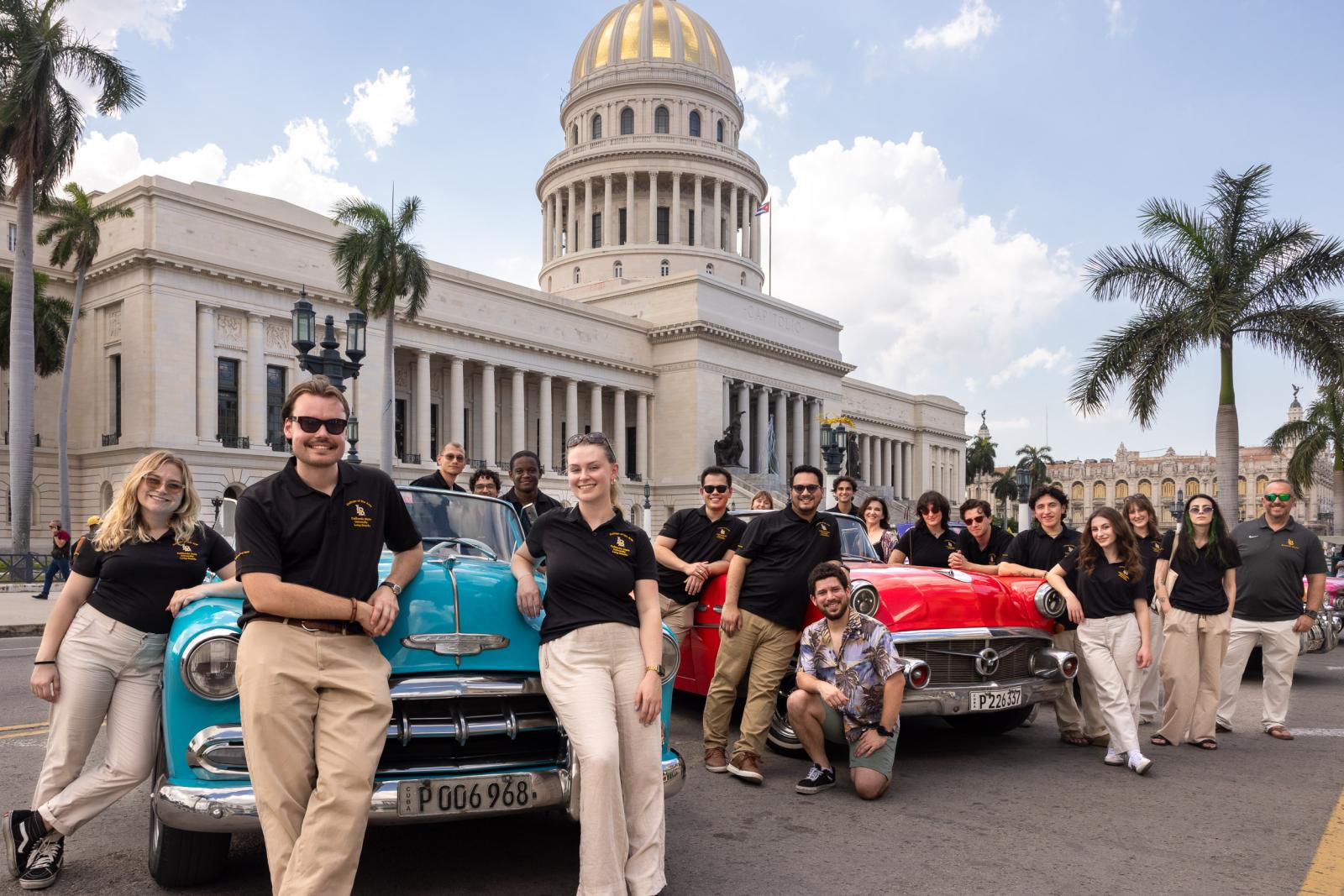
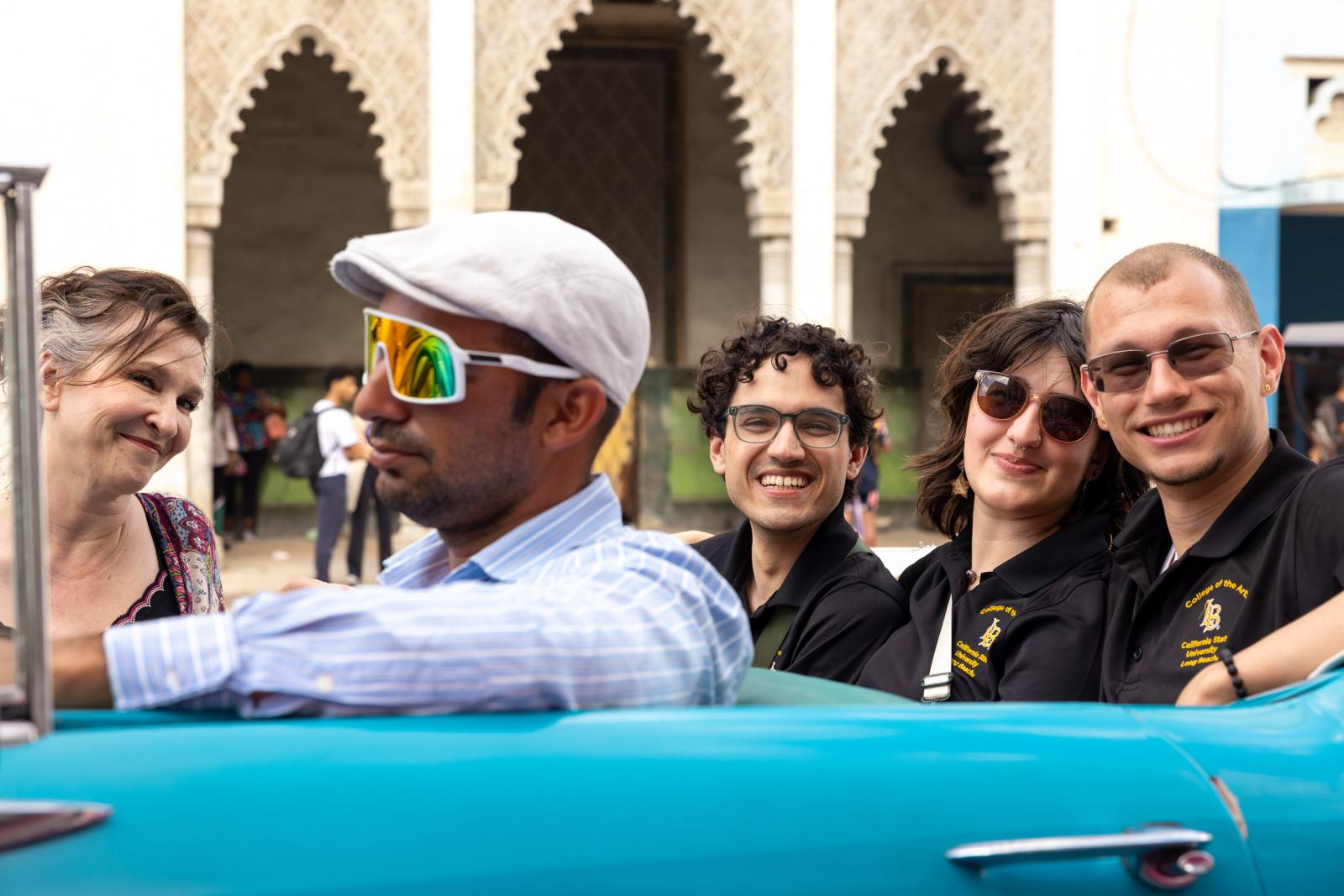
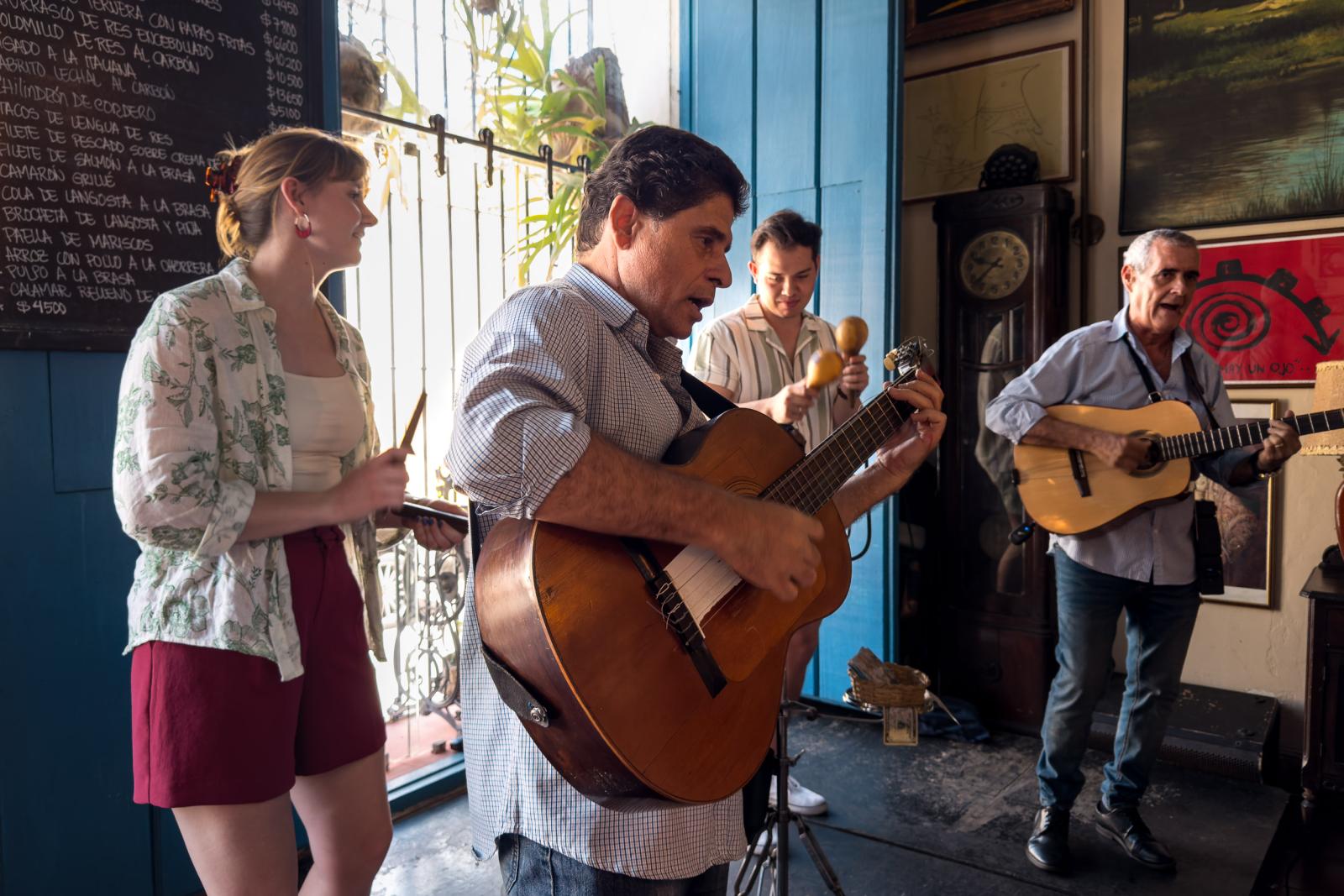
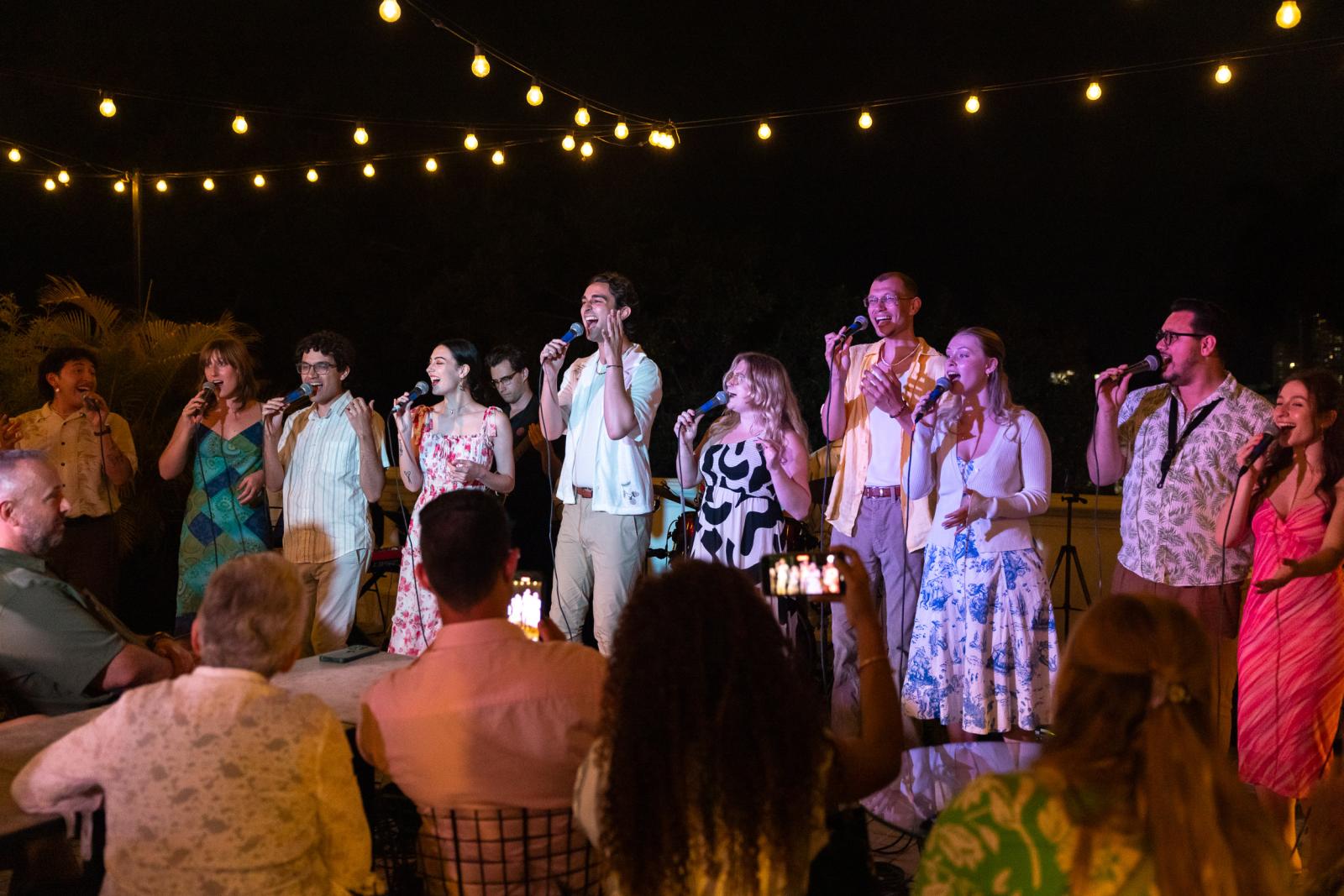
CSULB’s Pacific Standard Time vocal jazz ensemble in downtown Havana, Cuba.Marcus Carline, lead stage technician for the Bob Cole Conservatory of Music, speaks with PST members and students from the National School of Arts in Havana, Cuba.From left: CSULB vocal jazz director Christine Guter, a Cuban taxi driver, Max Smith, Chloe Swanson and Noah Jackson of PST in Havana.PST members Sarah Ruopp, left, and Ryan Dong, back, perform with local guitar players in the Al Carbon restaurant in Havana. A nighttime performance by Pacific Standard Time at the famous Claxon Hotel in Havana.
Editor’s Note: Though May Day is now more than a month past, People’s World presents these impressions of the mass May 1 march in Havana from Ike Nahem, a Cuba solidarity activist in the New York / New Jersey area. In this article and photo report, Nahem discusses not only the details of the May Day celebration in Cuba but also its importance as a symbol of Cubans’ determination to preserve their sovereignty, independence, and dignity in the face of an escalating economic assault by the U.S. government. As with all op-ed articles published by People’s World, the views expressed here are those of the author.
HAVANA—May Day 2025 in Havana 2025 was, first and foremost, an overwhelming revolutionary and patriotic mobilization of the Cuban working class and fighting people.
The huge turnout (800,000 in Havana, 5 million+ across the Island), organized under the leadership of the Cuban trade union federation, Central de Trabajadores de Cuba (CTC), was also a big morale boost for the Cuban people.
It registered the clear determination of the population as a whole to turn a corner out of the extended period of intensified (and accumulating) economic difficulties that has plagued them since the onset of the COVID pandemic in 2020.
That health crisis devastated Cuba’s tourism industry, which remains in slow recovery. All of this became a tipping point in the hammering of the Cuban economy over the past several years.
I hope the photos shown here can begin to convey some of the spirit of an amazing day which saw contingents from CTC-organized workplaces and industries, communities, and working-class families from all over the greater Havana area. They were up way early in the morning to board buses converging on Revolution Square.
There were large spirited student contingents from universities, colleges, and schools; soldiers in uniform marching with their families; artists and dancers—it was a real sea of Cuban humanity that stretched for well over a mile.
They had one loud and clear message: Understand this Trump, Rubio, Scott, and all other would-be imperialist aggressors—Cuba lives! Cuba resists! Cuba is not alone!
What stood out was the very youthful presence at May Day, the representation of a new generation of Cuban youth forged during the permanent pressure and aggression from U.S. sanctions. This includes intense imperialist propaganda on social media platforms targeting Cuban youth hoping to stimulate alienation, demoralization, and migration. And of course, there has been mass migration since the deepening of U.S. economic aggression.
All of these assaults aim to choke the dreams of Cuban youth for a better future inside Cuba. So it was particularly inspiring to see the identification of the Cuban youth on May Day with the history, heroes, and continuity of revolutionary, socialist Cuba.
From Trump to Biden to Trump
This is the Cuba that is fighting to get out of the seemingly endless grip of U.S. economic warfare under Trump and Biden over the past nine years. There has been a near-seamless continuity of U.S. anti-Cuba hostility since the reversal of the relative, and ultimately illusory, “normalization” under President Barack Obama.
What the Cuban working class has faced is an accumulating economic crisis of daily difficulties and near-calamitous conditions of shortages, including in medications and life-saving medical equipment. They have likewise experienced intense pressure on an overloaded, very old, and very inefficient electric grid.
These last years have seen cascading crises in production and consumption, currency instability, rising prices, and shortages. On top of these, add the major material devastation of the Saratoga Hotel and Matanzas Oil Storage Facility explosions and the “natural” disasters of hurricanes, flooding, and even earthquakes.
There are some signs and indicators lately of relative alleviation, with important direct foreign assistance, some advances in bilateral trade agreements and capital investment, as well as hopeful prospects that economic space can open up through Cuba’s formal association with the BRICs grouping (which has become more prominent in this era of Trump’s trade wars).
Nevertheless, the overall situation remains harsh and difficult for Cuban working people. And that’s why the May Day mobilizations are so politically powerful.
Targeting Travel to Cuba
Without the anticipated foreign exchange from tourism, the massive capital investments in new hotel construction and other projects have added to budget and financing problems for Cuba. When the tourists don’t come, there’s no money to pay off these infrastructure projects.
The entire Cuban tourism industry has been directly targeted by the U.S. since the relative relaxation of extant travel sanctions under Obama. In the years before the pandemic, the industry had been recovering steadily and impressively.
Travel to Cuba is today, however, is a bureaucratic labyrinth, and not because of any impediments from “communist Cuba,” but rather from the U.S. government. The administration in Washington hassles and tries to intimidate all travelers to Cuba, making visiting the island a de facto political defiance of the U.S. blockade—even for mutually beneficial people-to-people exchanges.
The U.S. government paints Cuba as a “hellhole” even as it aims to smother the right of U.S. citizens to travel and see its reality with our own eyes. Which poses the question: Who is afraid of whom?
U.S. visitors face severe restrictions in hotel and resort accommodations. Even folks on cruise ships face U.S.-instigated obstacles for stopping to enjoy Cuba’s truly rich revolutionary history, its marvelous architectural heritage, its music, museums, and art galleries, as well as its fabulous beaches.
For those who do manage to get in, the devastating impact of the decades-long U.S. economic war are apparent: beautiful structures along the famous Malacon in states of disrepair and collapse; long lines for gasoline; generalized shortages of food, medications and medical supplies; and the total absence from store shelves of so many commodities.
Previously more open, Canadian policy under the unpopular Justin Trudeau government became more aligned with bipartisan U.S. anti-Cuba policy. Perhaps the new Liberal Party government under Mark Carney, in its clashes with arrogant Trumpian bombast insulting Canadian sovereignty, may drop the anti-Cuba posturing of its predecessor, increase trade and travel with the Island, and cease echoing U.S. bellicosity.
Europeans who wish to travel to Cuba face a particularly gratuitous U.S. intimidation tactic under the Electronic System for Travel Authorization (ESTA) regulations. As part of the U.S. visa waiver program, ESTA allows travelers from certain countries to visit the U.S. without a visa. The ability to travel to the U.S. can be put in jeopardy if one has visited Cuba and that fact is registered in the databases and passports of one’s wholly legal travel. Hoops, barriers, repetitive forms, and even visits to a consulate may be among the bureaucratic obstacle-course awaiting international travelers.
Why does the U.S. government impose all these difficulties? In 2016, the ESTA eligibility rules changed as a result of the Terrorist Travel Prevention Act of 2015, which disqualified travelers who reside in or visit any of the countries on the U.S. State Sponsors of Terrorism (SSOT) list. In an outrageous, obscene affront to the truth, Cuba and the SSOT list have been in on-again, off-again relationship since the island was first removed by Obama in 2015.
The latter was in fact a precondition, along with the release of the three remaining Cuban Five political prisoners, for the establishment of diplomatic relations between Washington and Havana in 2015. It was among the steps that many hoped would lead toward actual normalization of relations between the two countries and an end to the U.S. blockade. This, of course, was illusory and short-lived.
The initial limited steps taken by Obama were reversed during the first Trump administration. The Trump changes were shamefully deepened under Biden and the Democratic Party leadership in Congress, even under the conditions of the pandemic. That was the exact opposite of Cuba’s medical internationalist heroics during the COVID years from the Caribbean to Italy to Africa, as Marco Rubio just found out in meetings with Caribbean Community (CARICOM) governments in March 2025.
The Importance of May Day
Over the recent crisis period, there was some diminution of the traditional May Day mobilizations. For the past two years, the Cuban government and CTC have been forced to vastly curtail the traditional festivities due to terrible shortages in gasoline and fuel that made the logistics of organizing transportation impossible.
Smaller mobilizations that were spirited and defiant did take place, but they didn’t match the scale of years past.
The overall situation has been alleviated enough to allow for a revival of the traditional mass Havana march this year. The change of situation was symbolized by the state’s ability to reserve the fuel necessary for the buses to converge near Revolution Square for the celebration.
I should add that for me, as a Marxist, May Day in Havana has always seemed a registration of a society where the working class is in fact the dominant class socially. It’s a chance for the people to showcase the moral values and social relations that are the true legacy of the Cuban Revolution. It’s an expression of the sovereignty which bipartisan Washington has been able to hurt but never defeat.
May Day 2025 showed the Cuban Revolution remains a living revolution.
Bogotá, June 2 (Prensa Latina) The Cuban popular dance music orchestra Los Van Van is today among the groups that will perform in this capital as part of the Concert of Hope, organized by the Colombian Public Media System.
The event will take place on June 8 in the central Plaza de Bolívar under the slogan ¡Latinoamérica Migrante Resiste! (Latin America Migrants Resist!), and aims to convey a message of unity, resistance, and a hopeful future to attendees, according to its organizers.
In addition to the Caribbean island group, recognized here as one of the most important and influential in the region with its salsa, tropical, and son music, other performers and orchestras from Latin America will be performing.
The Spanish folk metal band Mägo de Oz will be there, and from Chile comes the group Inti-Illimani and drummer and singer Miguel Tapia, known for having been part of the rock group Los Prisioneros.
Bersuit Vergarabat will arrive from Argentina with its rock proposal, and representatives of Colombian culture will include rap artists Motilonas RAP, Denis Cáceres and Sol Ortega, Alí AKA and Mind.
The Santander-based group Velandia y La Tigra, cultivators of the rasqa style (a fusion of peasant, rural, urban, and modern rhythms), and llanera music with the artist Joseíto Oviedo, will also be heard as part of the show.
The Concert of Hope will be held for the sixth time, and the third time it has been held by RTVC Public Media System.
The event, which is free, seeks to be a musical, cultural, and popular gathering for social transformation, a culture of peace, and the defense of human rights.
Former Rep. Charles Rangel (D-NY) died this week at 94. A member of Congress for almost half a century representing Harlem, Rangel advocated for the normalization of relations with Cuba for decades. He last visited Havana in 2016 during Obama’s historic visit to the island.
Caracas, June 1 (Prensa Latina) The governments of Venezuela and Cuba reviewed their health cooperation agenda in Caracas, official sources reported today.
“We had a pleasant meeting with the Cuban Minister of Health, José Ángel Portal Miranda, with whom we reviewed our health cooperation agenda within the framework of the comprehensive Cuba-Venezuela agreement,” Executive Vice President Delcy Rodríguez revealed on her Telegram account.
The Vice President of the Economy Sector stated that, on behalf of President Nicolás Maduro, “we reaffirm the commitment” of the Bolivarian Republic to health as a fundamental right of our people.
He also reaffirmed his willingness to continue expanding strategic alliances with sister countries.
Rodríguez was accompanied by Gabriela Jiménez, Vice President of the Science, Technology, Ecosocialism, and Health Sector of Venezuela, and Magaly Gutiérrez, Minister of Health.
HAVANA, Cuba, May 30 (ACN) Cuba will once again compete with the elite of continental baseball during the 1st Copa America Baseball, Juan Reinaldo Perez Pardo, president of the Cuban Baseball Federation, confirmed today to the Cuban News Agency.
The event, scheduled to be held from November 13 to 22 in Panama and Mexico, will gather the twelve best teams of the continent according to the ranking of the World Baseball and Softball Confederation (WBSC), in a competition that aspires to become a reference in the international calendar.
Cuba, ranked sixth in the area, will be part of Group B in Mexico along with the United States, Puerto Rico, Nicaragua, Canada and the host country, where they will battle for one of the three spots offered by the tournament to the Super Round.
In key A, to be played in Panama, the locals will face Venezuela, Dominican Republic, Colombia, Brazil and Curacao.
The tournament will grant tickets to the four best teams to the Central American and Caribbean Games in Santo Domingo 2026 and is also being considered to distribute places to the Pan American Games in Lima 2027, which increases the strategic importance of each clash.
For the Cuban Baseball Federation, this Cup represents a key opportunity in its goal of inserting the country’s players -both residents and contracted abroad- in tournaments of the highest competitive level. The aspiration is not only to reach the podium, but to reaffirm Cuba as a historic power in the sport in the Americas.
The WBSC Americas is hopeful that this first edition will mark a before and after in the organization of professional tournaments in a continent that, like few others, breathes and lives baseball to the fullest.
State Minister in the Ministry of Foreign Affairs and Foreign Trade, Alando Terrelonge (second right), greets scholarship recipient for accounting, Capeech Watkins (second left); scholarship recipient for veterinary medicine, Saunshay Smiley (left); and scholarship recipient for nursing, Cassandra Davy (third left). Looking on is Cuba’s Ambassador to Jamaica, Fermín Quiñones Sánchez (right). The interaction took place during the awards ceremony for the Cuba-Jamaica Bilateral Scholarship Programme, held on Wednesday, May 28 at the Embassy of Cuba in Kingston.
May 31, 2025 — The Gleaner
Fourteen Jamaican students have been awarded full scholarships to pursue undergraduate and postgraduate studies in Cuba under the longstanding Cuba-Jamaica Bilateral Scholarship Programme.
The students, who will begin their studies in August, will be enrolled in programmes, including medicine, nursing, dental services, veterinary medicine, accounting, and ophthalmology.
All costs associated with tuition, accommodation, and living expenses will be fully covered.
Speaking at the awards ceremony, held at the Embassy of the Republic of Cuba in St Andrew, on May 28, Cuba’s ambassador to Jamaica, Fermín Quiñones Sánchez, praised the awardees as “talented and dedicated young Jamaicans with excellent academic qualifications and a vocation of service to their communities and their country”.
He said the scholarships reflect the strength of the relationship between the two countries, noting that “these scholarships, offered under the Cuba-Jamaica Bilateral Scholarship Programme for the 2025–2026 academic year, are a symbol of the humanist and solidarity-based character of the Cuban Revolution and of Cuba’s cooperative relations with sister nations of the Caribbean, including Jamaica”.
Ambassador Quiñones Sánchez highlighted the impact of the initiative over the years. “The dreams of those receiving their scholarships today are the same dreams that guided approximately 700 Jamaican students graduating in Cuba through 2024 … Today, more than 300 young Jamaicans are studying in different Cuban universities,” he added.
The ambassador noted that the programme continues to contribute to human development across the region.
“Our duty of solidarity has transcended the training of professionals committed to the efforts of the nations to achieve development. Our humanistic work supports the need to train their young people,” he added.
CONTINUED COLLABORATION
For his part, State Minister in the Ministry of Foreign Affairs and Foreign Trade Alando Terrelonge commended the government and people of Cuba for their commitment to education and regional partnership.
“The journey that you will embark on is not just a journey of self. It is a journey of community. It is a journey of solidarity. It is a journey of the friendship of two countries that have lasted more than five decades,” he told the recipients.
State Minister Terrelonge encouraged the students to return home and contribute to Jamaica’s growth. “You will have your own roles to play in these refurbished and renovated hospitals and health centres when you come back to Jamaica,” he said.
“This journey is also about building a stronger Jamaica, a Jamaica with better healthcare facilities and doctors and nurses who understand patient care as well,” Terrelonge said.
One of the awardees who will pursue a degree in medicine, Ajani McFarlane, shared his excitement about the opportunity.
“I am very elated. I am very, very happy. I am also excited, a little bit nervous about going and leaving my family, but I am sure I will overcome that. The overarching feeling is that I am excited,” he said.
McFarlane noted that his programme will span six to seven years – one year of language and foundational studies, followed by six years of medical training.
He encouraged others to take advantage of the scholarship.
“Put your best foot forward, go for it if you have the feeling, do research, and you know, the Cuba-Jamaica Bilingual Scholarship is there for everyone who wants such an opportunity. I say, go for it, do your best, and apply,” he emphasised.
The scholarships stand as a testament to the continued collaboration between Jamaica and Cuba, strengthening educational, cultural, and professional ties between the two nations.
Washington, May 31 (Prensa Latina) U.S. Congresswoman Maxine Waters said today that President Donald Trump is demonstrating the utmost racism by attempting to expel 500,000 legal immigrants from the country.
Waters, the ranking member of the House Financial Services Committee, condemned the administration’s policy following the Supreme Court’s decision allowing the Trump administration to end humanitarian parole for migrants from Cuba, Haiti, Nicaragua, and Venezuela.
“I am appalled that the Supreme Court is allowing Trump to proceed with these racist deportation plans targeting legal, law-abiding immigrants who work, raise families, and contribute positively to their communities,” he said in a press release posted on his website.
The affected individuals followed a legal process to apply for and receive parole, which has allowed them to enter the United States and live and work here legally for two years, argued Waters, a representative from California since 1991.
He also considered it “absolutely cruel that Donald Trump would interfere in that process,” revoke their parole with virtually no warning, uproot them from their families, sponsors, and communities, and deport them.
He recalled that, during his election campaign, and even after his election, Trump “held rallies with racist and derogatory comments and outright lies about immigrants, especially Haitians, in an attempt to sow fear among the American people.”
He warned that their baseless attacks “caused irreparable damage to communities across the country and further tarnished America’s image around the world.”
The congresswoman also criticized Trump for “the false narrative about the genocide of white South Africans,” noting that the president “lied to the American people and the world by perpetuating a narrative” and then “used these lies to justify the arrival of white South Africans to the United States as refugees.”
South African President Cyril Ramaphosa, the US intelligence community, and the international community have confirmed that Trump lied about South Africa, he concluded.