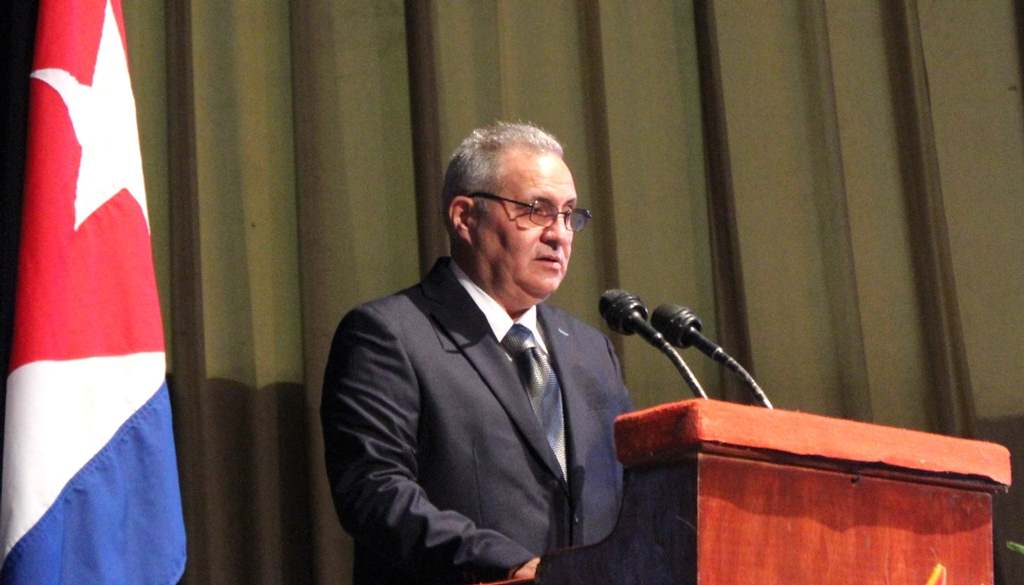
The largest of the Antilles will be in charge until August 15. Photo: United Nations
Comprising 33 nations, the entity advocates nuclear disarmament as a top priority
June 24 (Granma) Yesterday, Cuba assumed the role of Coordinator Country of the Group of 21 (G-21) in Geneva, within the context of the United Nations Conference on Disarmament. This was announced by Bruno Rodríguez Parrilla, member of the Political Bureau and Minister of Foreign Affairs of Cuba, who added that the G-21 is the largest consultation group at the Conference. Comprising 33 nations, the body advocates “nuclear disarmament as a top priority in this multilateral sphere,” the Cuban Foreign Minister emphasized in X. The Conference on Disarmament was recognized in 1978 by the Tenth Special Session of the United Nations General Assembly on Disarmament. It was conceived as the only multilateral forum for negotiation on disarmament in the international community. The Conference was preceded by the Ten-Nation Disarmament Committee (1960), the Eighteen-Nation Disarmament Committee (1962-1968), and the Conference of the Disarmament Committee (1969-1978). According to the Cuban Ministry of Foreign Affairs, Cuba will be in charge of leading the Group until August 15.
The forum and its predecessors have negotiated important multilateral arms limitation and disarmament agreements: The Treaty on the Non-Proliferation of Nuclear Weapons (NPT), The Biological Weapons Convention (BWC), The Chemical Weapons Convention (CWC), The Comprehensive Nuclear-Test-Ban Treaty (CTBT).
Source: United Nations Office for Disarmament Affairs
Santiago de Cuba, June 23 (Prensa Latina) With the goal of boosting trade in the region, the ExpoCaribe 2025 International Fair, Cuba’s second trade fair, opened today in this city. This time, it will feature 35 countries and more than 300 companies.
Host Governor Manuel Falcón, in welcoming the participants, emphasized that the fair is taking place in a difficult economic situation exacerbated by the US blockade of Cuba.
He also described the urgent need to fight for peace and respect for the self-determination of peoples, the integration of Latin America and the Caribbean, and the strengthening of trade among nations as the most viable path to addressing the great challenges facing societies.
First Deputy Minister of Foreign Trade and Investment, Carlos Luis Jorge, explained that the event will facilitate the identification and consolidation of interests, combined with economic and commercial complementarity among nations in the Caribbean region and beyond.
He also thanked Santiago de Cuba and its authorities for reopening its doors, for the extra effort they have put into ExpoCaribe 2025 despite the complex situation the country is facing, and for organizing the event, which he predicted will be a success.
The Minister of People’s Power for National Trade of the Bolivarian Republic of Venezuela, Luis Villegas, called on participants and organizers to make this fair an economic engine that will drive Cuba’s development.
Villegas considered the alliances that ExpoCaribe 2025 will generate to represent an economic rebellion of the global South, a starting point for the development of trade in the region, and praised the strengthening of economic, political, and solidarity ties between Venezuela and Cuba.
The opening ceremony was presided over by Beatriz Johnson, a member of the Party Central Committee and First Secretary in Santiago de Cuba; Governor Manuel Falcón; Carlos Luis Jorge, First Deputy Minister of Foreign Trade and Investment; and Antonio Carricarte, President of the Chamber of Commerce of the Republic of Cuba.
HAVANA, Cuba, Jun 23 (ACN) Cuba had a remarkable performance at the Troyes-Aube International Athletics Meet in France, securing three gold medals, one of them a record, as part of its preparatory tour for the World Championships in September in Tokyo.
The star of Sunday’s event was Lisyanet Ruiz, who won the 100-meter hurdles with a 12.81 seconds time, a record for the event, thus improved the 12.97 seconds held by Italian Giada Carmassi since 2024 and shaved one hundredth of a second off her personal best of 12.82, achieved in May during a national event.
In the same meeting, Greisys Robles confirmed her consistency with a time of 12.92 seconds, securing second place—the ninth time this season that the Cuban hurdler has dipped under 13 seconds.
The bronze medal went to Italy’s Eliza Maria Di Lazzaro (12.98).
Another outstanding moment was that of sprinter Reynaldo Espinosa, who won the 100-meter dash in 9.95 seconds, although it cannot be recognized as a personal best due to a tailwind exceeding the permitted limit (+2.3 m/s) . His best legal time remains 9.96, achieved in Salamanca in 2024. He is now joined on the podium by Dominican Franquelo Perez (10.10) and Colombian Abello Neiker (10.12).
Roxana Gomez dominated the 400 meters, clocking 50.98 seconds, very close to the 50.67 seconds that gave her gold a few days earlier at the Barrientos Memorial, while Burundi’s Sita Sibiri (52.21) and France’s Diana Iscaye (52.89) completed the top three.
In the two laps of the oval, Dayli Cooper once again shined with 2:00.21 minutes, her best time of the year, to take the silver medal, surpassed only Australia’s Bendere Oboya (2:00.16) and Britain’s Revee Walcott-Nolan (2:00.24) in third.
With this result, Cooper continues showing solid progress ahead of the global event.
Cuban delegation will continue its competitive journey on June 26 at the Malaga International Meeting in Spain, with the participation of several of its leading athletes, including long jumper Maykel Masso, who is returning to the international stage after an injury in 2023.
Moscow eyes deeper Latin American trade links via the Caribbean nations strategic port of Mariel
Russia and Cuba are working to establish a joint logistics hub at the Caribbean nation’s most significant deep-water port to boost cooperation, RIA Novosti reported on Monday.
The project, aimed at streamlining trade flows between Moscow and Latin America, was confirmed on the sidelines of the St. Petersburg International Economic Forum (SPIEF 2025), which wrapped up last week.
Tatyana Mashkova, head of Russia’s National Committee for Economic Cooperation with Latin American Countries, told the outlet that the two sides are working “in parallel” to set up the hub at Cuba’s Port of Mariel.
Situated at the mouth of the Gulf of Mexico, Mariel features a container terminal, free-trade zone, modern warehousing, and rail links. The area offers business-friendly tax breaks and customs preferences designed to encourage investment and local production. Several Russian companies are already present at the site.
Mashkova said Russian and Cuban business representatives are also discussing ways to strengthen financial cooperation, including with backing from the Russian Export Center. The goal is to facilitate bilateral trade and reduce logistical barriers.
“Our companies could benefit from this Cuban platform to deliver their goods more actively throughout the region,” she stated, pointing to opportunities across Central America and the Caribbean.
Cuba has also offered to host an industrial park for the Russia-led Eurasian Economic Union (EAEU) within the Mariel special economic zone. The proposed 50-hectare site would be leased to the bloc for 50 years, with an option to extend. The park would allow EAEU members to localize production, invest directly, and expand access to Latin American markets.
The EAEU brings together five post-Soviet nations: Armenia, Belarus, Kazakhstan, Kyrgyzstan, and Russia. Cuba has been cooperating with the bloc for several years and became an official observer in 2020.
Archbishop Paul Richard Gallagher, the Vatican’s Foreign Minister, visited Cuba earlier this month to commemorate 90 years of diplomatic relations between the island and the Holy See, marking the first official visit of a representative of Pope Leo XIV.
Gallagher met with Cuba’s President Miguel Díaz-Canel and held mass at the Cathedral of Havana. The last three popes have visited Cuba.
Pope Francis was instrumental in facilitating the negotiations that led to the historic normalization of relations between Cuba and the U.S. in 2014.
A strong message was delivered today at the Human Rights Council by a group of 64 countries, which highlighted the fundamental role of international medical cooperation in the realisation of the human right to health and its contribution to saving the lives of millions of people around the world.
At the same time, the nations expressed their firm rejection of any attempt to deprive peoples of the benefits of international medical cooperation and solidarity, for political or any other reasons.
“We emphasise that States should refrain from imposing any unilateral coercive measures, blockades or embargoes contrary to the Charter of the United Nations and international law, which restrict the supply to another State of medicines and adequate medical equipment, as a means of exerting political or economic pressure,” reads the declaration, read by Cuba on behalf of the group of countries.
The 64 nations also called for the strengthening and expansion of international medical assistance, solidarity and cooperation programmes to increase the provision of high quality health services, care for those most in need and contribute to the training of young health professionals.
This statement, supported by a large number of countries from different regions, is issued in the context of the dishonest campaign promoted by the US government against Cuba’s international medical cooperation.
(Cubaminrex-Permament Mission of Cuba in Geneva)
This campaign, as many countries have denounced, constitutes a direct attack on multilateralism and is a continuation of the policy of hostility against the island, even if it means affecting millions of people in the world who benefit from the selfless and humanitarian work of Cuban health collaborators.
The Inter-American Commission on Human Rights (IACHR), part of the D.C.-based Organization of American States (OAS), has sent a letter to member states requesting they submit information within 30 days about Cuba’s medical cooperation missions in their countries.
The move is unprecedented, according to Francesca Emanuele, senior international policy associate at the Center for Economic and Policy Research (CEPR), a Washington think tank. It also comes at a time when the Trump administration is ratcheting up its campaign against Cuban health cooperation abroad, including threats to restrict the visas of officials from other governments who have received the Cuban medical teams.
“The IACHR may be acting as an enforcer for the United States, a kind of policing arm advancing Washington’s agenda of tightening the 60-year-old blockade to try to overthrow the Cuban government,” said Emanuele, whose research is focused on the OAS. “The timing is highly suspicious especially given the context, which puts at risk public officials who are working to expand access to healthcare in their countries.”
The letter was sent on May 20 by Javier Palummo Lantes, the IACHR’s special rapporteur on Economic, Social, Cultural and Environmental Rights.
In the letter, Palummo submits a laundry list of requests for information about past and present Cuban medical missions, including details of the contracts, documentation of legal complaints and information about medical personnel who have abandoned the missions.
“To issue such a sweeping request to all countries and announce that the information will be made public seems either malicious, externally driven or dangerously naive,” said Emanuele.
U.S. Pressure On Medical Missions Bears Fruit
The IACHR letter was sent amid a U.S. government campaign to pressure other governments to stop receiving assistance from Cuban health professionals, under the guise of concern for human rights, claiming Cuban doctors are victims of “forced labor.”
However, extensive research and interviews with the doctors themselves tell a different story. While available information indicates the Cuban state takes the lion’s share of payments for the missions in most cases, the Cuban doctors and nurses volunteer for missions abroad and are paid many times more than their salaries back on the island.
The Cuban medical teams most often are posted in urban neighborhoods and remote rural areas home to the poorest of the poor. The teams have also been dispatched in response to international health emergencies such as Ebola and Covid, and natural disasters including earthquakes in Pakistan and Haiti.
Cuba has long championed health internationalism, whereby Cuban medical personnel serve on missions in other countries while thousands of students, mostly from Global South countries, study medicine for free at the Latin American School of Medicine (ELAM) in Havana.
In recent years, the missions have generated billions of dollars in revenue through agreements with host countries, making the export of medical services the government’s primary source of foreign currency. The Cuban government says the revenue is key to help fund free universal healthcare on the island.
The Trump administration’s propaganda and diplomatic arm-twisting aimed at Cuban medical cooperation, coupled with harsher sanctions, is a part of its “maximum pressure” strategy to bring about regime change via economic strangulation.
The Cuban people bear the brunt of these policies, but government officials in other countries are now feeling the pinch.
In February, Secretary of State Marco Rubio announced visa restrictions for foreign government officials – and their families – who have welcomed the Cuban medical teams. And earlier this month, Rubio announced that unnamed Central American officials had had their visas restricted.
The threats to restrict visas initially sparked outrage across the Caribbean, with several heads of government openly defying the U.S.
The Bahamas Health and Wellness Minister Michael Darville said his government would try to “enter into direct employment contracts” with the Cuban health personnel in the country, but indicated that such a new arrangement would need approval from the Trump administration.
“The services they provide in the country are needed, and so the [Bahamas] Ministry of Foreign Affairs is presently in discussions with their counterparts in the United States,” said Darville.
“We are working to ensure that the people who come here from Cuba meet the definition because of what the U.S. secretary of state mentioned, that the conditions of work here don’t run afoul of the requirements set by the United States of America,” said Guyana’s Vice President Bharrat Jagdeo at a news conference.
A Tool of U.S. Policy
The OAS has long served as a tool of U.S. foreign policy, supporting U.S.-backed dictators the likes of Chile’s Augusto Pinochet and U.S.-backed armed interventions, including the 1954 coup that toppled Jacobo Arbenz, Guatemala’s democratically elected president. At the insistence of the United States, Cuba was suspended from the OAS three years after its 1959 revolution.
The U.S. lost some control over the organization during the Pink Tide of the 2000s, when South American presidents like Hugo Chavez, Evo Morales, Luiz Inácio Lula da Silva, and the Kirchners pushed back against U.S. hegemony in the region.
But in 2015, the OAS took a sharp turn to the right under the leadership of Luis Almagro, who wielded the organization to back far-right politicians worldwide, from Spain’s Vox Party to Argentina’s President Javier Milei, and to vocally support Israel even as it committed genocide in Gaza. During Trump’s first term, Almagro said a U.S. military intervention in Venezuela should not be ruled out, a position that contradicted the OAS Charter’s principles of non-intervention and respect for national sovereignty.
Almagro, who counted on strong support from the Trump administration and Cuban-American hardliners like Marco Rubio, also opened the OAS’s doors to prominent Cuban opposition figures.
One of them, Rosa María Payá, was recently nominated by Trump to join the IACHR. Payá’s organization Cuba Decide is backed by numerous groups bankrolled by the U.S. government. She has also been a vocal supporter of U.S. sanctions against Cuba, which have contributed to shortages in food, medicine and electricity.
Almagro stepped down three weeks ago, replaced by Albert Ramdin, a Surinamese diplomat who was voted in with strong support from Caribbean nations.
Even if Ramdin wants to change the course of the organization, his options may be limited given that its budget is largely subsidized by the U.S. government. The U.S. hosts the OAS headquarters and is its largest financial contributor at more than $60 million in 2024.
Statement by the Ministry of Foreign Affairs of the Republic of Cuba
The Cuban Government reiterates its deep concern and alerts to the imminent risk of intensification of Israel’s war against the Islamic Republic of Iran, the threat of a direct attack by the United States and the danger that the conflict could go nuclear or that radioactive leaks may occur with disastrous and devastating consequences for humanity.
We call upon the American people and the international community to demand the immediate end of the military aggression against Iran, which has entered its seventh day today, in view of an eventual involvement of the United States Government, whose financial, political and military support to Israel, threatening statements and the recent deployment of means of warfare in the region, is acting as a destabilizing factor and represents a dangerous escalation of the conflict.
Cuba reiterates its full solidarity with the Islamic Republic of Iran and recalls the disastrous consequences of previous military interventions in Iraq, Afghanistan and Libya, leaving a trail of chaos, violence and insecurity in those countries and in the regional environment.
We make an urgent call to achieve peace through dialogue and negotiations without preconditions or pressure.
Cuba supports the Statement issued by the Non-Aligned Movement and urges the United Nations General Assembly and Security Council to exercise their primary responsibility to maintain international peace and security; put an immediate end to this aggression, the impunity with which the Zionist regime is acting and work tirelessly to restore peace.
An end must be put to Israel’s attacks against Iran’s peaceful nuclear facilities, in flagrant violation of International Law, and harm to civilians, in breach of International Humanitarian Law.
The Cuban Embassy in Iran remains operational while observing the necessary safety measures for exceptional situations and providing continued service to Iran resident Cubans. Women and children were evacuated from our Embassy, together with three Cuban nationals living in Teheran.
Cuba reiterates, at this delicate moment in history, that only a comprehensive, fair and lasting solution of the Israeli-Palestinian conflict will bring peace to the Middle-East region.
We must act with the urgency and determination required by this moment. Tomorrow will be too late.
FILE – Cuban doctors arrive at the Jose Marti International Airport in Havana, Cuba, June 8, 2020, after traveling to Italy to help with the COVID-19 emergency response. (Ismael Francisco/Pool via AP, File)
US discrediting doctors, Cossio says
June 18, 2025 by EDITH M. LEDERER — THE ASSOCIATED PRESS
printed in Northwest Arkansas Democrat Gazette
UNITED NATIONS — A senior Cuban diplomat has accused the Trump administration of trying to discredit the thousands of Cuban doctors working around the world and deprive the country of an important source of income.
Deputy Foreign Minister Carlos Fernandez de Cossio, who was at U.N. headquarters this week for a debate on sanctions, told The Associated Press that the U.S. is putting pressure on other countries and financial institutions to break their ties with Cuba.
Cossio said over the decades Cuba has sent more than 100,000 doctors to more than 70 countries to provide much needed medical care. More than 22,000 doctors are now working in more than 50 countries, according to the government.
U.S. Secretary of State Marco Rubio has described the program as “forced labor.” He announced visa restrictions in late February on Cuban and foreign government officials involved in Cuba’s medical missions. In June, the Trump administration imposed visa restrictions on several unidentified officials from Central America for their involvement with the Cuban program.
And in a letter obtained by AP last week, the Inter-American Commission on Human Rights asked the 34 members of the Organization of American States for details of any agreements with Cuba for medical missions. It specifically requested information on whether the medical workers have labor and union rights, and about any labor complaints.
The commission, an independent body of the Organization of American States, which is heavily funded by the United States, said it would analyze the data and make recommendations, “given the persistence of reports of rights violations.”
The State Department said Tuesday it was pleased its action “has prompted meaningful discussion of this exploitative labor export program after years of denial.” It said the U.S. will not stop raising these issues until Cuba curtails the “forced labor” of its own citizens.
Cossio defended the program in an interview on Monday. He said all Cuban doctors working abroad receive their regular salary, plus “a dignified stipend.”
Starting about 15 years ago, he said, Cuba began receiving compensation from wealthier countries for providing the doctors. That money covers the stipends, with the rest going to finance Cuba’s public health system, he said.
Cossio accused the United States of trying to discredit the medical missions, first by saying that Cuba was not sending doctors but agents to “subvert” these counties. He said the U.S. then accused Cuba of human trafficking and put pressure on the countries that have agreements with Cuba to refuse any future medical missions.
He said the U.S. wanted to stop the praise Cuba has received for sending doctors to many poor and developing countries and to deprive Cuba of a “legitimate source of income.” Cossio said Cuba would not break its agreements.
Trump’s travel ban is ostensibly aimed at terrorists and would-be immigrants. But in Cuba those affected include students, scientists, academics and entrepreneurs who have no intention of living in the U.S.
One of them is Greta Tilán, a Cuban entrepreneur who makes and sells natural cosmetics. Greta says her trips to the United States helped her grow her business. She learned from similar companies while on a student visa there and later traveled on a business visa to purchase equipment she needed in Cuba. Under the new ban, Greta is no longer able to return to the United States as a student or on business.
“The Obama era was a time of great prosperity for the country, because tourism increased,” says Tilán. “There were many businesses, and that made many things easier. There used to be opportunities for entrepreneurs, opportunities for growth and development. They no longer exist.”
Tilán says it’s not just the travel ban that has made life harder for entrepreneurs.
“The United States has made everything much more difficult,” she says. “The embargo imposed on Cuba prevents other countries from trading with Cuba. For example, if I’m Cuban and I go to any other country in the world to open a bank account so I can do business, I can’t because the U.S. government doesn’t deal with banks that have accounts for Cubans.”