Havana, Oct 17 (Prensa Latina) President Miguel Díaz-Canel today highlighted the support of the Cuban authorities and people for the Venezuelan government led by Nicolás Maduro.
“More than four million Cubans, led by Army General Raúl Castro Ruz, put our names in the Guest Book in support of the sister nation of Venezuela,” the head of state stated in X.
“We made it clear in the Solidarity Tribune this morning: Venezuela is not alone!” he stated on the social network itself.
This Friday, more than 50,000 Cubans, led by Díaz-Canel, gathered on Avenida de los Presidentes in this capital to reaffirm their solidarity with the Venezuelan people and President Nicolás Maduro.
Also attending the rally were the first vice president of the Venezuelan National Assembly, Pedro Infante, and guests from the Third Meeting of Left-Wing Publications, which held three days in Havana.
The occasion was opportune for the Cuban leader to present Infante with the first book of signatures, headed by Army General Raúl Castro Ruz, followed by just over four million others in support of the Cuban Government’s Declaration in support of the Bolivarian nation.
Havana, Oct 15 (ACN) Cuban Foreign Minister Bruno Rodríguez denounced the danger posed by a US military aggression against Venezuela and reiterated Cuba’s unwavering support of the sister South American nation.
On his X account, the Minister expressed his support for the Venezuelan government led by Nicolás Maduro and called on the international community to mobilize to stop the US attack and preserve Latin America and the Caribbean as a zone of peace.
Rodríguez Parrilla indicated that he presented this claim Wednesday at the 19th Ministerial Meeting of the Non-Aligned Movement (Mnoal), in Uganda.
“Faced with the danger of military aggression, we reiterate unwavering and total support for Venezuela and the People’s and Military Union, led by legitimate President Nicolás Maduro. We call on the international community to mobilize to stop the attack and preserve Latin America and the Caribbean as a #ZoneOfPeace.”
In his speech, the Cuban minister pointed out that Washington imposes unilateral coercive measures against developing nations with of destabilization and domination purposes, which constitutes a threat to international stability.
He rejected the military deployment of the United States in the Caribbean, presented as an anti-drug operation, considering it a violation of International Law and a risk to regional peace.
He also condemned the actions by the government of that North American country against the United Nations Organization and multilateral agreements indispensable to face global challenges.
The Kampala meeting takes place in a context of growing international tensions which, according to the Minister, reinforces the need to defend multilateralism as a way to face common challenges.
The Cuban Minister began a tour of Africa on October 9, with visits to Togo, Benin and Ethiopia, before his participation in the Non-Aligned ministerial meeting in Uganda.
Mexico’s president Claudia Sheinbaum announced Monday that she would not attend the Summit of the Americas this December after the Dominican Republic, the event’s host, announced that Cuba, Venezuela and Nicaragua would not be invited.
“We do not agree with the exclusion of any country,” Sheinbaum said (watch a video of her statement).
On Wednesday, Colombia’s president Gustavo Petro followed suit: “I will not attend the Summit of the Americas. Dialogue does not begin with exclusions.”
According to Cuba’s Ministry of Foreign Affairs, the D.R.’s move to exclude the three countries is a result of “brutal and unilateral pressure” from Secretary of State Marco Rubio.
The Summit of the Americas has been held every three years since 1994 by the Organization of American States (OAS). Cuba was expelled from the OAS in 1962, while Venezuela and Nicaragua withdrew in 2019 and 2021, respectively. All three have participated in the summit in the past.
Sheinbaum also attributed her decision to the recent floods in Mexico, which have so far killed over 60 people, while Petro referenced U.S. military escalation in the Caribbean as another reason for his refusal to participate.
Sheinbaum’s predecessor, Andrés Manuel López Obrador, boycotted the 2022 Summit in Los Angeles after the Biden administration refused to invite the three countries. Several other heads of state also refused to participate. Watch our video about the 2022 summit boycott.
Havana, Oct 14 (Prensa Latina) Cuban Foreign Minister Bruno Rodríguez emphasized today that Cuban health workers are participating in care and support efforts for the population affected by the recent floods in Mexico.
In a message posted on the social network X, Rodríguez highlighted that this work, carried out in communities such as Pahuatlán, in the state of Puebla, “is an expression of the solidarity and humanism that characterize the medical cooperation that Cuba offers to the world.”
According to reports from Mexican authorities, 64 people have died and 65 remain unaccounted for, as well as 111 municipalities affected and 100,000 homes damaged.
From October 6 to 9, intense rainfall was recorded as a result of Tropical Disturbance 90-E, particularly in Veracruz, Hidalgo, Puebla, Querétaro, and San Luis Potosí.
According to Laura Velázquez, National Civil Protection Coordinator, on October 8, 280 mm of rain fell in Veracruz and 286 mm in Puebla, causing river and stream levels in these states to rise.
The president stated that “under the current circumstances, we must focus on the country and, in particular, the emergency.” Photo: EFE
Claudia Sheinbaum criticized the fact that Cuba, Venezuela, and Nicaragua were not invited, stressing that “we do not agree with the exclusion of any country.”
October 13, 025 — teleSUR
Mexican President Claudia Sheinbaum has stated that she will not attend the Summit of the Americas scheduled for December 4 and 5 in the Dominican Republic.
Sheinbaum criticized the exclusion of Cuba, Venezuela, and Nicaragua , stressing that “we do not agree with the exclusion of any country.”
During her morning press conference this Monday, the president stated that the possibility of a representative from the Ministry of Foreign Affairs attending is still being analyzed. “That’s what we’re looking at, to see if there’s someone from the Foreign Ministry who could attend,” she said.
She added that “under the current circumstances, we must continue to focus on the country, and in particular, the emergency,” referring to the effects of heavy rains in Veracruz, Hidalgo, Puebla, Querétaro, and San Luis Potosí, which have so far caused 64 deaths. Another 65 people remain missing .
The National Civil Protection Coordination recorded rainfall between 232 mm in Querétaro and 540 mm in Veracruz , between October 6 and 9, which caused significant damage.
Like the Government of Mexico, the Plurinational State of Bolivia expressed its rejection of the exclusion of Venezuela, Cuba, and Nicaragua from the upcoming Summit of the Americas, convened by the Organization of American States (OAS) .
La Paz affirmed that such exclusion contradicts the principles of respect, inclusion, self-determination, and non-interference in the internal affairs of States , essential foundations of international law and regional multilateralism.
“The Summit of the Americas must become a space for inclusive political dialogue, aimed at promoting cooperation, regional integration, and respect for the ideological and political diversity of states,” states the text issued by the Bolivian Foreign Ministry.
Dominican social organizations also denounced U.S. pressure on Luis Abinader’s government to prevent Latin American countries subjected to unilateral coercive measures by Washington from participating.
They also insist that the OAS, historically at the service of the United States, endorsed the US military invasion of the Dominican Republic in 1965. Among the organizations that joined this denunciation are the Broad Front (FA), the Communist Labor Party (PCT), the United Left Movement (MIU), the Dominican Popular Movement, and the Assembly of the Peoples of the Caribbean–Dominican Chapter.
The political platforms condemn the “submission to the interests of the United States and the OAS,” considering it contrary to the Dominican Republic’s tradition of sovereignty and historical solidarity with the peoples of Latin America and the Caribbean.
The leaders agreed that the exclusion of the three countries violates fundamental principles of the Constitution, international law, and the values of hemispheric integration.
Mexico City, Oct 12 (Prensa Latina) Delegates to the IX Continental Meeting of Solidarity with Cuba, held in Mexico, called today for participation in the People’s Summit against the exclusion of the island, Venezuela, and Nicaragua from the Summit of the Americas.
The coordinator of the Dominican Campaign of Solidarity with the Caribbean nation, Roberto Payano, stated in this capital that the meeting, sponsored by this organization and the Solidarity Committee in Puerto Rico, will take place from December 4 to 6 in Santo Domingo.
“The exclusion of these three countries constitutes a capitulation by the host country’s government (Dominican Republic) to the brutal unilateral pressure of the United States, which is attempting to reimpose the Monroe Doctrine, threatening regional peace, security, and stability,” the activist denounced.
“Faced with a Summit of the Americas built on coercion and exclusion and in the face of the imperialist offensive,” Payano called for promoting “solidarity, unity, and peace in our region” and demonstrating that Cuba, Venezuela, and Nicaragua are not alone.
He described the initiative as “a kind of reparation to these countries, our true brothers, without interests, who share what they have, what they don’t have, and who have never gone anywhere to steal natural resources or other property.”
In front of more than 500 delegates from primarily Latin American nations, he also asked the Dominican government to reconsider these exclusions and expressed his hope that the administration could review and fulfill its promise of an inclusive summit.
“We are not in a time for exclusive summits where we are afraid of what one country might say. Rather, it is for peaceful discussion among brothers and sisters and for reaching a consensus,” he noted.
At the end of September, the Dominican Republic’s Ministry of Foreign Affairs announced that Cuba, Venezuela, and Nicaragua would not be invited to the Summit of the Americas, arguing that it would prioritize the success of the meeting.
The island’s foreign minister, Bruno Rodríguez, immediately condemned the announcement by Luis Abinader’s government.
“We express deep concern and rejection of the decision imposed by the U.S. government on the Dominican Republic to exclude three countries, including Cuba, from the 10th Summit of the Americas,” the Minister of Foreign Affairs said in a message on the social network X.
Organizations and governments from several countries have expressed their rejection of the Dominican administration’s decision.
Mexico City, Oct 11 (Prensa Latina) Cuban Congressman Elián González highlighted the importance of solidarity movements with the island and the importance of recruiting young people to them, during a meeting in support of his country held today in Mexico.
“If we’ve won many of our battles, it’s precisely thanks to solidarity, and when I talk about solidarity, I’m not referring to donations or anything material, but rather to not feeling alone, to knowing that you have support anywhere in the world,” he said in an interview with Prensa Latina.
González, who was held in the United States without his father’s consent at just six years old and returned to Cuba in 2000 after an intense political and public opinion battle, emphasized how people from many nations approach him here and talk to him about that process.
“How they also helped me return to Cuba. So, first of all, that’s a boost, because it makes me see that Cuba isn’t alone and has never been alone, and second, it makes us understand that they’ve also been part of our victories,” he asserted.
The young man commented that his father, Juan Miguel González, always speaks to him a lot “about what the American people did when they really knew what was happening, how they supported us and stood by us, by our people, and by my family.”
“That’s why it’s important to maintain these movements, set new goals, rethink strategies, and bring young people together. And that’s precisely what this event is for: to bring ideas to life and continue the work they’re doing,” he said, referring to the IX Continental Meeting of Solidarity with Cuba.
At the event, which began last Thursday and will conclude tomorrow at the Los Pinos Cultural Complex in the capital, the representative presented yesterday, along with the president of the Cuban Institute of Friendship with the Peoples, Fernando González, the conference “Cuban Youth, Continuity and Guarantee of the Revolution.”
He pointed out that the central focus of his presentation was on youth as a generational replacement for the process of social change that began in his country in 1959.
“We also want to bring it a little bit closer to solidarity, which is what we also want to achieve with solidarity and with solidarity movements with Cuba, bringing young people increasingly closer to these movements, which are the ones that will be able to continue their legacy in the future,” he noted.
Elián’s mother, Elizabeth Brotons, smuggled him off the island to the United States in November 1999, aboard a rustic boat that sank in the ocean, along with several others, leaving only the boy to survive.
When fishermen discovered him off the coast of Florida, the U.S. Immigration and Naturalization Service placed him in the custody of Lázaro González, a great-uncle who lived in Miami and had only met him once.
Elián remained kidnapped for seven months, during which legal and political disputes erupted, as his father, Juan Miguel, demanded his legitimate right to parental authority and return to his country.
The boy’s return became a popular demand, bringing citizens to the streets of the Caribbean nation, led by the historic leader of the Cuban Revolution, Fidel Castro.
President Miguel Díaz-Canel leads the signature campaign in Havana in solidarity with Venezuela against possible military aggression. Photo: teleSUR
October 10, 2025 — teleSUR
The initiative, titled “It is urgent to prevent a military aggression against the Bolivarian Republic of Venezuela,” expresses the Cuban people’s rejection of any attempt at military intervention in the South American country.
Cuban President Miguel Díaz-Canel , accompanied by the secretariat of the Central Committee of the Communist Party of Cuba (PCC) and its auxiliary structure, reaffirmed his support for the declaration of solidarity with Venezuela this Wednesday at the José Martí Memorial in Havana’s Plaza de la Revolución.
The initiative, titled “It is urgent to prevent a military aggression against the Bolivarian Republic of Venezuela,” expresses the Cuban people’s rejection of any attempt at military intervention in the South American country, amid the escalation caused by the United States’ military deployment in the Caribbean Sea under the pretext of combating drug trafficking.
The document was also signed by workers from the Palace of the Revolution and the Central Committee of the Communist Party of Cuba (PCC).
In Havana, the day began at the Hermanos Ameijeiras Hospital complex, with the presence of the Venezuelan ambassador to Cuba, Orlando Maneiro, as well as representatives of the Union of Young Communists and youth movements .
The Venezuelan ambassador expressed his gratitude for Cuba’s support, emphasizing that “unity between the two countries is key to confronting hostile policies promoted from Washington .” He also rejected Cuba’s inclusion on unilateral lists of state sponsors of terrorism .
The announcement of the signature collection was made by Roberto Morales Ojeda , member of the Political Bureau and Secretary of Organization of the PCC, during a recent meeting in Caracas with Venezuelan President Nicolás Maduro.
Morales Ojeda stated that this action represents “a concrete manifestation of solidarity with the Venezuelan political process” and with the civilian, military, and police structures that support it.
The campaign reflects Cuba’s commitment to Venezuelan sovereignty , continuing the support of social organizations, grassroots movements, and sectors of civil society on the island in the face of the attacks against Caracas.
The call involves workers, farmers, students, artists, intellectuals, athletes, and other social sectors, who will be able to participate at the designated locations throughout the week.
The campaign, active until September 30, has participation points in workplaces, educational institutions, and communities throughout Cuba and will include cultural activities and events in various locations as an expression of support for the Venezuelan people.
Cuba has repeatedly reaffirmed the 2014 CELAC proclamation calling for the preservation of Latin America and the Caribbean as a Zone of Peace , a commitment that obliges all States to resolve their differences through dialogue, respect national sovereignty, and reject any attempt at foreign intervention.
Mexico City, Oct 10 (Prensa Latina) The United States’ economic war against Cuba is criminal, inhumane, immoral, and violates international law, said Johana Tablada, an official with the Cuban Foreign Ministry, in Mexico today.
“This medieval siege that the United States applies against Cuba is criminal (…), it is inhumane, because it is dedicated precisely to depriving people and hindering them from having a livelihood; it is the very essence of life that it puts in danger,” he asserted.
During the IX Continental Meeting of Solidarity with Cuba, the deputy director general of the United States Office at the Ministry of Foreign Affairs of the Caribbean country spoke with Prensa Latina about the blockade imposed on her nation for more than six decades.
Referring to the differences that now exist compared to other periods in the past, he said that after having suffered the most comprehensive system of unilateral coercive measures in the world, and for the longest period of time, Cuba is once again subjected to additional measures of suffocation.
“From 2019 onward, primarily during the two administrations of (US President Donald) Trump, we have witnessed a deliberate attack on the main sources of income left to the population” of the largest of the Antilles, he explained.
He also mentioned the media aggression against the island, as the authorities of the northern country “need lies to defend what they do, because in cold blood it is very evident that this is a policy of genocide.”
“They say they want the well-being of the Cuban people, but when we publish their actions in a timely manner, it shows that their actions are aimed at undermining that well-being,” he emphasized, pointing out how Washington is hindering the island’s access to resources, especially oil.
Tablada noted that Cuba is accustomed to living with Washington’s aggressive measures, but every day it seeks to be more innovative and creative in circumventing the siege, breaking it, seeking new partnerships, and stepping outside its “comfort zone.”
Regarding relations with the United States, he considered them to be at their worst point and described how US Secretary of State Marco Rubio, in particular, has used all his power to minimize official exchanges.
Also, he added, to carry out provocations aimed at getting the largest of the Antilles to respond and “be able to apply measures that currently have no support in the United States and undertake them and, if possible, lead us to scenarios of confrontation.”
“That’s their job, and Cuba’s job has been to be the adult in the room, to resist provocations but not allow any humiliation, to denounce every trick, every trap they play on us, every action they take, and to respond but not do what they want,” he said.
Regarding the event in this capital, where she presented the conference “Cuba Facing Extermination. A Hope That Must Not Die. An Update on the Impact of the Blockade and its Relations with the United States,” the deputy director general described it as “a hug for the Cuban people.”
The meeting, which began yesterday and will conclude on Sunday, brings together hundreds of delegates from 25 Latin American countries, as well as Spain, Lebanon, and the United States, with the goal of developing guidelines and strategies to strengthen solidarity actions with the Caribbean nation.
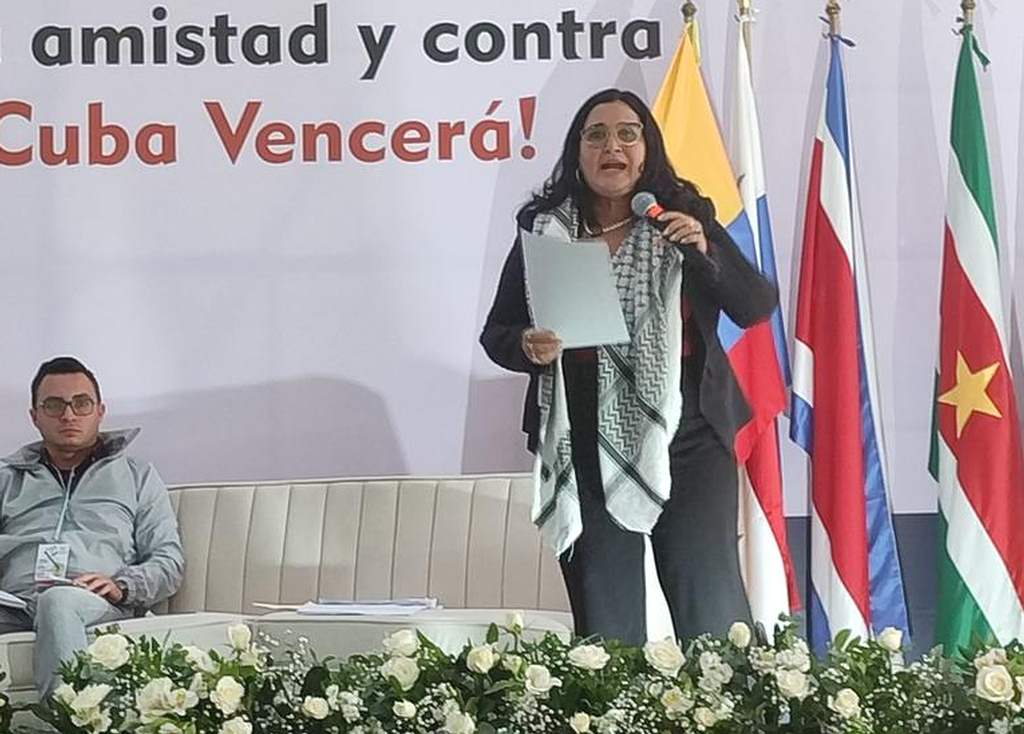
Mexico City, Oct 10 (Prensa Latina) The IX Continental Meeting of Solidarity with Cuba began in Mexico with demonstrations in support of the island and a call to plan actions to continue the fight against the economic blockade imposed by the United States.
Photo: X @EmbaCuMex
During the inauguration at the National Center for the Arts in Havana, Fernando González, president of the Cuban Institute of Friendship with the Peoples, thanked the participants for their support and urged them to develop coordinated, united strategies.
This, he added, is intended to further influence the political, media, and economic spheres by denouncing the US blockade, which “unfortunately remains the main obstacle to development” in the Caribbean nation.
Before more than 500 people from various Latin American countries and other regions of the world, González urged support for an initiative by the José Martí Association of Cuban Residents in Mexico to raise funds for the purchase and shipment of an oil tanker to the island.
We also need to continue the fight for the Caribbean nation’s exclusion from Washington’s unilateral list of states that allegedly sponsor terrorism, and for the return of the territory illegally occupied by the naval base in Guantánamo Bay, in the eastern part of the island.
The Hero of the Republic of Cuba also called for continued support for the medical collaboration of the largest of the Antilles in other nations.
“Let us embrace more strongly the just causes we defend, including the defense of the Bolivarian Revolution (in Venezuela), the commitment to peace in Colombia, the special relationship of friendship with the CARICOM (Caribbean Community) countries, and the independence of Puerto Rico,” he said.
González condemned the genocide perpetrated by Israel in the Gaza Strip and rejected the deployment of US military forces in the Caribbean and in international waters near Venezuela.
He also referred to the deep ties of friendship between Cuba and Mexico.
For her part, the president of the Mexican Senate, Laura Itzel Castillo, praised the Cuban people’s example of resilience and demanded an end to the economic, commercial, and financial siege imposed by the United States against Cuba for more than six decades.
Carlos Imanol Belausteguigoitia, Director General for Central America and the Caribbean of the Ministry of Foreign Affairs, also spoke in this regard. He also highlighted the solidarity between his country and Cuba and the excellent moment of understanding that currently characterizes the bilateral relationship.
Tamara Barra, of the Mexican Movement of Solidarity with Cuba, expressed confidence that the meeting, which concludes next Sunday, will strengthen solidarity efforts and foster the development of strategies to continue fighting the blockade.
The inauguration was attended by Carolina Rangel, secretary general of the ruling Morena party, as well as representatives, senators, the ambassadors from Palestine, Russia, Venezuela, and Vietnam, and delegates from 25 Latin American nations and 24 Mexican states.