
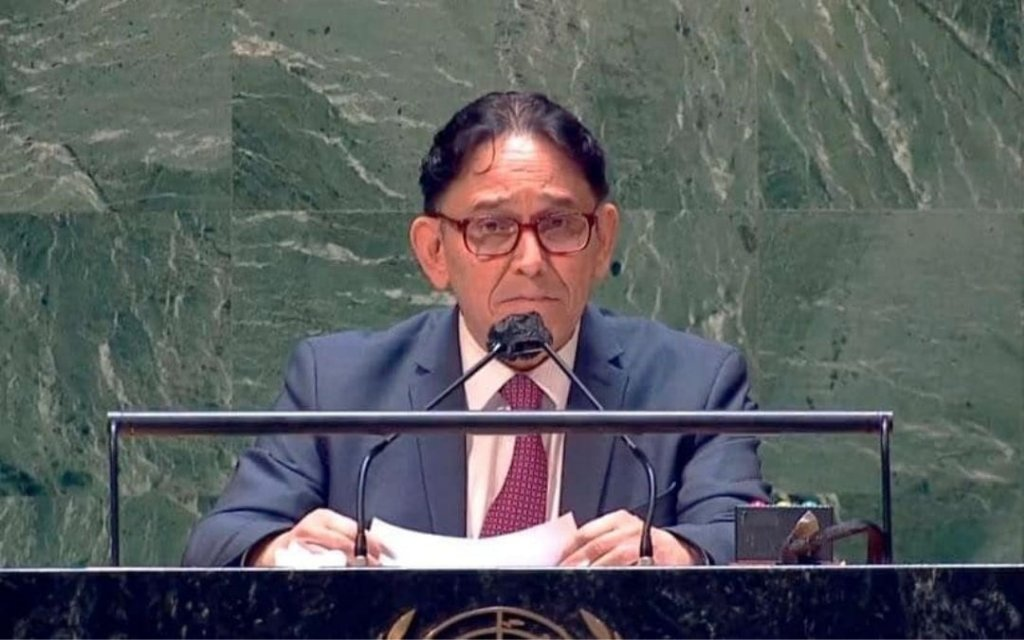
Managua, September 29 (Prensa Latina) Nicaragua’s Permanent Representative to the UN, Jaime Hermida, highlighted today the struggle of the Cuban people against the United States blockade and stressed the need for a comprehensive reform of the multilateral organization.
Speaking to the program “Revista en Vivo” on Channel 4 television, the diplomat noted that the UN General Assembly has approved 28 resolutions calling for an end to this US policy against Cuba, but so far it has not been lifted.
Hermida considered that these votes reflect broad international support for the Cuban claim and affirmed that the continuation of the diplomatic struggle strengthens the legitimacy of Havana’s demand.
“The case of our brotherly Cuban people has been a constant source of condemnation, demanding an end to this unjust and criminal blockade against this fighting people,” the Nicaraguan representative said.
The ambassador argued that, despite the support achieved by the resolutions, there are institutional limitations to guarantee their compliance, due to the operating mechanisms of the United Nations and the role played by the Security Council.
He explained that the General Assembly can approve resolutions by large majorities, but noted that the possibilities of implementing those decisions are conditioned by the powers of other bodies in the multilateral system.
In this regard, he recalled that the Security Council is the main body responsible for adopting binding decisions on international peace and security, and mentioned the veto power of its five permanent members as one of the elements that affect the functioning of the organization.
Hermida considered that the structure of the United Nations must adapt to the transformations experienced by the world during the last eight decades, because, in his opinion, the new realities require timely responses to the problems that affect the development of peoples.
“We must continue this struggle, because that also gives the Cuban people moral authority regarding the justice of their claim,” he stated.
In that context, he advocated a profound transformation of the organization, one that is not limited to introducing partial adjustments, but that comprehensively encompasses its structures and operating mechanisms.
The economic, commercial and financial embargo imposed by the United States government against Cuba has lasted for more than six decades and is considered by the island’s authorities as the main obstacle to the country’s development.
This unilateral measure has intensified in recent months with an oil blockade and other sanctions that seek to subdue the Cuban people through hunger and need.
mar/ybv
