
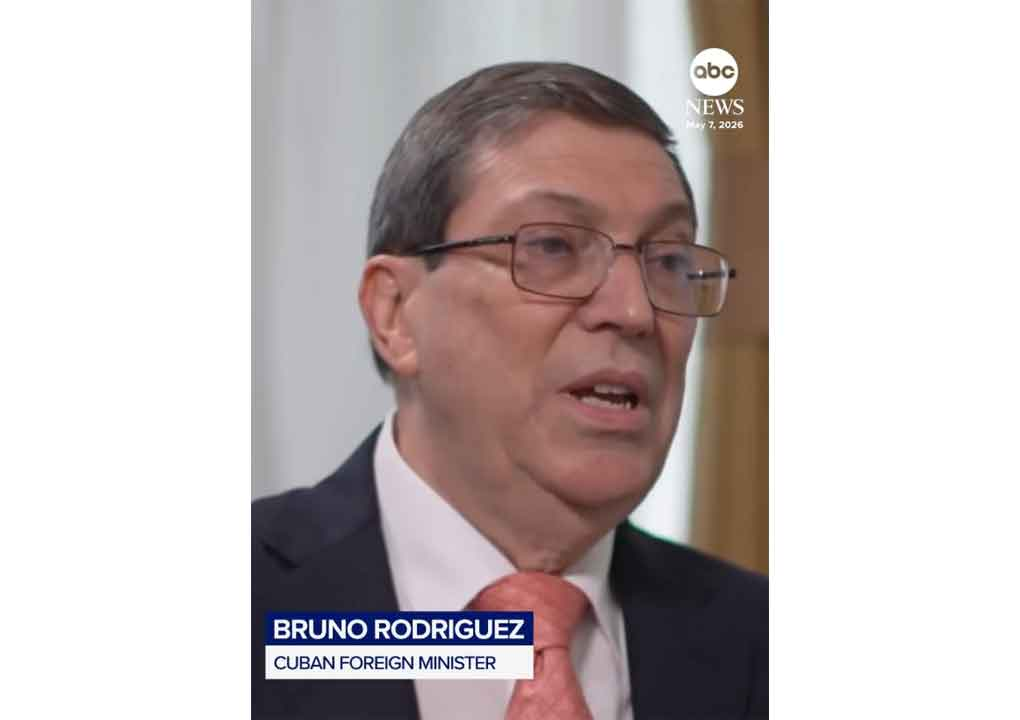
Washington, May 8 (Prensa Latina) Foreign Minister Bruno Rodríguez reaffirmed that Cuba will safeguard its independence and stated that it “will exercise its right to legitimate self-defense to the very end, with the massive and overwhelming support of the people.”
In an interview with the American media outlet ABC News, the Foreign Minister was clear: “Cuba does not represent a threat to the United States: not to its national security, not to its foreign policy, not to its economy, not to the American way of life.”
“It appears that the United States government has chosen a dangerous path; a path that could lead to unimaginable consequences, to a humanitarian catastrophe, to genocide, to the loss of Cuban lives and young Americans; it could also lead to a bloodbath in Cuba,” he said.
Rodríguez stated that there has been no progress in the talks with the United States and dismissed the recent demands from the Donald Trump administration regarding political and economic reforms. “I can tell you that I see no progress,” he emphasized.
The Cuban foreign minister reiterated his willingness to engage in dialogue “on a wide variety of bilateral issues,” but emphasized that issues related to Cuba’s political system or internal affairs “are not on the table.”
Rodríguez refuted the false pretexts used by the Trump White House to justify a possible military aggression against Cuba, something “prohibited by international law,” he noted.
In recent weeks, the hostility of Trump and his Secretary of State, Marco Rubio, has escalated with constant threats of future actions against the island “very soon”.
Trump has referred – with the mentality of a 21st-century conqueror – to “taking control of Cuba almost immediately” and threatens to deploy US aircraft carriers near its shores to, supposedly, force a surrender.
Since assuming his second term in the White House on January 20 of last year, President Trump has doubled down on his stance against Cuba. On his first day in office, he signed an executive order reversing belated but progressive measures taken by his Democratic predecessor, Joe Biden.
Biden, who during his four years in the Oval Office remained in line with Trump’s policy towards Cuba, decided a week before the end of his presidency to remove the country from the unilateral and arbitrary United States list of alleged sponsors of terrorism.
Thus, in a cascade, the provisions arrived one after another, all destined to strangle the Caribbean nation with an unprecedented strengthening of the longest economic, financial and commercial blockade in history with the objective of overthrowing the Cuban Revolution or, that is, regime change.
He attacked remittances (they were suspended from January 31, 2025); he increased the persecution of Cuba’s international cooperation in the area of health through pressure campaigns that made some countries give in, which abandoned that humanitarian program.
The Office of Foreign Assets Control (OFAC) has also intensified its pursuit of the island’s financial operations; it ended the humanitarian parole program; it suspended visas for cultural, sports, and scientific exchanges; and in an unprecedented move after 23 years of suspension, Trump activated Title III of the Helms-Burton Act.
On January 29, a year after his return to power, he signed an executive order declaring a national emergency regarding Cuba under the false argument that it constitutes an “unusual and extraordinary threat” to the national security and foreign policy of the United States.
As a result, an energy blockade was imposed on the island, and punitive tariffs and secondary sanctions were threatened against any country, company, or shipping company that attempted to sell oil to Cuba, which constitutes a flagrant violation of the sovereignty of third-party states.
On May 1, Trump published a decree that expands his government’s unilateral coercive actions against Cuba, which are an extension of those announced in January, although he did not mention any specific entity or person at that time, but yesterday the Secretary of State revealed the Cuban entities and people included in this registry of penalties that demonstrates its extraterritoriality.
A recent vote (51-47) in the United States Senate rejected a Democratic initiative on war powers to limit possible military operations that Trump could order against Cuba without the authorization of Congress.
ro/dfm
