

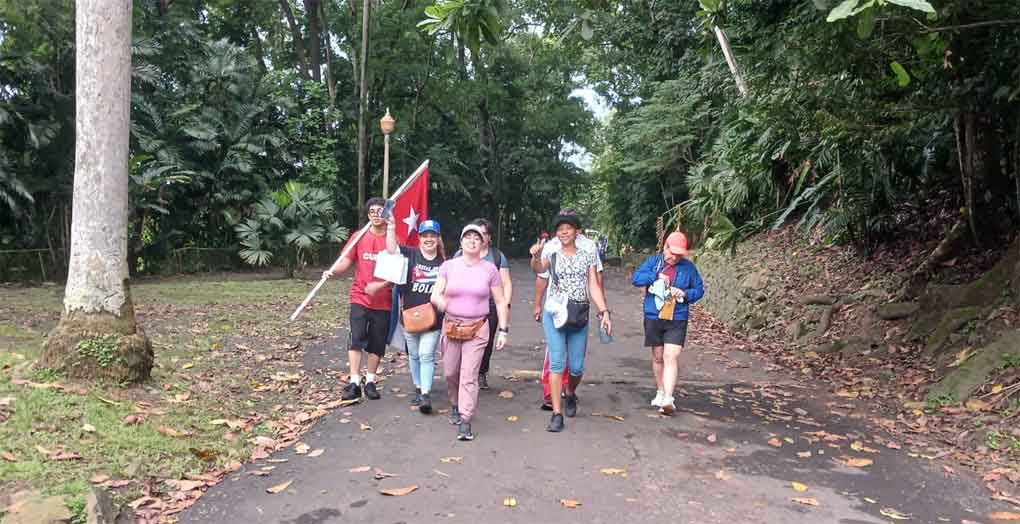
Panama City, June 29 (Prensa Latina) Panamanians and Cubans reached the top of Ancón Hill in this capital today to condemn the U.S. blockade imposed on the island for more than six decades, but destined to fail, they said.
In a symbolic and emotional event organized by the Cuban embassy on the isthmus, and after climbing the 199-meter-high hill from which the Central American nation’s largest flag flies, members of the state mission, Cuban residents, and solidarity groups demanded an end to the hostile policy.
On behalf of the participants, diplomatic official Yuniarque Canto noted that the harshness of the siege has not prevented the Revolution, which triumphed in 1959, from protecting the health and quality of life of the population, especially the most vulnerable.
As he explained, one expression of this cruel economic war can be seen in the obstacles they must overcome to acquire medical supplies and equipment and to provide care for people’s health, as demonstrated during the COVID-19 pandemic.
Canto emphasized the spirit of resistance that has characterized the Caribbean nation and that emerges as a greater human shield against the most brutal and prolonged siege the world has ever known.
Among the participants in the walk, members of the Martí Association of Cubans Residing in Panama highlighted that a similar commitment to their homeland was evident at the recent VII Meeting of Cubans Residing in Latin America and the Caribbean, held in the Dominican Republic between the 13th and 15th of this month.
According to Cuban Foreign Minister Bruno Rodríguez, this criminal measure constitutes the most ruthless, comprehensive, and prolonged economic warfare policy ever imposed on any country.
He also stated that as a result of the blockade, Cuba suffered losses of $5.568 billion from March 1, 2023, to February 29, 2024, representing an increase of nearly $200 million compared to the previous report submitted to the United Nations.
The estimated impact is more than $421 million per month, or $13.8 million per day, and he noted that over 60 years, these impacts have risen to $1 trillion 499 billion.
For the island’s top diplomat, Havana’s arbitrary inclusion on the State Department’s list of countries that allegedly sponsor terrorism deepens the difficulties and significantly affects Cuban families.
rgh/ga

