Havana, Oct 23 (RHC) Mexican authorities and companies will participate in the upcoming Havana International Fair. Approximately twenty of these companies will be present as exhibitors.
According to Katia Alonso, commercial economic counselor of the Cuban Embassy, another group of businesspeople from Mexico will explore the opportunities offered by the island in terms of trade and investment during the 40th edition of the event, which will take place from November 4 to 9.
The activities include a Cuba-Mexico Business Forum and the celebration of the National Day of Mexico, when the Aztec country will inaugurate its pavilion.
The Fair, which will take place at the Expocuba venue, will attract representatives from more than 50 countries and approximately 700 companies, including 500 foreign and 200 local businesses, according to the organizers.
The 7th Investment Forum will take place on November 5th and 6th. During this time, a portfolio of foreign investment opportunities will be presented, and an exhibition of the Mariel Special Economic Zone will be organized.
Every day of the fair, there will be product and service launches, presentations, and conferences on topics related to promoting foreign trade and investment. Additionally, various business forums will be held.
On this occasion, a pavilion will be dedicated to territories, showcasing the potential of economic actors in Cuban municipalities. (Source: Prensa Latina)
Oct 21 (Once Noticias – Mexico) The Federal Electricity Commission also offered its technical support to Havana for the prompt restoration of electricity
The Government of Mexico , through its embassy in Havana , offered support, including technical assistance, to solve the energy emergency that Cuba has been facing for several days, the Ministry of Foreign Affairs (SRE) reported on social media.
To this end, Foreign Minister Juan Ramón de la Fuente Ramírez has maintained permanent contact with his Cuban counterpart, Bruno Rodríguez Parrilla .
While the Mexican Embassy in Cuba is working with the relevant authorities to provide updated information on the situation, the following emergency lines have been made available to its citizens in that country:
The ministry added that the Federal Electricity Commission (CFE) also offered its technical support “for the prompt restoration of electricity” on the island.
Electricity restoration progresses in Cuba
Nearly 90% of Havana residents had their electricity restored on October 21 , the fourth day of the national blackout in Cuba, although several provinces in the country remain without service, the Havana Electric Company said.
The almost complete restoration of electricity in the capital of 2 million inhabitants was announced by Havana’s energy company, while tropical storm “Oscar” passes through the east of the country, leaving houses without roofs and destroyed, according to the latest report.
“According to the Havana Electric Company, 768,810 customers on 301 circuits have electric service in Havana, representing 89.3% of the total,” the state-run news portal Cubadebate said , citing the company.
Since October 18, the Cuban government declared an “energy emergency” following the collapse of the Antonio Guiteras thermoelectric plant , the most important in the country.
Last weekend, authorities made great efforts to restore the service, but without success. As a result, the president of this country, Miguel Díaz Canel, acknowledged that the situation of the electrical system was “complex.”
“The greatest damage is in the province of Guantánamo (east), especially in Baracoa, Imías, Maisí, with major flooding,” the Cuban presidency reported on its X account.
Oscar also caused the total or partial loss of homes in Baracoa, where strong winds blew away roofs and walls of houses and knocked down poles and trees, according to state television, without showing images.
In four provinces in the east of the country, home to 10 million people, authorities have announced protective measures for the population, including evacuations in areas at risk from flooding.
Cuba receives shows of solidarity from different parts of the world
Havana, Oct 23 (RHC) Shows of solidarity with Cuba are being held in various parts of the world in response to the energy crisis the island is facing and the devastation caused by Hurricane Oscar in the eastern region.
In a statement, the Communist Party of Belarus expressed its full support and solidarity with the Cuban people. The political organization expressed confidence that the Cuban government is taking all necessary measures to overcome the consequences of the incident at the Antonio Guiteras thermoelectric power plant as soon as possible.
Similarly, the Communist Party of Ireland reaffirmed its support for Cuba, the government, and people, and recalled that the island was facing an electrical emergency while still enduring the devastating consequences of the illegal US embargo.
For its part, the Association of Friends of Cuba in Slovakia repeated its call on the international community to lift the economic embargo and remove Cuba from its arbitrary and illegal list of states allegedly sponsoring terrorism.
The Association of Cubans in Cyprus also expressed its solidarity with the Caribbean country and stressed that Cuban resilience had been tested many times before.
Likewise, the Articulation of Social Movements towards the ALBA called upon the organizations making up the platform to stay attentive to the evolving situation and denounce the historic and current responsibility of American imperialism.
On Tuesday, a letter published in The New York Times urged President Biden to reverse the aggressive policy of his predecessor Donald Trump towards Cuba during his last 90 days in office.
Cuba is facing a serious energy crisis as the result of the shutdown this October 18 of the Antonio Guiteras thermal power station, and the recent impact of hurricane Oscar. (Source: PL)
Cuban delegation thanks Angola for support against US blockade
Havana, Oct 21 (RHC) The Minister of Public Health of Cuba, José Ángel Portal, expressed gratitude to Angola for its unwavering support in the face of the economic, commercial, and financial blockade imposed by the United States.
During the inauguration of the new hospital in Cuanza Sul, named after Comandante Raúl Díaz Argüelles, Portal emphasized the strong collaboration between the two countries in the field of healthcare, and reiterated the commitment to continue the joint work.
He highlighted the friendship between the two nations, built on mutual solidarity and respect, and reflected on the shared challenges and triumphs over the years.
During the ceremony, Angolan Minister of Health Silvia Lutucuta underlined the strategic partnership between Angola and Cuba. She expressed gratitude for the support provided by the island in this territory over time.
Currently, 1,243 Cuban medical professionals are serving in Angola, with over 16,500 since the beginning of cooperation. This includes contributions to the training of human resources in both countries, with 1,646 alumni and 52 continuing their studies.
Lutucuta emphasized the facilities of the new hospital, which has a capacity of 200 beds and provides services in pediatrics, hemodialysis, gynecology, obstetrics, otology, ophthalmology, surgery, orthopedics, cardiology, intensive care, mammography, and imaging. Over 1,100 employees, including 20 Cuban doctors, will provide care for the population of Cuanza Sul in this state-of-the-art facility.
During the ceremony, a tribute was paid to Raúl Díaz Argüelles, the first leader of the Cuban mission in Angola who passed away on December 11th, 1975, after a vehicle he was traveling in collided with an anti-tank mine.
Natacha Diaz-Argüelles, daughter of the combatant, participated in the ceremony as part of a Cuban delegation, which also included Major General Ramón Pardo Guerrero and other Cubans who fought for Angolan independence and territorial integrity. (Source: Prensa Latina)
Díaz-Canel referred to the effects of Hurricane Oscar in Guantánamo and the energy emergency in the country. Photo: @PresidenciaCuba
Havana, October 22 (RHC) –The President of the National Defense Council, Miguel Díaz-Canel, reported this Monday that the Guantanamo municipalities of Imías and San Antonio del Sur are in a state of emergency due to the severe damage caused by Hurricane Oscar in Cuba.
In statements to national television, the Cuban leader confirmed that Oscar, already downgraded to a tropical storm, claimed the lives of six people in San Antonio del Sur.
Díaz-Canel pointed out that in those two areas there were levels of flooding that have no historical records.
He said that at this time members of the Ministry of the Interior and the Revolutionary Armed Forces are carrying out rescue and salvage operations, and are also assessing the possible damages in territories that remain inaccessible.
Regarding the electrical contingency that the country is going through, he explained that there is a notable progress thanks to the deep, intense work based on the expertise of specialists in the field.
He reported that more than 36 percent of the service has been restored, functioning with stability, and it is expected that this figure will increase in the next few hours.
He indicated that after the restoration of the system in Havana, they are seeking to increase the levels of service in the rest of the eastern provinces.
The president considered that the Caribbean nation will soon overcome the energy emergency, caused by the disconnection of the National Electric System, and will enter a stage of management of the generation deficit caused by the lack of fuel.
He recalled that the tense situation in the sector is due to the intensification of the blockade imposed by the United States and the inclusion of the island in the unilateral list of countries sponsoring terrorism. (Source: Prensa Latina)
Landscape of the Havana, this morning, Oct 21, 2024 Photo: Radio Habana Cuba
The Havana Electric Company reports that already 261 circuits in Havana have service, which is equivalent to 721 379 customers, 83.6 percent of the total.
Oct 21 (teleSUR) In the midst of a serious energy crisis, Havana has managed to restore electricity service to 83.6 of its customers, according to the Havana Electric Company in the early afternoon. 508MW are reported in service and only 2 hospitals are still to be restored.
On the morning of October 21, the general director of Electricity of the Ministry of Energy and Mines, Lázaro Guerra Hernández, provided an update in the information magazine Buenos días, reporting that in total there are 700 MW served throughout the country.
Guerra pointed out that the western microsystem is more consolidated, with unit number 8 of the Mariel and floating power plants in Havana, such as Mariel and Energás Boca de Jaruco, operating. This has allowed a level of coverage in Havana, Mayabeque and Artemisa.
The central microsystem has more than 200 MW and covers the provinces from Matanzas to Camagüey. “The subsystems have been designed from the beginning of the total system fall and are running,” added the engineer, underlining efforts to consolidate existing microsystems to improve the stability of the power supply.
However, the situation remains fragile and the government is working hard to increase supply to more users, depending on available generation capacities.
Accordingly, the Cuban Government has also presented a new strategy to stabilize SEN by reorganizing electricity generation by regions. This includes the creation of clusters in the west and east of the country as well as in the centre to optimize the operation of thermal units.
President Miguel Díaz-Canel has described the current situation as «exceptional», highlighting the challenges facing the country, including fuel shortages aggravated by the US economic embargo.
“The blockade has led to a lack of stable supplies, preventing the system from functioning normally,” he said, referring to the crisis that has led to the collapse of the National Electricity System (SEN) and frequent disconnections in recent days.
Díaz-Canel also praised the dedication of the electrical workers and the understanding of the people in the situation. However, he made a call to civility, condemning acts of vandalism that have tried to disrupt the city’s tranquility. “The Revolution will not tolerate this kind of behavior,” he emphasized.
Simultaneously, the country is preparing to face tropical storm Oscar, which is slowly advancing over eastern Cuba.
With sustained maximum winds of 85 km/h, the storm is expected to impact local infrastructure, which has led the government to suspend non-essential activities and classes on October 21, 22 and 23. The priority is to ensure the safety of the population and facilitate the recovery of the electrical system.
The president also emphasized that in Havana, 90 percent of the electrical system has already been restored, and efforts will continue to address issues in other provinces Oct 21, 2024 Photo: @PresidenciaCuba
Additionally, he reiterated that the energy crisis is exacerbated by “the intensification of the blockade against Cuba and our country’s inclusion on the list of state sponsors of terrorism.”
Oct 21 (teleSUR) In a recent message to the Cuban people, President Miguel Díaz-Canel Bermúdez addressed the ongoing electrical crisis affecting the nation. During his remarks, he highlighted the efforts being made to restore electricity following multiple outages.
“Since last night, after the third disconnection, a thorough analysis of various options and possibilities has been undertaken,” the president stated.
According to Díaz-Canel, thanks to the work of professionals, workers, and engineers within the national electric system, significant progress has been made: “Thirty-six percent of the service has been restored, and in the coming hours, we will continue to increase services to the population.”
Hay más de un 36 % del servicio eléctrico restablecido, funcionando con estabilidad en estos momentos; se seguirán dando pasos, y en las próximas horas se incrementará el servicio.
“More than 36% of the electricity service has been restored, currently operating with stability; steps will be taken further, in the coming hours the service will be increased”.
The president also emphasized that in Havana, 90 percent of the electrical system has already been restored, and efforts will continue to address issues in other provinces. Additionally, he reiterated that the energy crisis is exacerbated by “the intensification of the blockade against Cuba and our country’s inclusion on the list of state sponsors of terrorism.”
Díaz-Canel stressed the Cuban government’s commitment to facing these challenges and ensuring the well-being of its people.
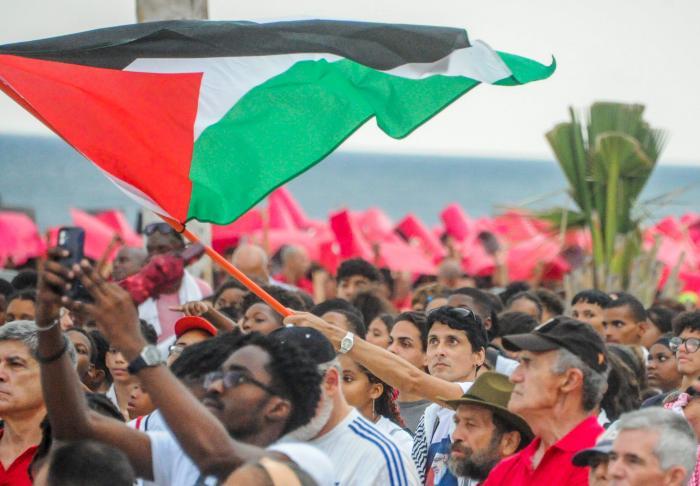
Díaz-Canel leads march in solidarity with Palestine
Oct 15 (Granma) “They ripped away my right to live in my country. Today we are all Gaza; hatred does not stop, hatred kills you,” expressed a young Palestinian who is studying in Havana, determined to build a future different from the desolation generated in his own land by the Israeli genocide. Those who share that fate, despite the uncertainty, the uprooting from their native environment and the loss of relatives, showed firmness in the island’s capital to send a message of resistance in a solidarity march of Cubans with the Arab nation.
Foto: José Manuel Correa
Sensitivity to those who suffer a war for excessive ambitions, beyond any circumstantial vicissitude, was enough to mobilize thousands of people from both countries. Human nature should aim at kindness, declared Hiram La O Hernandez, of the Union of Young Communists (UJC) at the Technological University of Havana. As silence implies complicity, and this rebellious alligator always raised his voice in the face of injustice, everyone amplified with their attitude the words of the first secretary of the UJC National Committee, Meyvis Estévez Echavarría: “May the Palestinian flag be raised high, firm and energetic, in the arms of Cuban children and adolescents!”
Italian solidarity groups support Cuba in the face of the energy crisis
Rome, 21 October (RHC) The National Association of Italian-Cuban Friendship (ANAIC) has reaffirmed its unconditional solidarity and support for the Cuban people in the face of the complex energy problems that the country is currently facing, according to a press release.
Marco Papacci, president of Anaic, handed over to Prensa Latina a document issued by this organization in which it denounces that the serious situation of the island is mainly a consequence of the economic, commercial and financial blockade imposed by the United States against this nation more than 60 years ago.
ANAIC points out that this measure, which violates human rights and which it describes as criminal and merciless, “affects all sectors of Cuban society and affects the lives of the population on a daily basis”.
“The blockade, which has been condemned more than 30 times by the United Nations General Assembly, is a shameful act that hinders Cuba’s efforts for economic development and the well-being of its citizens, affecting the country in vital sectors such as energy”.
As Italian citizens, we will never forget the contribution of solidarity during the pandemic emergency that brought us to our knees”, nor “the lesson of humanity received from the Cuban health personnel” in the first difficult moments when Covid-19 caused thousands of deaths in this European nation, expressed the members of this association.
ANAIC expresses its full confidence that the Cuban people “will be able to overcome this new challenge” given the current energy situation, and at the same time calls on the international community to support the country in its fight against the US blockade and to demand its immediate lifting.(Source: Prensa Latina)
Minister Vicente de la O Levy expects the country’s electricity supply to be fully restored by Tuesday.
Oct 21 (teleSUR) On Monday, the the state-owned company Union Electrica (UNE) confirmed that around 50 percent of Havana’s residents now have power, nearly 72 hours after the total blackout that affected the entire island.
The UNE also emphasized that its “people are not resting” as they work to restore the National Electric System (SEN) following the “national zero power coverage” event that occurred on Friday, which has only been gradually addressed amid repeated setbacks in recent days.
On Sunday, authorities announced that the current strategy to address this crisis is to reorganize the SEN into three regions to facilitate the startup of different generation units. The goal is to reconnect the SEN as quickly as possible to gradually restore service to the nearly ten million inhabitants of the island.
Energy Minister Vicente de la O Levy expects the country’s electricity supply to be fully restored by Tuesday. The first total blackout was recorded last Friday morning, following an unexpected shutdown of the Guiteras thermoelectric plant, one of the largest in the country and considered key to SEN’s stability.
On Saturday, efforts to re-energize and restore the SEN failed again, leading to a second total disconnection. In the final hours of that day, the subsystem created in the western half of the island collapsed, requiring restoration efforts to start over.
The SEN is in a very precarious state due to fuel shortages—stemming from a lack of foreign currency to import it—and frequent breakdowns in the outdated thermoelectric plants, which have been in operation for four decades and suffer from chronic underinvestment.
Blackouts have been common for years, but the situation has worsened in recent weeks. In recent days, maximum disruption rates have exceeded 50 percent, meaning that at times, half of the country was simultaneously without power.
The frequent blackouts are damaging Cuba’s economy, which contracted by 1.9 percent in 2023. A similar zero production situation occurred was in September 2022, after Hurricane Ian passed through the island’s western tip. This caused significant disruptions, and the recovery took several days.
#Cuba | This is how Monday began in Havana. The effort concentrated on restoring electricity service nationwide