Havana, Nov 17 (Prensa Latina) Cuban authorities today congratulated the island’s students, in the context of the celebration of International Students’ Day.
A hug goes out to all the students who are standing and fighting for Cuba in their communities, scholarships and study centers, wrote the country’s president, Miguel Díaz-Canel, on the social network X.
The head of state highlighted that during the date many citizens, including students from various levels of education, participate in recovery efforts after the ravages of hurricanes Oscar and Rafael, plus two earthquakes, in less than 30 days.
“A heartfelt congratulations to the Cuban students; who contribute decisively, always at the forefront, to the economic-social development of our country,” said, meanwhile, the president of the National Assembly of People’s Power (Parliament), Esteban Lazo.
Every November 17th marks the anniversary of the Nazi raid on Charles University in Prague in 1939, following demonstrations against the German occupation of Czechoslovakia and the murders of Jan Opletal and worker Václav Sedláček.
The Nazis murdered nine student leaders, sent more than 1,200 to concentration camps and closed all Czech universities.
Detroit, November 16 (Radio Habana Cuba) — The National Network on Cuba (NNOC), representing more than 70 organizations working in solidarity with Cuba in the U.S., kicked off its annual conference Saturday, November 16th, in the historic working class city of Detroit, Michigan.
Photo: Bill Hackwell
The meeting reaffirmed the groups’ commitment to redouble their efforts with new methods and projects to end the cruel and genocidal blockade of the island that exists simply because the Cuban people demand their sovereignty against all odds.
Photo: Bill Hackwell
Photo: Bill Hackwell
Friday night, as a prelude to the conference, a photographic exhibition commemorating the 65th anniversary of Prensa Latina was held at the Swords to Plowshares gallery in downtown Detroit, with the participation of the chief correspondent of the Cuban news agency’s U.S. bureau, Deisy Francis Mexidor.
[ Special thanks to RHC correspondent Bill Hackwell for this report ]
Havana, Nov 15 (Prensa Latina) The First International Congress of Graduates of the Latin American School of Medicine (ELAM) concludes in this capital on Friday celebrating the 25th anniversary of this institution, which was founded on November 15, 1999.
Taking place at Havana’s Conference Center since November 13, the event brings together representatives of 20 graduations who addressed issues such as primary healthcare, emergencies, natural disasters, and pedagogy in higher medical education.
Participants in panels, roundtable discussions, research presentations, posters, other forms of dissemination of science and technological innovations, debated nuclear sciences, nanotechnologies, and the progress of health systems in Latin American countries, where the health ministers are now ELAM graduates.
The 2nd International Assembly of Graduates (SMI-ELAM) was also held in its three working sessions, where delegates discussed postgraduate training, challenges, and experiences in medical sciences.
Cuban Public Health Minister Jose Angel Portal Miranda gave a master lecture about the peculiarities of this nation’s health system and acknowledged the historic milestone of having the ELAM to train health professionals from all over the world.
“The ELAM has been a beacon for unity and international cooperation promoted by Cuba, where quality medical education is a priority, thanks to its more than 200 professors, a feature confirmed by the highest qualification granted by the Union of Universities of Latin America and the Caribbean (UDUALC),” Portal pointed out.
Havana, Nov 15 (Prensa Latina) Cuban President Miguel Díaz-Canel today visited the coastal municipality of Pilón, in the eastern province of Granma, shaken by earthquakes that caused damage to buildings and services for the population.
In this territory, the most affected by the recent earthquakes of magnitude 6.0 and 6.8 on the Saffir-Simpson scale, the president of the National Defense Council also noted the magnitude of the damage, the recovery, the support and solidarity toward the inhabitants.
Díaz-Canel spoke with the population at the Sevilla Popular Council, was interested in the mood and psychological state of the people, and recognized the organization and discipline with which they faced this event.
He asked about the recovery phase, since in Sevilla alone, more than 400 homes were damaged, the Presidency reported on social network X.
After listening to the neighbors, he conveyed confidence and was interested in the work being done in the processing office to speed up the process of recovering properties.
He insisted on the importance of the lessons learned from this experience, to continue preparing ourselves for phenomena of this nature.
Havana, November 16 (RHC) — The First Secretary of the Central Committee of the Communist Party of Cuba and President of the Republic, Miguel Díaz-Canel received Friday the vice president of China’s International Development Cooperation Agency, Liu Jianfeng, on a visit to the country.
In his account on the social network X, the dignitary said that the meeting with the Chinese official was useful and timely to thank the support of the Asian giant.
Díaz-Canel and Liu Jianfeng agreed to move forward in building a community of shared future between the two countries.
The senior official conveyed to the Antillean leader “cordial greetings and best wishes” from the president and general secretary of the Communist Party of China, Xi Jiping.
Liu said that the leader of the Asian giant pays close attention to Sino-Cuban relations and has been very concerned about the earthquakes, hurricanes and the situation of the Cuban people.
“In the first half of this year, Xi Jiping instructed a group of measures to support Cuba with assistance, and now, with these events, he approved to deploy a second round,” said the vice president of that cooperation entity. (Source: Prensa Latina)
Havana, Nov 11 (Prensa Latina) A painting mural in tribute to African-American revolutionary leader Malcolm X (1925-1965) decorates on Monday one of the walls of the Casa de las Americas cultural institution in this capital, a result of the feelings and creativity by US artist Jasmine Nicole.
Nicole and other artists from Mexico, Colombia, Argentina, Uruguay, and Cuba gathered in Havana to attend the 5th Meeting of Thought and Young Creation “Casa Tomada 2024,” which brought about the exchange of knowledge and brotherhood in that institution.
As the Instagram profile of Casa de las Americas reported, the visual artist, from Atlanta, Georgia, set herself up as a powerful voice in the world of art and culture.
As an African-US cultural worker and organizer, she uses her art to explore her own experiences as a black woman from the South; she also seeks to inspire the working class and those oppressed to rise and seek liberation through engraving and mural painting.
Deeply influenced by iconic figures such as Elizabeth Catlett and Emory Douglas, her work highlights the transformative power of portrait and public art, according to the publication.
“Jasmine’s murals not only decorate the streets of the United States but also cross borders until Mexico, bringing her message of resistance and hope to diverse communities.”
Havana, November 15 (Radio Habana Cuba) — The Latin American School of Medicine (ELAM) is celebrating its 25th anniversary Friday, November 15th. The more than 31 thousand doctors who have been trained in Cuba as part of that beautiful project dreamed by Fidel, have managed to become true standard bearers in defense of life.
There are those who say that at the end of 1998, hope had abandoned Central America and the Caribbean: two tremendous hurricanes, George and Mitch, left a large number of deaths and incalculable material damage in those towns, which had already been plagued by the pandemic of poverty.
In the midst of “generous offers” and “millions of dollars” of aid from the most powerful, which in a few weeks were forgotten, Cuba was determined to help rebuild hope there. Cuba did not make promises, Cuba got down to work to make dreams come true, and with a stroke of solidarity began to give shape to a wonderful life project that this November 15 celebrates its 25th anniversary.
Hope: that is precisely what the Latin American School of Medicine (ELAM) has become for the thousands of young people from the poorest places in the world who have been coming to its classrooms for a quarter of a century to contribute in their countries “to the noblest and most humane of all trades: saving lives and preserving health,” as Fidel asked them on the founding day of this emblematic center.
It was at a Science and Technology Forum, on November 21, 1998, when the Commander in Chief announced the creation of a medical school and offered the first 500 scholarships for sister Nicaragua. The then Granma Naval Academy was the chosen site, and even in the midst of the commendable construction work that was underway, on February 27, 1999, the first 327 young people from that country arrived: by June, enrollment had reached 1,929 students from 18 nations.
On November 15, 1999, in the context of the IX Ibero-American Summit of Heads of State and Government, in the presence of a large number of presidents and heads of delegations attending the event, the Commander in Chief officially inaugurated the ELAM, which he considered “a modest contribution of Cuba to the unity and integration of the peoples.”
But this great dream of Fidel’s was not limited to a single and tangible geographic space in the Cuban capital city, but, three years after the first step, it began to spread to the universities of Medical Sciences throughout the national territory where, course after course, hundreds of professionals who are part of this wonderful solidarity project graduate.
Valuable and committed educators have made Fidel’s dream of training doctors of science and conscience come true. After 20 graduations, the ELAM has graduated 31,180 professionals from 122 countries, who have become standard-bearers of that great dream conceived by Fidel to bring “doctors and not bombs” to the world.
And if those founding days were difficult for Cuba -when the country was going through the complex years of the special period-, no less difficult today is the context in which we are developing, marked by the imposition on our people of the unjust economic, commercial and financial blockade by the United States government, as well as the inclusion of the largest of the Antilles in the list of alleged State sponsors of terrorism.
In the midst of so many economic obstacles, the principles that gave birth to ELAM remain intact. The more than 200 educators who make up its faculty are determined to bring to the classrooms a quality training, which is not only distinguished by the high level of preparation of the students, but also by their principles of solidarity, ethics, commitment, sensitivity, professionalism… those that for more than six decades have distinguished the daily work of Cuban doctors.
To dream and believe in hope, the Commander in Chief summoned the poorest who, 25 years ago, came to our country to train as doctors and defend life from that noble trench. The history of ELAM, a University indissolubly linked to the history of Cuba, has shown the world that in our small island “maker of the impossible” we will never stop believing in hope.
Mexico, Nov 14 (Prensa Latina) The 12th National Meeting of Cuban Residents in Mexico will take place on November 16 and 17 in the city of Querétaro, in the central state of the same name, organizers announced on Thursday.
According to the call, the meeting will be an ideal forum to improve the tasks of the José Martí Association of Cubans Residents in Mexico, debate on the main challenges and commit to Cuba.
We continue to defend the homeland and demand “the immediate lifting of the criminal economic, commercial and financial blockade imposed for more than 60 years by the Government of the United States on Cuba,” the organization asserted in the press release.
It also demands Cuba’s exclusion from “the spurious (unilateral) list of countries that alledgely sponsor terrorism” and the return to Cuba of the territory illegally occupied by the United States Naval Base in Guantanamo.
The meeting will be inaugurated by Cuban Ambassador to Mexico Marcos Rodríguez, and will screen an audiovisual material about the Association’s activities during the 2022-2024 period.
Also noteworthy will be a speech by the general director of Consular Affairs and Attention to Cuban Residents Abroad at the Cuban Foreign Ministry, Ana Teresita González, on the links between the nation and emigration and their challenges under the current circumstances.
In addition, speeches will be given by the presidents of the José Martí Association of Cuban Residents in Mexico, Sergio Chaviano; and the head of its branch in Querétaro, Andrés Rodríguez.
Among other topics, the participants will address work projections for the next two years, as well as the Association’s actions to erode the United States blockade against Cuba.
Marco Rubio, Self-Proclaimed Architect of Trump’s War on Cuba, to Oversee U.S. Foreign Policy
By Alyssa Oursler – Belly of the Beast
November 12, 2024
Nov 14 (Belly of the Beast) For Cuba, the storms keep coming. As if hurricanes, earthquakes, multiple failures of the electrical grid, and the re-election of Trump weren’t enough, Cuban-American Sen. Marco Rubio is Trump’s pick to be Secretary of State.
Rubio was the architect of Trump’s “maximum pressure” policy toward Cuba and has claimed it as one of his greatest accomplishments. Rubio could soon go from being the shadow Secretary of State for Latin America to the real thing.
There’s irony to the appointment.
In 2015, in addition to making fun of each other for parts of their anatomy, Rubio labeled Trump a “con artist” and Trump called Rubio a “total lightweight” whom he wouldn’t hire to run even a small company.
A deeper irony stems from the fact that Trump’s re-election campaign was built on xenophobic rhetoric around immigration. And yet, the war on Cuba that he and Rubio unleashed — and which Biden has done little to reverse — has driven unprecedented migration of Cubans to the United States.
Trump’s policies and the COVID-19 pandemic created the perfect storm for an economic implosion in which Cuba’s GDP contracted by double-digits. From 2022 to 2023, an estimated 10% of Cuba’s population — more than a million people — has left as the economic and humanitarian situation worsened.
Rubio’s appointment suggests the Trump administration, despite anti-immigrant and isolationist rhetoric, would likely accelerate a maximum pressure policy that would continue to ravage Cuba’s economy while fueling migration to the United States.
“Rubio will not only block any efforts to help Cuba through the terrible economic and social crisis that the Cuban people are enduring, he will probably propose piling on new sanctions that will make their lives even harder,” says William LeoGrande, a Cuba expert and professor of government at American University. “But he and President Trump should beware that [anything that] makes life harder for Cubans will just convince more of them that it’s time to leave and come to the United States, with or without a visa.”
Rubio is also emblematic of the outsized power a handful of Florida lawmakers have over the island’s fate.
When Trump was first elected, an interagency review about U.S.-Cuba policy was held. Most people involved were “unanimous in their support for the Cuba policies already on the books, including the Obama-era normalization efforts,” Mother Jones reported.
It did not take long for Cuban-American hardliners to hijack policy toward Cuba and the rest of Latin America.
Why did Biden embrace the Trump-Rubio war on Cuba? Watch Uphill on the Hill to find out.
Leading the way was Rubio, who would play a key role inserting Cuban-American hardliners into top positions in the Trump administration. John Barsa was named head of USAID’s Bureau for Latin America and the Caribbean, and Mauricio Claver-Carone, a former pro-embargo lobbyist, went to the National Security Council, where he became the architect of some of Trump’s most damaging measures, including activation of Title III of the Helms Burton Act.
Rep. María Elvira Salazar and Rep. Mario Díaz-Balart, also hardliners from the Sunshine State, praised Rubio’s appointment.
@Huge congratulations to my friend @marcorubio on his nomination for Secretary of State! As Cuban Americans from Miami & members of the exile community, we share a commitment to fighting communism & protecting freedom. Marco will restore American leadership abroad!
Salazar is the sponsor of the FORCE Act, which aims to make the removal of Cuba from the “state sponsors of terrorism” list — a designation made by Trump during the final days of his first term — impossible without regime change. Previously, it was assumed that, should the bill pass the House, it would fail in the Senate. Now, the Republicans have a Senate majority and are expected to maintain control of the House.
Last month, the United Nations voted overwhelmingly to condemn U.S. sanctions on Cuba
Never mind that the U.S. is isolated in claiming that Cuba sponsors terrorism (there is consensus among intelligence officials that Cuba does not sponsor terrorism), much like it is isolated in defending its policy towards Cuba writ large. Last month, the entire United Nations General Assembly, save the U.S. and Israel, voted for an end to U.S. sanctions on Cuba.
The U.S. government’s isolationism when it comes to Cuba could become even more extreme, as Cuban-American hardliners take over key positions of power. Díaz-Balart is vying to become the next chair of the House Foreign Affairs Committee and Carlos Trujillo, another hardliner who under Trump was U.S. ambassador to the Organization of Americas States, is being considered for the position of assistant secretary of state for Western Hemisphere Affairs, according to The Miami Herald.
Meanwhile, Trump has asked Rep. Mike Waltz, yet another Florida Republican, to serve as his national security advisor.
Despite Rubio’s extremist policy positions, his appointment — which LeoGrande calls “the culmination of Cuba’s Annus Horribilis” — seems inevitable.
Sen. John Fetterman of Pennsylvania, a Democrat, has wasted no time in expressing his support.
The far-right ideologues who dominate politics in Trump’s home state of Florida, it seems, will be running foreign policy when he returns to the White House next year.
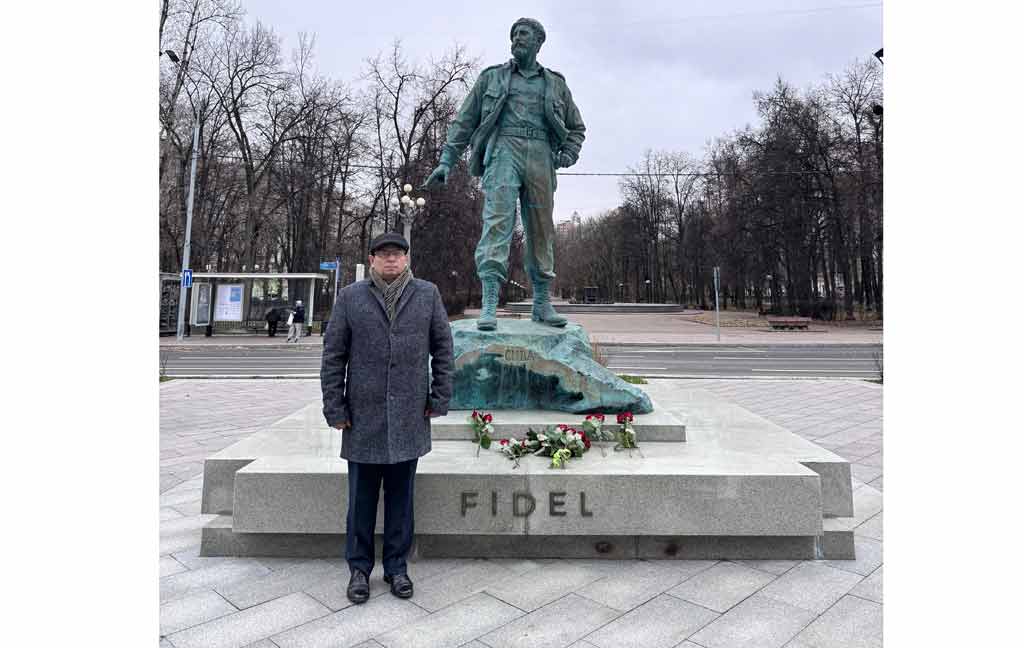
Moscow, Nov 14 (Prensa Latina) The president of the Cuban Institute of Friendship with the Peoples (ICAP) and Hero of the Republic of Cuba, Fernando Gonzalez, paid tribute to the historic leader of the Cuban Revolution, Fidel Castro, in this capital on Thursday.
During his first stop, after he arrived in Moscow to participate in the celebrations of the 60th anniversary of the Russian Society of Friendship with Cuba, Gonzalez said he was proud to visit a space of high political and social relevance for both countries.
“For the ICAP, to come for the first time to this place of remembrance to Fidel, means to revive the years of friendship and solidarity that unite our nations, and it is also a sign of gratitude to Russia for building a monument in memory of the undefeated Cuban commander-in-chief,” the ICAP president told Prensa Latina.
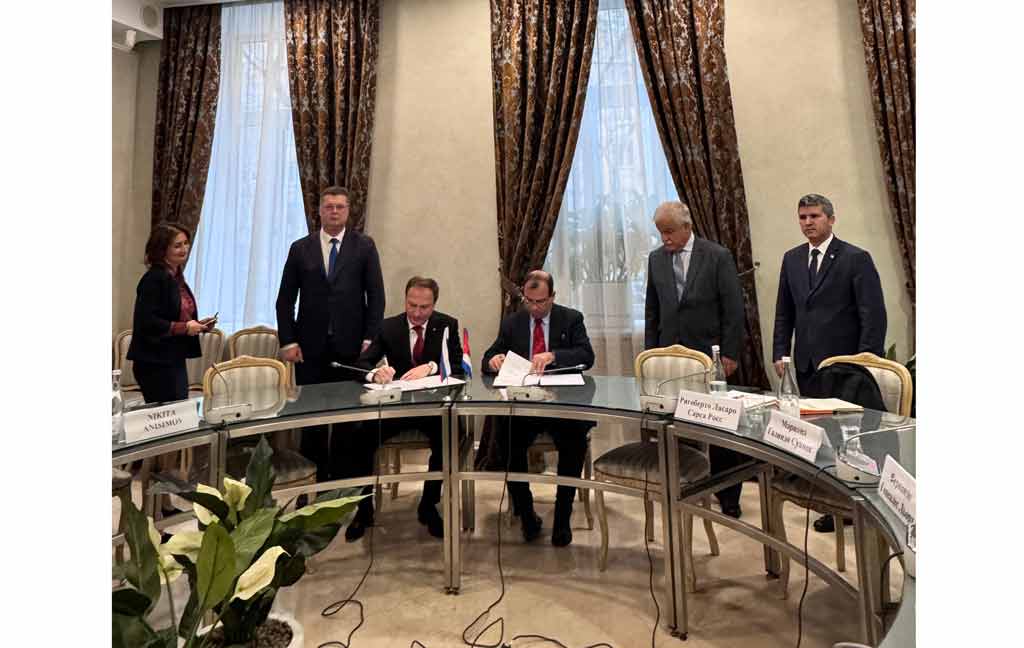
After this symbolic moment, Gonzalez and his accompanying delegation went to the headquarters of the Civic Chamber of the Russian Federation, where the two institutions signed a Memorandum of Understanding (MoU).
Alexander Shkolnik, Deputy Secretary of the Civic Chamber, signed the document on the Russian side. The text intends to expand cooperation relations in several fields and continue working for common Russian and Cuban causes.
Cuban Ambassador to Russia, Julio Garmendia, and ICAP European director Rigoberto Zarza attended the ceremony.
In this final stage, the ICAP president will attend the International Conference on the 60th Anniversary of the Russian Society of Friendship with Cuba, where he will deliver a letter of recognition to the organization sent by Cuban President Miguel Diaz-Canel.