Nov 27 (Belly of the Beast) Of course, the war on Cuba didn’t begin with Trump. The U.S. has attempted to replace the Cuban government through a variety of means since the ‘60s.
During one of the 1960 presidential debates, Richard Nixon explained that the goal of U.S. sanctions was regime change. See the clip HERE.
More than six decades later, the same failed strategy — embraced by Trump and Biden — is still in place.
But Cuba is particularly vulnerable now, battered by the economic effects of Covid, worldwide inflation and a string of natural disasters.
See our on-the-ground report about the most recent hurricanes to hit Cuba.
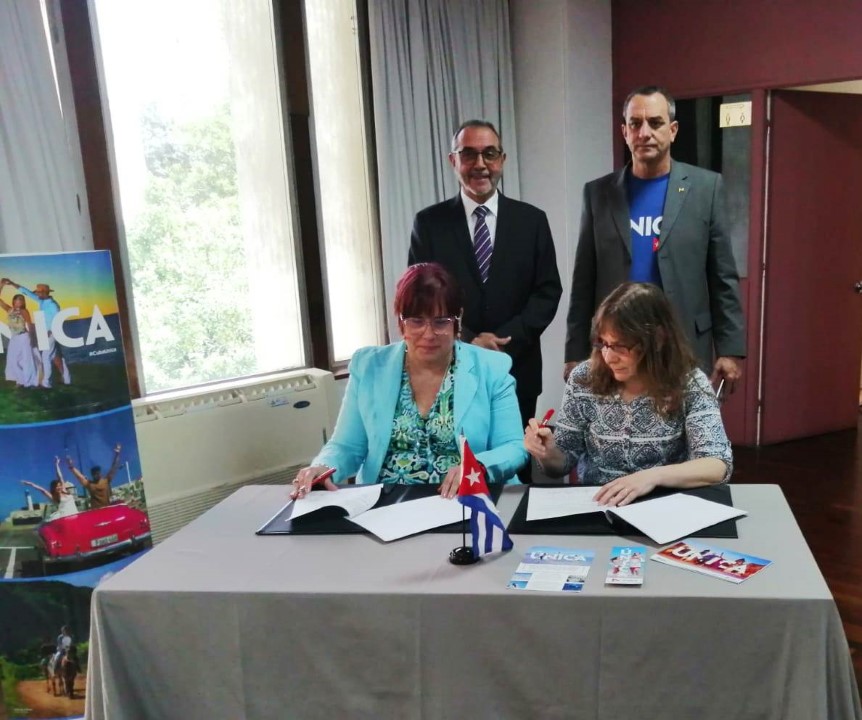
Montevideo, Nov 30 (Prensa Latina) Cuba has much to offer Uruguayan tourists, the island’s tourism advisor for South America, José Antonio Aguilera, told tour operators here on Friday.
Aguilera was speaking at the headquarters of the Latin American Integration Association (Aladi), before representatives of companies from the Uruguayan Association of Travel Agencies, Cuban residents here linked to travel and executives from Cubana de Aviación, the Cuban Airlines, who particpated via online.
Cuba is a unique destination, by virtue of its geography, climate, history, culture, gastronomy and, above all, its people, emphasized Aguilera.
He expounded on the qualities of the main destinations in the Cuban archipelago, including the Varadero resort, whose beach was recognized this year as the second best on the planet, he said.
Havana is the Latin American capital of cocktails, he added, referring to another awarded Cuban produce.
He stressed that his country is the birthplace of son, an also famous for its rum, international events tourism and health tourism.
Aguilera mentioned airlines connecting Uruguay with his country, such as Latam, Copa, Avianca and the Bolivian Boa.
As a novelty, he announced the upcoming visit of a delegation from Cubana de Aviación, on an exploratory mission that could lead to reopening flights to South America.
The Cubana delegation is to meet with Uruguayan tour operators on December 6.
For her part, the Cuban consul, Yamila Herrera, explained that the electronic visa to Cuba active since July offers additional facilities.
We want many Uruguayans to travel to Cuba, said in closing remarks Cuban ambassador Jorge Martí, permanent representative of the island before Aladi and president of the Committee of Representatives of that integrative association.
Los Ríos governor received Cuban ambassador to Chile
Havana, Nov 30 (Radio Habana Cuba) The governor of the Los Ríos region, Luis Cuvertino, received today the Cuban ambassador of Cuba, Mercedes Vicente, who is attending the national meeting of solidarity with her country, in the city of Valdivia.
At the meeting, the two discussed the historical ties between the two nations, dating back to the time when Chilean citizens participated in the Cuban wars of independence against Spanish colonialism.
The diplomat also recalled the friendship that existed between the president of the Popular Unity government, Salvador Allende, and the historic leader of the Cuban Revolution, Fidel Castro.
In a statement to the press, Cuvertino described the meeting as very pleasant and expressed that this visit will create a permanent platform for collaboration in various fields, including culture.
The choice of Valdivia as the venue for the meeting of the Solidarity Movement is significant, as Cuba sent its first medical brigade to Chile in 1960 to assist the victims of the 9.5 magnitude earthquake.
The political advisor and head of the foreign ministry, Raúl Mojena, and the first secretary, Rosario Rodríguez, were also present at the meeting. (Source: Prensa Latina)
Nov 27 (Belly of the Beast) On Thanksgiving Day in 1999, five-year-old Elián González was found alone on an inner tube off the coast of Florida.
He’d left Cuba by boat with his mother, who didn’t survive the journey.
Elián soon became the center of an international custody battle between his relatives in Miami and his father in Cuba — a story that, to many, was emblematic of relations between the two countries.
Elián has given “only a handful of interviews since he was unwittingly thrust into the geopolitical spotlight as a boy,” PBS reported in 2023.
At a time when fear-mongering, hate-spewing rhetoric dominates political discourse in Miami, Elián’s message of forgiveness and hope stands in stark contrast.
“I know the U.S. people,” Elián told Liz. “I know they have a good heart and that it is worthwhile to continue fighting and appealing to them to help lift the sanctions currently imposed on our country.”
Cienfuegos, Cuba, Nov 27 (Prensa Latina) Cuban President Miguel Díaz-Canel visited production centers in Lajas municipality, in Cienfuegos province, as part of regular visits he pays to the territories to assess their socioeconomic development.
According to the Presidency of the Republic, Díaz-Canel’s work system allows him to participate in constant exchange with the people, party and government leaders.
In Lajas, the first item on the agenda of the head of State was a meeting with farmer Luis Alberto Pérez, near his sugar cane fields.
Pérez, who previously worked in the pork industry, has worked in sugar cane fields over the past four year. He explained to the president that success lies in the day-to-day work, in doing things well.
The farmer was accompanied by six workers of his farm, where he has ventured to use byproducts and has reported yields of 90 tons per hectare.
Díaz-Canel was interested in the sugar harvest in Cienfuegos province, where three sugar cane mills will be grinding from December to March, although one of them, considered the most comprehensive in the country, has already started its operations.
After the meeting, the president visited the Ciudad Caracas Mill, which is practically ready to start up operations on December 4.
Díaz-Canel extolled the preparation done and insisted on the need for the sugar cane mills to generate electricity outside of the harvest campaign as well.
The president, who was accompanied by the secretary of Organization of the Communist Party of Cuba (PCC), Roberto Morales, and provincial authorities, toured the sugar mill, which has guaranteed its workforce, including 51 young people.
Another item on his agenda was a visit to the La Planta neighborhood, a formerly illegal settlement, where homes have been legalized, electricity has been supplied, communications services have been provided, and houses have been rehabilitated.
Díaz-Canel met with local residents about the need for popular participation and inquired about the state of basic services on the territory.
He referred to the harmony among neighbors and how it is demonstrated every day that despite the difficult economic situation, progress can be made in the well-being of the people.
Díaz-Canel also talked with citizens who were waiting for him in front of the municipal PCC headquarters about the impact of the US blockade and the heroism of the Cuban people.
Havana, November 29 (Radio Habana Cuba) — With the motto “Equality, Equity and Social Justice,” the International Conference Decade of Afro-descendants Cuba 2024 will be held from December 9th to the 13th.
The international conference will take place at the Havana Convention Center and other venues, the organizers reported at a press conference on Thursday.
The first two days will take place at the important meeting center, with panels oriented to the National Program against Racism and Racial Discrimination and its 12 subprograms, in which the achievements, challenges and perspectives that each of them faces will be addressed.
Prior to the inauguration, on December 8th, the Cuban Civil Society Forum will take place at the Varona Convention Center of the University of Havana, to discuss issues related to the agenda of the meeting.
The delegates to the International Conference on Afro-descendants will talk with community residents and enjoy musical pieces of genres such as rumba, jazz and son.
Other visits include the Literacy Museum, a primary school and a special education school, located in Ciudad Escolar Libertad, in addition to the Enrique José Varona University of Pedagogical Sciences and the Cintio Vitier Community Project, focused on the visual arts.
The participants will also visit the Quintín Bandera Cultural Center and the Museum of the Rebel Slave in the province of Matanzas, according to the organizers.
Music, meetings of thought, book presentations on Calle de Madera in the Historic Center of Havana, among other initiatives distinguish a contest that advocates for the protection of the rights of people of African descent, recognizing their contributions and the preservation of their rich cultural heritage.
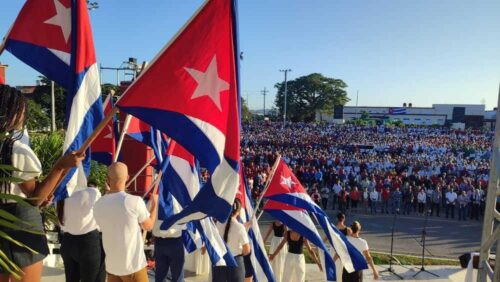
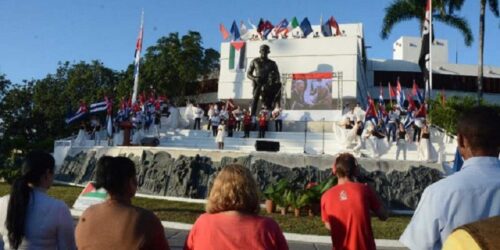
Sancti Spíritus, Cuba, Nov 29 (Prensa Latina) Cuban President Miguel Díaz-Canel chaired today in this central province of the country the Anti-Imperialist Tribune in defense of the cause of the Palestinian people, which was attended by thousands of Sancti Spíritus residents.
The president was accompanied by Roberto Morales, member of the Political Bureau and Secretary of Organization of the Central Committee of the Communist Party of Cuba, and by the highest authorities of the Party and the Government in Sancti Spíritus.
Students, workers and the general public gathered this Friday at the Plaza de la Revolución Mayor General Serafín Sánchez Valdivia to denounce the genocide of the Israeli occupation army in the Palestinian territory since October 7, 2023.
The central words of the event were given by Abran Sánchez, first secretary of the Provincial Committee of the Union of Young Communists, who pointed out that “History will not forgive the indifferent” and described this occupation as ruthless.
“The Zionists have waged an endless war,” he said, adding that “of the more than 40,000 dead, the majority are women, children and the elderly,” and then stressed that nothing can justify what is happening in Gaza.
“The world condemns Israeli barbarity against the Palestinian people. For this Palestine of dreams, for this Palestine of dignity and decorum, for its children and women, for the generous blood of its children, all our solidarity,” he concluded.
Caroline García, a sixth grade student at the Serafín Sánchez Valdivia Primary School, and Sanad Abdulralhmam, a Master and PhD student in Agricultural Sciences, from the sister Republic of Yemen, took part in the activity.
Caroline called for “the birdsong to be heard, not the sound of bombs,” while Sanad said that “every wound and every woman or child martyred shakes us to the core and encourages us to continue defending the cause of the Palestinian people.”
On behalf of the workers from Sancti Spíritus, Maidenly Toledo, from the Sancti Spíritus Meat Company, said that “Justice cannot be delayed any longer. Let the world see us and listen to us until one day Palestine finally has peace.”
The Plaza de la Revolución was filled this day with patriotic music and poetry, such as the one entitled Enamorado de Palestina, performed by the quartet A su Tiempo: Palestina, mi amor, and the power of the verse of the improvised poets, accompanied by the Parranda Espirituana.
As a grand finale, the emblematic song Cuba, how beautiful Cuba is was heard.
The Anti-Imperialist Tribune took place on the occasion of the International Day of Solidarity with the Palestinian People, declared on December 2, 1977 by the United Nations General Assembly.
Mexico City, Nov 28 (Prensa Latina) Mexican President Claudia Sheinbaum said today that she proposed to the elected president of the United States, Donald Trump, to end the economic blockades against Cuba and Venezuela imposed by that northern country.
Referring to the conversation held yesterday with the politician at her usual press conference, the dignitary pointed out that these fences “make people suffer and cause a phenomenon like migration.”
As a result of this US policy, Cuba suffered losses of 5,056.8 million dollars from March 1, 2023 to February 29, 2024, according to official figures.
In six decades, the damage caused by the blockade, condemned every year by the vast majority of countries in the United Nations, exceeded 1.499 billion 710 million dollars, taking into account the behavior of the dollar against the value of gold in the international market.
The march started from the steps of the University of Havana. Photo: Luis Jiménez Echevarría
Havana, November 28 (Radio Habana Cuba) — The First Secretary of the Central Committee of the Communist Party of Cuba (PCC) and President of the Republic, Miguel Díaz-Canel accompanied thousands of young people who took part on Wednesday in the traditional pilgrimage for the 153rd anniversary of the shooting of the eight medical students at the hands of Spanish colonialism.
Also present at the march, which started from the steps of the University of Havana to the monument that commemorates the vile murder, located at Prado and Malecón, were Roberto Morales Ojeda, member of the Political Bureau and Secretary of Organization of the Central Committee of the PCC; Meyvis Estévez Echeverría, first secretary of the National Committee of the Union of Young Communists, among other representatives of the Party, the Government and mass and student organizations.
The national president of the Federation of University Students (FEU), Ricardo Rodríguez González, referred to the pain that these events awaken, which affects Cuban youth today and their will to protest against any similar injustice.
He affirmed that those who intend to subdue the Cuban nation and hand it over to the anti-Martian project of servility will be opposed by this same youth that honors its dead and does not forget the cruelty of the crime and its perpetrators.
“We are called by the history of this revolutionary staircase and always an accomplice of the Cuban student movement and a platform of condemnation against injustices such as the blockade imposed by the United States Government and the Zionist genocide in Palestine,” he added.
For Diana Duhaldeborde, a second-year student at the Faculty of Medical Sciences at the ‘Comandante Manuel Fajardo’ Clinical-Surgical University Hospital, this particular page of Cuban history reaffirms the rejection of injustices by the new generations, both those that occurred a hundred years ago and those of today.
As a future doctor, she expressed her willingness to pay tribute with her professional conduct to the memory of those who fell then and proudly highlighted how this feeling expands with the humanist, supportive and internationalist vocation of the revolutionary process, embodied in her doctors.
On November 24, 1871, students of the first year of Medicine were waiting in the Anatomical Amphitheater for the arrival of their professor Pablo Valencia, who was to give a class, but upon learning that he would be late, several of them decided to attend the dissection practices of Dr. Domingo Fernández Cubas.
According to historical notes, some of them entered the cemetery, located near the school, and walked around its courtyards, since entry was not prohibited, and one of them, Alonso Álvarez de la Campa, took a flower that was in front of the cemetery offices, which provoked the anger of the caretaker, named Vicente Cobas.
He accused them of scratching the glass that covered the niche where the remains of the Spanish journalist Gonzalo Castañón, director of La Voz de Cuba, spokesman for the volunteer corps, who had been killed by a Cuban patriot in Key West, United States, rested.
The students were arrested and tried in a summary trial, but the verdict was not accepted, and a second trial was held in which it was determined to sentence the young men to the maximum penalty, while three others were chosen at random to satisfy the volunteers’ demands for blood.
The eight students sentenced to death were taken three days later, on November 27, 1871, to the esplanade of La Punta, where the execution took place, considered one of the most atrocious crimes committed on the island by Spanish colonialism. (Source: ACN)