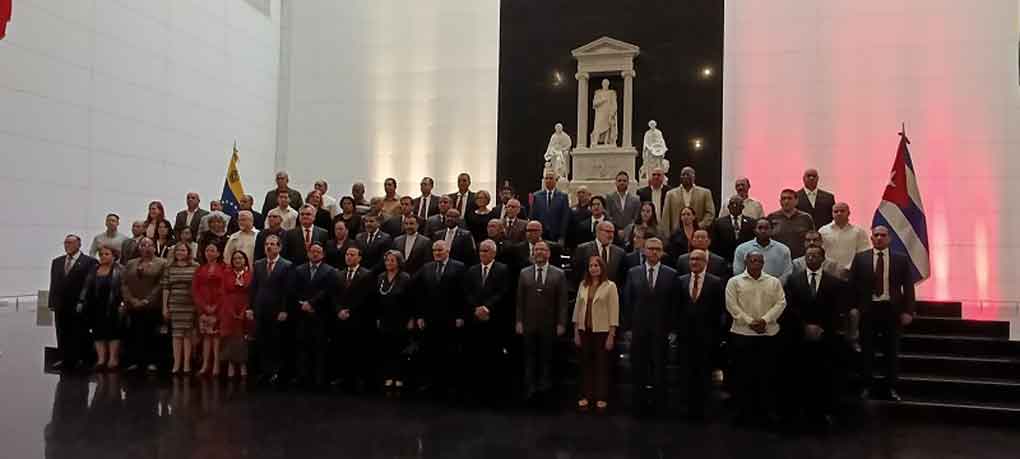
Havana, Dec 16 (Prensa Latina) The President of Namibia, Nangolo Mbumba, began an official visit to Cuba, which will last until December 18.
On his arrival, the day before, at the capital’s José Martí International Airport, the African president was greeted by Deputy Foreign Minister Anayansi Rodríguez.
The visitor will hold official talks in Havana with his Cuban counterpart, Miguel Diaz-Canel, and other officials of this Caribbean nation.
He will also receive the José Martí Order, the highest decoration awarded by the government of the Republic of Cuba.
Agreements are also expected to be signed that will foster bilateral ties.
Madrid, Dec 16 (Prensa Latina) Donations of medical supplies were ready today to be sent to Cuba from Spain, as part of a campaign of solidarity with the victims of Hurricane Rafael.
It is a cargo of 1.3 tons of medical supplies, with a value of approximately 300,000 euros, which was prepared by the Embassy of Cuba in Spain, together with numerous Associations of Solidarity with the Caribbean island.
Also participating in the initiative were the Movimiento Primero de Febrero, Rincón Cubano Granma, Asociación de Solidaridad y Cooperación para el Desarrollo Ernesto Guevara, Medicuba España, Comisiones Obreras de Madrid, Izquierda Unida, Partido Comunista de España de Madrid and Cubans living in the Iberian country.
The donation will soon be sent by air and will be received by the Ministry of Public Health, and distributed in the western provinces affected by Hurricane Rafael.
According to the organizers, this gesture of solidarity is another example of the bonds of friendship that unite the peoples of Spain and Cuba.
Cubans are grateful for the continued support it receives from solidarity movements and political parties, and appreciate “the tireless work they do to overcome the handicaps imposed by the unjust and inhumane blockade of Cuba by the U.S. Government.”
Mexico City, Dec 16 (Prensa Latina) As part of an agreement with the Mexican government, in the Sierra del Nayar, one of the most remote areas of Nayarit, Cuban doctors are guaranteeing health in populations where no specialist had ever arrived before.
It is a place of difficult access, with indigenous communities, where the island’s professionals have achieved a very high level of prominence, they have saved the lives of many newborns, the monitoring of pregnant women is at a high level and the rates of surgery have increased, explained Dr. Barbiel Nápoles.
The coordinator of the Caribbean country’s medical brigade in that state, located on the Pacific coast, told Prensa Latina that this group was the first from Cuba to arrive in the North American nation and did so on July 22, 2022 with specialists in Internal Medicine, Surgery, Pediatrics and Gynecology and Obstetrics.
Initially, the team had 60 professionals, and now totals 164, including cardiologists, ENT specialists, neurologists and coloproctologists.
“The relationship is wonderful. We have been welcomed with great love and affection by the people here in Nayarit. The objective is to continue the mission by bringing health to the most intricate area,” stated Nápoles, assuring that they will be there whenever their presence is needed.
He considered leading the brigade a challenge, but at the same time said that all its members are trained specialists and have become very well integrated into the medicine of this nation.
“We have shared our experiences, experiences in other countries, and we have learned a lot about medicine here,” said the head of the brigade of the largest of the Antilles in Nayarit, who highlighted the brotherhood with citizens and local colleagues.
We always think about “the ideals, about our people, about the fact that we can never disappoint the country that saw us born and shaped us as doctors and that has instilled in us that spirit of humanity, of solidarity that we will never disappoint,” he stressed.
During the conversation, Nápoles highlighted the ties between both countries and referred to several milestones, such as the presence here of the National Hero of Cuba, José Martí, and the expedition of the Granma yacht, which set sail in 1956 from Tuxpan guided by the historic leader of the Revolution, Fidel Castro.
“In the most difficult times of the present, Mexico has always been there to support us as the brothers and sisters that we are. And what better way to offer health to the people than in gratitude for all the support that this people has had for us,” he emphasized.
In his opinion, there are plenty of anecdotes that all specialists can tell about their time in peripheral areas.
“But the biggest story,” he said, “is that we have tried to bring health to this people with love, affection and a high scientific level, with all our heart. Many lives have been saved by Cuban doctors.”
As part of bilateral cooperation, there are currently more than three thousand specialists from the island in Mexico, who contribute to the health care of sometimes remote places, but also support the development of colleagues in this country.
Washington, Dec 15 (Prensa Latina) The Hands Off Cuba Committee of Los Angeles launched a campaign to collect medical supplies that will be sent to hospitals on the island, affected today by the intensification of the U.S. blockade.
According to the organization, which is part of the vast National Network on Cuba in the United States, the efforts that will be carried out for a month in Southern California are aimed at collecting funds or donating painkillers and anti-inflammatories.
The drugs will be sent to health centres such as Calixto García, the main trauma hospital in Havana.
In their call, the solidarity friends said that this whole situation is a consequence of the blockade – which has lasted more than six decades – and the decision of the United States Government to keep Cuba on the (unilateral) list of countries sponsoring terrorism.
The initiative will be supported by graduates from the Latin American School of Medicine in Havana in Los Angeles, local doctors, Not Just Tourists and Global Health Partners (GHP), the latter of which will cover the shipping costs to the Caribbean nation.
“We have just received news from GHP that Havana’s main trauma hospital, Calixto Garcia, has run out of all painkillers!!! A result of the blockade and SSOT (State Sponsors of Terrorism)!!!” the message stressed.
The NGO Global Health Partners and the Saving Lives coalition are also leading a campaign here to send vital devices required by heart patients, such as pacemakers, which are in short supply on the island due to the restrictions imposed by Washington, which prevents and hinders their acquisition.
This is one of the many projects to help the Cuban health system supported by solidarity within the United States. In addition, there is the Hatuey Project, which raises funds for the purchase of cytostatics for pediatric wards.
Dec 13 (Belly of the Beast) Journey inside the kitchen of celebrity chef Luis Ramón Batlle, an ambassador for Cuban cuisine. While U.S. sanctions impact the availability and cost of food, Chef Batlle says there is a silver lining: forcing creativity. “You become a magician, an inventor,” he says.
Batlle was part of the first delegation of Cuban chefs to visit the U.S. during the Obama opening. “It changed my life,” he says. But things changed when Trump became president. Cuban food culture, which was flourishing during normalization, has taken a hit from sanctions and other restrictions imposed by Trump and Biden. It is harder for Cuban chefs to travel to the United States, there are fewer visitors to Cuba and food is scarcer than ever.
Santo Domingo, Dec 13 (Prensa Latina) Cuban Deputy Foreign Minister Carlos Fernández de Cossío said here today that the rigorous application of the United States blockade to suffocate Cuba’s economy is damaging the standard of living of its population.
Cossío, who attended an international forum in the Dominican Republic on the occasion of the 30th anniversary of the Summit of the Americas, organized by the Ministry of Foreign Affairs of this country, reiterated the negative impact that the economic, commercial and financial blockade, the longest in history, has on that Caribbean nation and on its families.
During an exchange with the Cuban state mission in Santo Domingo, the Vice Minister spoke about the state of relations between Havana and Washington. He pointed out that this economic siege was tightened under the government of Donald Trump (2017-2021) and continued under the current administration of Joseph Biden.
He pointed out that Biden implemented all the measures imposed by his predecessor and will finish his term in January without any changes in the hostile policy towards Havana.
Regarding the mass deportation publicly announced by the upcoming Donald Trump administration, he considered it unrealistic to happen, and noted that there are immigration agreements that must be respected.
He also referred to the irregular treatment received at U.S. airports by Cubans residing in that territory and others who travel to the northern country, even when they live in third countries.
Fernández de Cossío described the atmosphere of the meeting held this week in the Dominican city of Punta Cana with the presence of several former presidents, foreign ministers and other officials as favorable. Lissette Pérez Pérez, a specialist from the General Directorate of Latin America and the Caribbean of the Ministry of Foreign Affairs, traveled to the Dominican Republic along with the Cuban vice minister.
The Dominican Republic will host the 10th Summit of the Americas in 2025; the 9th of these meetings, held in Los Angeles, United States, was marked by the absence of several regional leaders.
Some of them decided not to attend in response to the White House’s decision to leave the presidents of Cuba, Venezuela and Nicaragua off its guest list.
Moscow, Dec 13 (Prensa Latina) Cuba and Bolivia could join BRICS as partner countries as of January 1, 2025, Russian Deputy Foreign Minister Sergei Riabkov told the Izvestia newspaper.
“Both countries are part of the group that received an invitation. We are confident that everything will work out as partners,” said the Russian diplomat, who stressed that negotiations on the inclusion of the invited states of the group in the status of partners have not yet been completed, but Russia has not received any refusal.
“For all invited countries this is a big and serious prospect, there are only a few days left, after which the corresponding list will be made public,” the official added.
On October 23rd, Russian presidential adviser Yuri Ushakov reported that a list of 13 states that could become BRICS partner countries had been agreed upon.
Russian Deputy Foreign Minister Alexander Pankin said on November 15th that Thailand, Indonesia, and Malaysia had become partners of the BRICS. Another deputy foreign minister, Andrei Rudenko, noted that Vietnam had also announced its desire to join as a partner state.
Havana, Dec 13 (Prensa Latina) Foreign Minister Bruno Rodríguez on Friday rejected the position of the Government of the United States that persists in keeping Cuba on Washington’s State Sponsors of Terrorism (SSOT) list.
On his X profile, the head of Cuban diplomacy affirmed that US authorities know “as much as anyone, that Cuba does not sponsor terrorism. With full awareness, it lies about it to justify the adoption of harsh coercive economic measures of extraterritorial scope.”
Rodríguez considered this inclusion as “a dishonest act and a mockery of the victims of the scourge,” he wrote.
The Cuban diplomat pointed out, on the same network, that his nation has an exemplary record in the fight against terrorism and, in contrast, he questioned that the White House “cannot say the same of its own conduct.”
He asserted that there are voices opposed to the economic, financial and commercial blockade in the Congress of the United States, although the true nature of the anti-Cuba mafia is evident in that forum.
Rodriguez alluded to the recently-held hearing in the US Congress, in which Congresswoman María Elvira Salazar, a contumacious enemy of the Cuban people, demanded that Secretary of State Anthony Blinken maintain that policy unchanged.
Cuba’s inclusion in the unjust and unilateral State Sponsors of Terrorism (SSOT) list arouses the nearly total rejection of the international community, which has been ignored by the White House.
Havana, Dec 10 (Prensa Latina) The Cuban Foreign Ministry (MINREX) categorically rejected the No Stolen Trademarks Honored in America Act, and stated that it is a new unilateral coercive measure against the Caribbean nation.
In a statement published on its website, the Foreign Ministry pointed out that the law, promoted by anti-Cuba sectors in the US Congress, reinforces the blockade against the Cuban economy.
“This expands the scope of Section 211 of the Appropriations Act for fiscal year 1999, which, according to the Dispute Settlement Body of the World Trade Organization, infringes the international system of protection of intellectual property,” the MINREX said.
It also stressed that the legislation deals a new blow to the international system of protection of industrial property and confirms Washington’s contempt for the institutions of international law, in particular, the Agreement on Trade-Related Aspects of Intellectual Property and the Paris Convention for the Protection of Industrial Property.
The Cuban Foreign Ministry stated that the No Stolen Trademarks Honored in America Act provides a patent of marque that widens the path to consolidate the theft of Cuban trademarks legitimately registered in the Trademark and Patent Office of the United States.
The US Government’s attitude contrasts with that of Cuban authorities, who have always acted in strict compliance with the international agreements on intellectual property to which Cuba and the United States are party, the text stressed.
The information specifies that currently, 6,448 US trademarks are registered and protected in Cuba.
The Foreign Ministry indicated that with the approval of this norm, Washington once again provides space “to the dark interests of the most aggressive anti-Cuba sectors whose manipulation of the US political system has become a practice.”
The MINREX pointed out that the same thing happened in 1996, when “the infamous and colonial Helms-Burton Act, which some also called the Bacardi Act” was approved.
With great participation in the drafting of the Helms-Burton Act and the so-called section 211, Bacardi shares the responsibility for the suffering imposed on Cuba by those who do not accept the path of independence and sovereignty chosen by the Cuban people, the MINREX added.
Havana, Dec 12 (Prensa Latina) The Cuba-European Union (EU) Interregional Meeting for the Sustainability of the Santa Clara School opened here on Wednesday, aimed at pondering a number of collaboration agreements and promoting the study of restoration among youth.
Attended by 16 experts from Spain, Italy, Belgium and Austria, the forum will wrap up on December 13, after sharing good practices considering cooperation, in a bid to make the Santa Clara School an international center teaching restoration and heritage.
The forum opened with a welcoming speech by the director and representative of the UNESCO Regional Office in Havana, Anne Lemaistre, who was escorted by ambassador of the EU in Cuba, Isabel Brilhante, and the director of Heritage of the Office of the Historian of the City, Gladys Collazo.
In her speech, Lemaistre extolled late Havana Historian Eusebio Leal, who once embraced the dream that is likely to become a reality with the Transcultura project.
“Here I see here the workers who day after day bring this desire, this goal of Leal’s, into reality, imbued of the primary objective of training, professionalizing and offering employment opportunities to young people, said the UNESCO official.
Speaking to Prensa Latina, Lemaistre expressed that this three-day meeting stands out as a privileged moment.
“We have waited a long time for this meeting to happen, and the construction of a sustainability strategy for the Santa Clara School makes us very happy, as we expect that academic courses in arts and restoration will start in 2025”, indicated Lemaistre.
“There is also a possibility for countries in Europe and the Caribbean to send their students to Havana to learn how to restore, how to treat those Italian marbles preserved here in architecture since colonial times”, she said.