Rome, July 3 (Prensa Latina) The city hall of the Italian commune of Empoli welcomed the Hero of the Republic of Cuba, Gerardo Hernandez, to an event in support of the Caribbean nation, where they also condemned the US blockade.
Marco Papacci, president of the National Association of Italy-Cuba Friendship (ANAIC), emphasized that the event, presided over by Leonardo Masi, mayor of that town in the central Italian region of Tuscany, reaffirmed the close ties of brotherhood and solidarity between the peoples of both nations.
In his exchange with Hernandez, one of the five anti-terrorist fighters imprisoned for many years in US prisons for defending their country, Masi emphasized the goal of promoting actions to demand an end to Washington’s measures against Cuba, which violate human rights.
The Cuban hero, a Parliament member and of the Council of State, explained the repercussion of the blockade imposed by the US government for more than 60 years, which has severely impacted the island’s development and the lives of its citizens.
For her part, Marianna Gorpia, secretary of the Anaic circle in Empoli, noted that “in recent days, the blockade has been reinforced by the Trump administration, which included Cuba on the list of countries that finance terrorism, an unfounded decision and a historical falsehood,” with the aim of increasing pressure.
Gorpia also recalled the bond that has united Empoli and Cuba since the 1990s, thanks in large part to the association’s activities. “We have managed to carry out numerous projects, thanks in part to the willingness show by both the local mayor’s office and other regional institutions.”
In a message posted on social media, the mayor of Empoli expressed, following that meeting with Gerardo Hernandez, that “following the even greater restrictions imposed by the United States on June 30, 2025, we commit to the city council expressing its opinion on this matter again.”
NEW YORK — At a June 28 program here, sponsored by the New York-New Jersey Cuba Sí Coalition, Bob Schwartz, executive director of Global Health Partners, announced a national effort to raise $150,000 to send 150 pacemakers to Cuba. The effort is part of the Saving Lives Campaign. Cuba Sí has set a goal to raise $10,000.
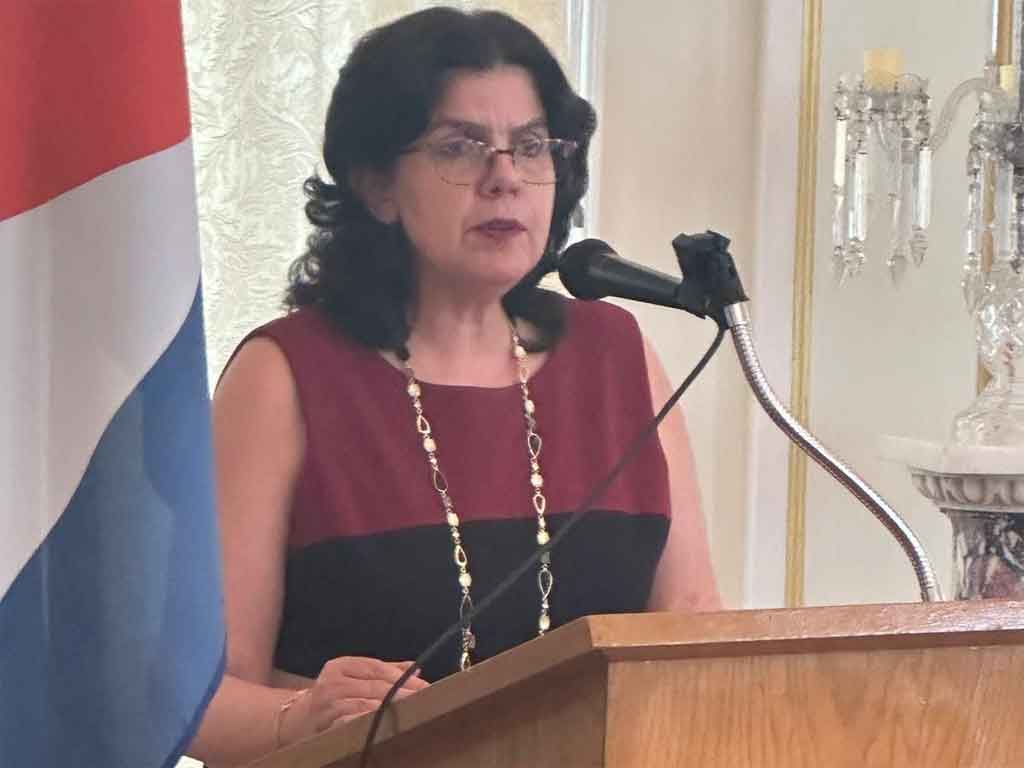
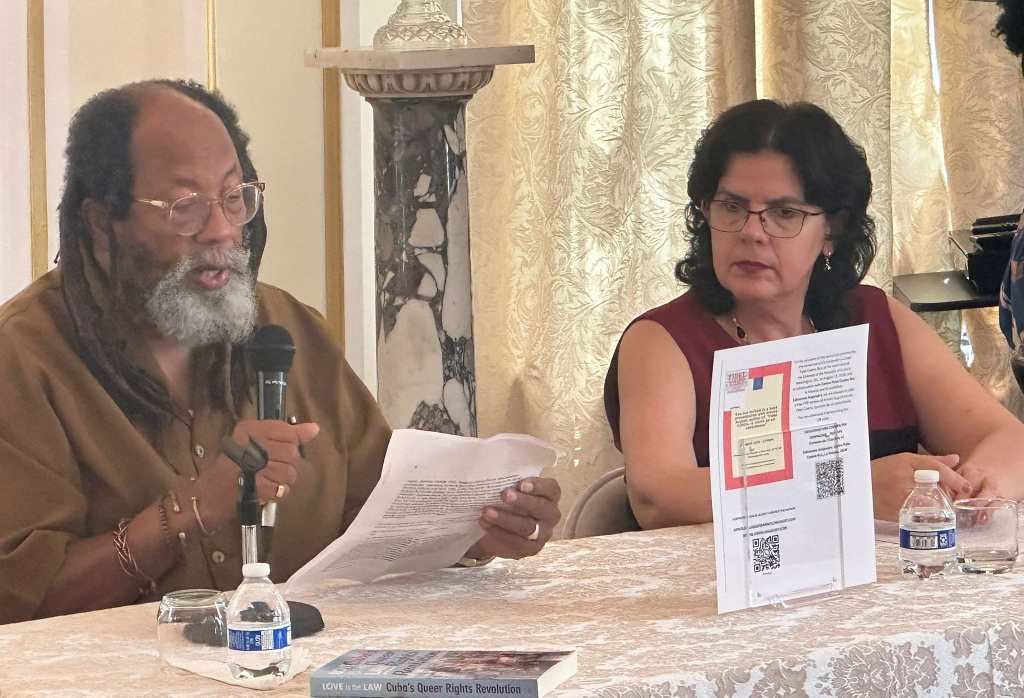
The featured speaker at the event was Ambassador Yuri Gala López, the deputy permanent representative of Cuba to the United Nations. Some 30 people attended.
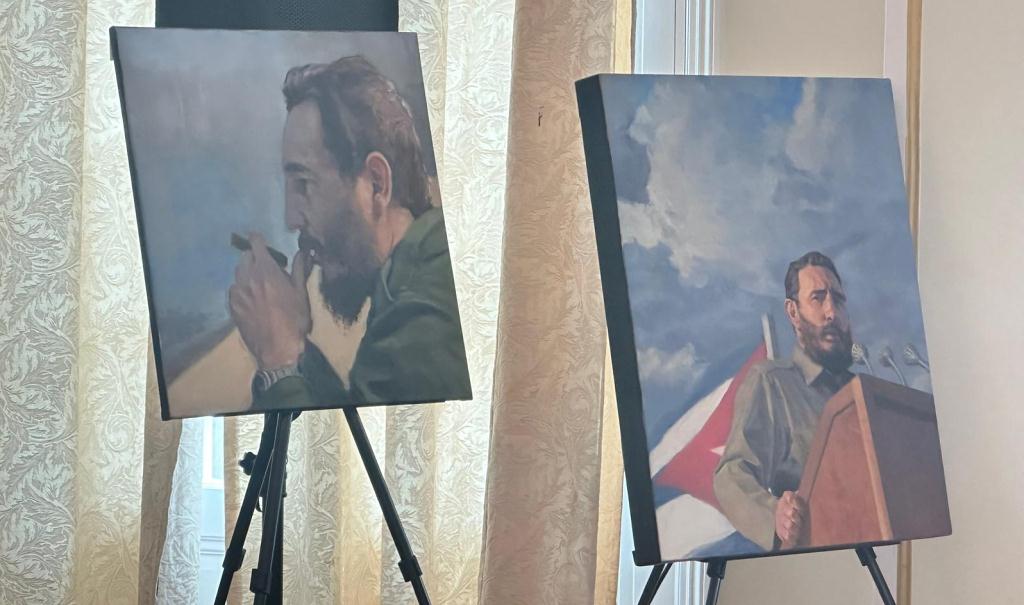
“Speaking about health care in Cuba means speaking about Fidel Castro,” Gala said. “From the very beginning of the Cuban Revolution, Fidel envisioned health care as a universal human right and an essential pillar of the revolution.” Health care in Cuba is free and accessible to all.
Cuba’s record in health care extends to its internationalist solidarity, he said. The Latin American School of Medicine has trained 31,000 doctors from 122 nations free of charge. Cuban medical professionals have served in 165 countries, often in the most remote areas.
For many countries, including Haiti, one of the poorest in the world, Cuban medical volunteers provide care at no cost, Gala said. Governments that can afford it, pay Cuba something. In these cases, the income helps fund Cuba’s free health care system.
The medical volunteers receive their regular pay, plus bonuses. “Our doctors have saved millions of lives,” he said.
Because of how the Cuban Revolution transformed conditions for working people, Gala said, Cuba’s health indicators are in many cases comparable to those in developed countries. But the impact of the U.S. economic war on Cuba for more than six decades, undermines the gains Cuba has made.
A few years ago infant mortality in Cuba was four deaths per 1,000 live births, Gala said. Because of the embargo, it’s now at seven. By comparison, in the U.S., the richest country in the world, it’s a little more than five.
“We have shortages in food, fuel, transport, medicines and technology,” he said, noting this was mostly due to Washington’s embargo.
Washington is also waging a “vicious disinformation campaign against the volunteer medical brigades Cuba sends abroad,” he said. U.S. officials outrageously say Cuba is engaged in “human trafficking,” and they’ve announced they will impose visa restrictions on anyone linked to the Cuban medical missions. Their goal is to smear the Cuban Revolution and cut off legitimate income. Their charges are “baseless and absurd.”
On June 30, just two days after the New York meeting, Trump signed a presidential memorandum announcing stepped-up attacks on Cuba, including tightening restrictions on travel by U.S. residents to the island.
‘From our hearts to Cuban hearts’
“Global Health Partners has been raising funds for medical supplies in Cuba for three decades,” Bob Schwartz said. He noted that during the COVID pandemic Cuba developed its own effective vaccines, but they needed 27 million syringes to administer them. “We took a goal of sending a million syringes to Cuba, but we ended up with 6 million, enough to vaccinate 20% of the population.
“As Ambassador Gala said, the embargo impacts every sector of the Cuban economy,” Schwartz said. “But above all it affects public health, especially children and the elderly.”
The event included a slide show on the 2025 May Day rally in Havana, and a new documentary by Belly of the Beast called “Teresita’s Dream: Cuba’s battle against Alzheimer’s.”
Other speakers included Brima Sylla, vice president of the Amazon Labor Union, and Colette Pean, from the December 12 Movement.
To contribute to the Saving Lives Pacemaker Campaign, make your check payable to Global Health Partners with “pacemakers” on the memo line, and mail it to: Global Health Partners, 39 Broadway, Suite 1540, New York, NY 10006. To pay by debit or credit card, visit ghpartners.org.
Table tennis World Cup winner Hugo Calderano has been barred from entering the United States because of a visit to Cuba in 2023.
The Brazilian, who had been expected to compete at the WTT Grand Smash in Las Vegas, confirmed he had been denied a visa in a post on his social media channels on Friday.
According to US regulations, any individual who has travelled to Cuba is required to obtain a visa, even if they qualify for the country’s visa waiver programme (VWP), which the 29-year-old does through his Portuguese citizenship.
However, if an individual has travelled to a country on the US’ list of state sponsors of terrorism – which includes Cuba, North Korea, Iran and Iraq – they are no longer eligible for the VWP.
Calderano had been in Havana, Cuba’s capital, for the ITTF Pan American Championships two years ago, where he won his fourth singles title.
Hugo Calderano in action during the men’s teams quarter-finals at the Paris Olympics. Photo: AP
“I followed the same protocol as all my previous trips to the United States using my Portuguese passport,” Calderano said. “When I was informed of the situation, I mobilised my entire team to obtain an emergency visa, but unfortunately, there was not enough time.
“It is frustrating to be left out of one of the most important competitions of the season for reasons beyond my control, especially coming off such positive results.”
The WTT Grand Smash events are the sport’s biggest competitions, equivalent to tennis’ grand slams, and represent a huge blow to Calderano’s ambitions.
In April, he won the ITTF Men’s World Cup in Macau, followed by a silver medal at the ITTF World Table Tennis Championships Finals in Doha a month later.
The withdrawal of fourth seed Calderano meant Chinese duo Liang Jingkun and Xiang Peng moved up a place each in the men’s rankings to fourth and ninth, respectively.
Meanwhile, two further withdrawals lower down the rankings saw compatriots Lin Gaoyuan move from 17th to 15th and Chen Yuanyu from 19th to 16th.
Former US President Joe Biden had removed Cuba from the list in January in one of his last acts before stepping down, but his successor Donald Trump signed an order banning nationals from 12 countries from entering the US and placed restrictions on seven others – which included the Caribbean island.
However, Trump said the ban would not apply to those travelling for major sporting events.
On July 2, the Cuban women’s national volleyball team also said they were denied visas ahead of their trip to Puerto Rico for the Women’s Final Four tournament.
Trump’s order, revived from his first term, fully restricts nationals of Afghanistan, Myanmar, Chad, the Republic of the Congo, Equatorial Guinea, Eritrea, Haiti, Iran, Libya, Somalia, Sudan and Yemen from entering the US.
The entry of nationals of Burundi, Cuba, Laos, Sierra Leone, Togo, Turkmenistan and Venezuela was partly restricted.
The Post has contacted the US Consulate General in Hong Kong for comment.
Dani Hernádez, NBC principal dancer and General Director of the National Ballet School in Cuba. VNS Photos Đoàn Tùng
Two principal dancers of Ballet Nacional de Cuba tell Việt Nam News how their dance careers took off.
July 5, 2025 — Việt Nam News
Enrolled to study at the National Ballet School of Cuba aged 13, Dani Hernádez is now the school’s General Director. Việt Nam News asks him about training a new generation of dancers.
Việt Nam News: What do you love most about dance as a career, as a professional dancer?
Dani Hernádez: Well, as a career, ballet is something extraordinary. Dance itself is one of the manifestations that allows human beings to express from within all the feelings and sensations they may have throughout their lives. In fact, dance is considered the first form of human expression as it evolved through the ages.
And that’s precisely what makes me happy. Ballet allows me to express all those feelings I have. It allows me to play characters I’ve never met, and through dance I can connect with those stories, with those great stages that humanity has had for so long.
There’s nothing more gratifying for a dancer after a performance than the applause of an audience. And that’s what fulfils us most, no matter where we’re performing, knowing that the audience understood, connected and was part of what we’re delivering. And that is despite all the physical effort, exhaustion, mental work and study.
So, is ballet your life?
Yes, ballet is my life. It’s what makes me feel happy with every step I take. And it’s what I’ll take with me everywhere in the future.
LIFETIME’S WORK: Dani Hernádez performs ‘Swan Lake’ with Viengsay Valdés at Hà Nội Hồ Gươm Opera House.
As a dancer, do you think you represent the best of Cuba?
Yes. Ballet itself is one of the main pillars of Cuban culture today. In fact, our small island State boasts one of the world’s great ballet schools: the Cuban School of Ballet. Today, I am not only the principal dancer trained by this school, but I am also the General Director of the National Ballet School of Cuba.
In Havana, there are over 200 students in that school alone. Nationally, there are seven schools: six in the provinces and one in Havana.
Ballet is very demanding. What is your secret to becoming successful – as a dancer, teacher, and now director?
The secret lies in the student’s perseverance. Just that: perseverance. Discipline, taking care of your body, knowing how to train each day, recovery times and consistent, daily work.
These were the lessons our teachers taught us; they are the lessons we uphold today and pass on to all new generations, both inside and outside of school. And this is what has made Cuban ballet recognised worldwide.
Cuba is a young ballet country compared to Europe or the US. What makes Cuban ballet special?
The Cuban Ballet School was the youngest to be established. First there was the Italian school, then the French, Russian, Danish, English and finally, the Cuban school. Since then, there have been no more officially recognised schools.
And that’s what makes Cuban ballet great: having its own methodology, developed by our founders Fernando, Alicia and Alberto Alonso, passed down through generations. And now, as director, it’s my turn to continue that legacy.
What’s your impression of Việt Nam? If you choreographed a piece about Việt Nam, what would it be about?
Well, this is my second time here. From the moment we arrived, we received very special recognition and attention from all quarters. The most impressive was the public.
When we first performed at this very theatre, the reception was like we were back on the big stages of Cuba, with the warmth of the audience, the interaction and the mutual understanding.
If I had to choreograph a ballet about Việt Nam, it would be about its people, its history, its perseverance in the face of adversity.
Yankiel Vásquez, NBC principal dancer.
Yankiel Vasquez, principal dancer of Ballet Nacional de Cuba, tells Việt Nam News what it means to be a dancer.
Việt Nam News: What do you like most about ballet as a career?
Yankiel Vasquez: What I like most, and what we all like most, beyond travelling, is that we’ve been to several countries, and they’re all different cultures. But the most important thing is that we make so many friends, and that’s what we’ll stay with for life.
You’ve travelled a lot, but can you name three places that impressed you the most?
Oh, I really like Spain. I really like Spain, followed by China and Việt Nam.
FAN FAVOURITE: Yankiel Vásquez performs ‘The Dying Swan’ in Hà Nội
What do you think about the people here in Việt Nam?
The way you treat your people since we arrived has been impressive. The human quality, and the way they’ve treated us.
Do you think dancers like you represent the best of Cuba?
Cuban dancers are spread all over the world. And wherever there’s a Cuban dancer, I think we’ll be the best representative because we’re always giving our best.
What is the biggest sacrifice you’ve made to become a professional dancer?
In my personal case, I left home at a young age. When you do that, you separate yourself from your family. It’s very difficult, because you struggle from a young age. It’s difficult, but at the same time, it makes us stronger.
That’s one of the greatest sacrifices I think I was able to overcome. It was like a 3-4 hour drive. I’d leave on a Sunday, stay all week, and return on Friday.
What did your parents do?
Well, my dad had already passed away and he was a grocer, and my mom was a housewife.
Do you remember your first time going to Havana to study ballet? Did someone accompany you, and were you sad or excited?
I just went alone. The first few days were sad, because I couldn’t go home. At least when I was in Pinar del Río, I could go weekly, so I’d be there for two days. But when I was in Havana, I went very rarely. Even when I joined the company, I couldn’t spend the holidays with them anymore. It was a very radical change.
Would you like to come back to Việt Nam and perform again?
Oh, of course. It’s been a very nice experience. And I’ve already said it: the treatment has been wonderful. I’m beyond grateful for that. VNS
July 3, 2025 – Post Independent – Serving Glenwood Springs and Garfield County, Colorado
Understandably, a growing number of Americans are dissatisfied with our expensive, dysfunctional health care system. We spend far more money on health care than any other country, yet rank far down the list of health outcomes. Our system is also dangerous—medical errors are the third cause of death in the U.S., following heart disease and cancer.
In looking for solutions, it’s important to look at successful health care systems in other countries. Today’s column is about health care in Cuba, based in part on an article that appeared in The Atlantic Monthly magazine a few years ago. The title is “How Cubans Live as Long as Americans at a Tenth of the Cost.”
Cuba certainly has its problems. But it is known for its medical education—which is free, like all education there. Free health care for all citizens is a constitutional right. In order to make this system work in a poor country like Cuba, the emphasis is on prevention–keeping people healthy, as opposed to the expensive “disease management system” that we have in the U.S.
The Cuban system is based on primary care, and Cuba has twice as many primary care doctors per capita as the U.S. does. Family doctors and nurses work in teams. They are assigned to live in a particular neighborhood, and care for everyone in that neighborhood. At least once a year the doctor sees each patient for whom they are responsible, in the patient’s home. Doctors are trained to talk about healthy lifestyle, such as nutrition, exercise and tobacco cessation. These check-ups also involve questions about jobs, social lives and living environment (which is easy to assess given the home visits). Doctors then put patients into risk categories, which determine how often they need to be seen in the future. If necessary, primary care doctors refer patients for specialty care.
In 2016 Cuba spent $813 per person annually on health care—in American we spent $9,403 ($14,570 in 2024). In spite of Cuba being a poor country, their average life expectancy is slightly longer than ours. Their number of years lived in good health surpasses ours, and their infant mortality is lower. Vaccines are mandatory, so they have one of the lowest rates of vaccine-preventable diseases in the world.
Of course, the Cuban system isn’t perfect. For example, people don’t have a choice of providers, and pay for doctors is low. Due to lack of money and the U.S. embargo, medical supplies and pharmaceuticals are sometimes hard to come by. Hospitals are often old and in disrepair. But maybe we in the U.S. can learn something from the good parts of the Cuban system.
The Atlantic article concludes by saying this: “While Cuba’s situation is far from ideal, it serves as an elegant counterpoint to the three-trillion-dollar U.S. health-care system[5 trillion in 2024]—which is controlled by corporations [privatized insurance, pharmaceutical, medical-device, and hospital systems] that drive people to pay exorbitant costs [either directly or through taxes]. Cuba offers a reminder that efficient healthcare can be provided at much less cost to the people—when the focus is on primary care and prevention.
Dr. Greg Feinsinger is a retired family physician who started the non-profit Center For Prevention and Treatment of Disease Through Nutrition. For questions or to schedule a free consultation about nutrition or heart attack prevention contact him at gfmd41@gmail.com or 970-379-5718.
Havana, July 3 (Prensa Latina) Cuban Foreign Minister Bruno Rodríguez today thanked Mexico and its president, Claudia Sheinbaum, for their continued rejection of the United States blockade against the Caribbean nation.
Thank you very much President @Claudiashein, for your support and for the
Mexico’s ongoing denunciation of the blockade that has lasted for more than 6 decades
maintained by the US government against the people of #Cuba, wrote the
chancellor in X.
In her regular press conference, the head of state recalled that Mexico has always opposed this US economic blockade, regardless of the political affiliation of the current government.
On June 30, President Donald Trump signed a Memorandum
Presidential reissues and amends a package of anti-Cuban measures
adopted during his first term that affect the people and the
The U.S. embassy in Havana posted a video on social media of U.S. Chargé d’Affaires Mike Hammer visiting Cuban beach resort Varadero. In the video, Hammer took a jab at the number of Russian tourists there.
“I’m still touring Cuba, this time in Varadero with my family,” reads a comment posted by the diplomat on the embassy’s instagram account. “I’m telling you I hear a lot of Russian.”
Hammer’s comments cynically overlooks how Russian tourism to Cuba has become increasingly noticeable in large part because tightened U.S. travel restrictions have intentionally driven away visitors from the U.S. and Europe.
U.S. citizens are prohibited from visiting Cuba as tourists. Despite this, people from the U.S. flocked to the island during Obama’s opening, traveling under authorized categories such as “people-to-people” travel.
U.S. citizens can still visit Cuba under similar categories (learn more about how HERE), but Trump’s policy, which included banning cruise ships from visiting the island, has resulted in a massive drop-off in U.S. travel.
Biden kept most of Trump’s “maximum pressure” strategy in place, which included listing Cuba as a “state sponsor of terrorism.”
One of the results of this designation — for which no credible evidence exists — is that it strips Europeans who visit Cuba of their U.S. visa waiver. For example, a tourist from England can fill out a simple online form before going to the U.S. But if they’ve set foot in Cuba, they would be barred from entry to the U.S. unless they go through the lengthy process of applying for a visa.
Watch our video and hear what European travelers think of the U.S. measure HERE.
Not only has the number of travelers dramatically dropped in the last five years, but many Cuban property owners and tour guides can no longer use U.S. booking companies.
Expedia’s license to operate in Cuba was not renewed this year. The company has suspended all Cuba bookings.
In the meantime, Airbnb has stopped Cuba services unless the hosts use a bank account abroad. Airbnb’s move may stem from the inclusion of Orbit, a Cuban state company that handles foreign transactions, on a U.S. government list of entities off limits for U.S. citizens and companies. According to hosts interviewed by Belly of the Beast, Orbit was involved in their payment process.
The aim of these measures is to wipe out tourism, which is one of Cuba’s main sources of foreign currency.
Since arriving in Havana, Hammer has been posting videos urging Cubans to talk to him about their “concerns” and dreams.
For Cubans working in tourism, U.S. efforts to sabotage travel to the island are a major concern.
But concerns that hold the mirror up to U.S. policy don’t seem to be of interest to Hammer. In a video posted on Facebook, Hammer is seen talking with some Cubans in the street in Varadero. When he was asked when Cuba would be removed from the U.S. government’s terrorism list, he simply walked away.
The 2017 memorandum reversed Barack Obama’s policy of engagement, and was the starting point for dozens of subsequent measures that smashed Cuba’s economy.
Joe Biden kept the core of those Trump sanctions in place until he finally revoked the memorandum on January 14. But Trump restored the memo on his first day in office.
As such, apart from the last six days of Biden’s presidency, Trump’s June 2017 memo has effectively been in place for the last eight years.
Cuba’s Minister of Foreign Affairs Bruno Rodríguez described the memo as “a clear example of the U.S.’s aggressive conduct,” which aims at “strengthening the economic siege and causing scarcity for the Cuban people.”
Watch our documentary series The War on Cuba to see what Trump’s first term and the Biden presidency meant for Cuba.
More of the same, with one addition
The new memo carries the same name as the one published in 2017 (NSPM-5). And its language is almost identical. But there’s one notable exception.
The 2017 memo ordered the secretary of state to identify and publish a list of Cuban state entities with which direct financial transactions would be off-limits to U.S. nationals and companies. The new memo calls for a list of Cuban state entities with which direct and indirect financial transactions would be banned.
It is not clear whether the list would be expanded. Nor is it clear what the impact of adding indirect transactions would be.
Like the old memo, the new one states that U.S. policy is to “support the economic embargo of Cuba,” deprive the Cuban government of funds, enforce a ban on U.S. tourism to Cuba and sanction specific government entities.
“It’s more of the same,” William LeoGrande, a specialist in US. foreign policy toward Latin America and professor of government at American University, told Belly of the Beast. “The new memo seems like nothing more than a continuation of the policy Trump adopted at the start of his first term.”
The document itself does not impose new sanctions on Cuba. But like the Cuba memo in Trump’s first term, it seems likely to pave the way for harsher measures to come.
Secondary sanctions in the pipeline?
Citing “a source with knowledge of the new regulations,” the Miami Herald has reported that the new memo will open the door to “secondary sanctions” targeting foreign companies that do business in Cuba.
However, the memo does not explicitly target foreign companies nor is it clear how it would allow for secondary sanctions.
According to LeoGrande, “indirect” sanctions are not the same as “secondary” sanctions.
“Secondary sanctions would target foreign companies that have no U.S. presence and therefore are not covered by current sanctions,” said LeoGrande. “Nothing in the memo precludes the administration from doing that in the future, but this memo itself does not have that broad a reach.”
Regardless of the new memo, Trump could issue an executive order sanctioning companies from third countries. Former U.S. Special Envoy for Latin America Mauricio Claver-Carone, until recently Rubio’s right-hand man on Cuba policy, indicated earlier this year that “modernized sanctions” aimed at third parties were in the pipeline.
More sanctions on foreign companies doing business in Cuba would be another blow to the island’s moribund economy. They could also create blowback for the U.S., since several of Cuba’s main economic partners are U.S. allies.
With Cuban-American hardliner Marco Rubio running foreign policy, the Trump administration’s doubling down on its “maximum pressure” strategy comes as no surprise.
Rubio was a driving force behind the Cold War-era approach toward Cuba during Trump’s first term. Less than two weeks after becoming secretary of state he confirmed the administration would embrace “a tough U.S.-Cuba policy.”
China on Wednesday slammed the “barbarian” US blockade of Cuba, urging Washington to end sanctions on Havana.
“We urge the US to lift the blockade and sanctions,” Chinese Foreign Ministry spokeswoman Mao Ning told a news conference in Beijing, calling on the US to remove its designation of Cuba as a “State Sponsor of Terrorism.”
“Over the past 60 years, the US barbarian blockade and illegal sanctions against Cuba have severely infringed on Cuba’s right to subsistence and development and violated basic rules of international relations, which wreak havoc on the Cuban people,” the spokeswoman said.
The remarks from Beijing came after US President Donald Trump on Monday signed a memorandum to intensify economic pressure and restrictions on Cuba, which was slammed by Havana for “punishing the entire Cuban people.”
“We firmly support Cuba in following a development path fit for its national conditions, and oppose the US’ moves to abuse unilateral sanctions under the pretext of freedom and democracy,” Mao Ning added.
Trump’s move to sign the memorandum was one of several decisions taken against the Cuban government, such as reinstating Cuba as a “State Sponsor of Terrorism,” and continuing efforts to reverse the Biden administration’s attempts to improve the relationship with Havana.
HAVANA — The Cuban women’s national volleyball team was denied a chance to play in a tournament in Puerto Rico following the new visa restrictions imposed by U.S. President Donald Trump.
The Cuban Volleyball Federation said last week that the team, comprising 12 athletes, a referee and several coaches, had their visa request denied and will be unable to attend the tournament later this month.
“The disappointment is huge because I train every day, every hour of training is leading up to this and dedicate myself to it,” national team player Laura Suarez told The Associated Press. “It’s really disappointing not to be able to participate in the competition, which is what I’ve been preparing myself for.
Cuba was scheduled to play in the NORCECA Women’s Final Four tournament in Manatí, Puerto Rico. The tournament includes Puerto Rico, Mexico and Costa Rica and it awards ranking points toward qualification for the Volleyball Nations League.
“We were focused on the competition because it’s right there,” said Dayana Martínez, another player. “Arriving at the embassy and being denied the visa affects us a lot because that competition gives us points to improve our ranking,”
The Cuban team’s coach, Wilfredo Robinson, said the decision means his team is likely to miss out on the Nations League.
“The competition grants points for each match and at the end it all adds up,” Robinson said. “In September, we have another tournament and if we get there needing to achieve 80 or 100 points we are not going to be able to do it.”
The United States added Cuba to a list of 12 countries with restrictions for entering the U.S. or its territories, effective from early June. It includes nationals from Afghanistan, the Republic of Congo, Iran, Venezuela and other nations.
“Denial of visas is part of a racist and xenophobic list of visa restrictions,” Cuban foreign minister Bruno Rodriguez wrote on his X account.
In a message sent to The Associated Press, the U.S. Embassy in Cuba stated that, according to its privacy policies, it could not comment on specific cases but that directives were being implemented to secure the borders and protect U.S. communities and citizens.
The Cuban women’s national team won back-to-back world championships in 1994 and 1998. It also won three Olympic golds in a row in Barcelona 1992, Atlanta 1996 and Sydney 2000.
The U.S. measures are likely to impact many more Cuban athletes who depend on international competitions, including some on American soil to qualify for major championships and the next Olympics scheduled to be played in Los Angeles in 2028.