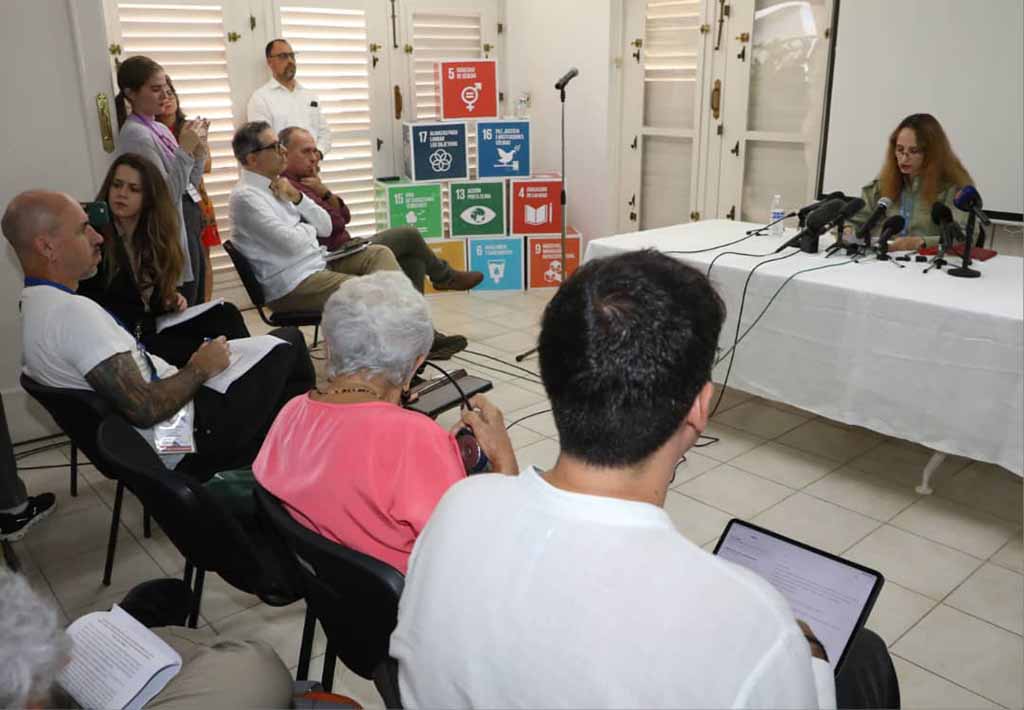
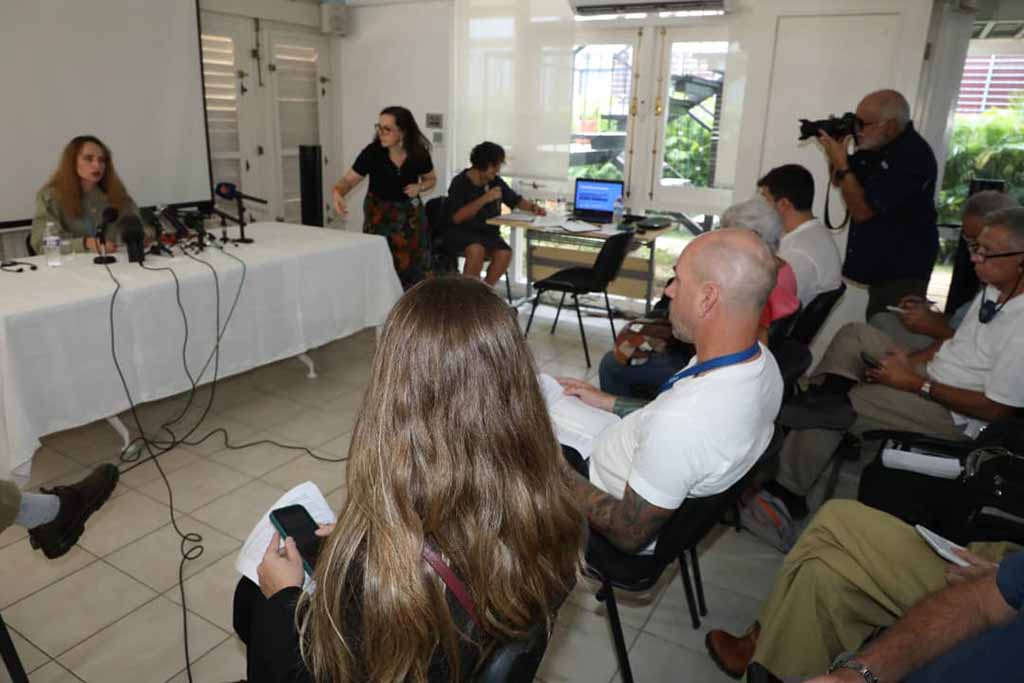
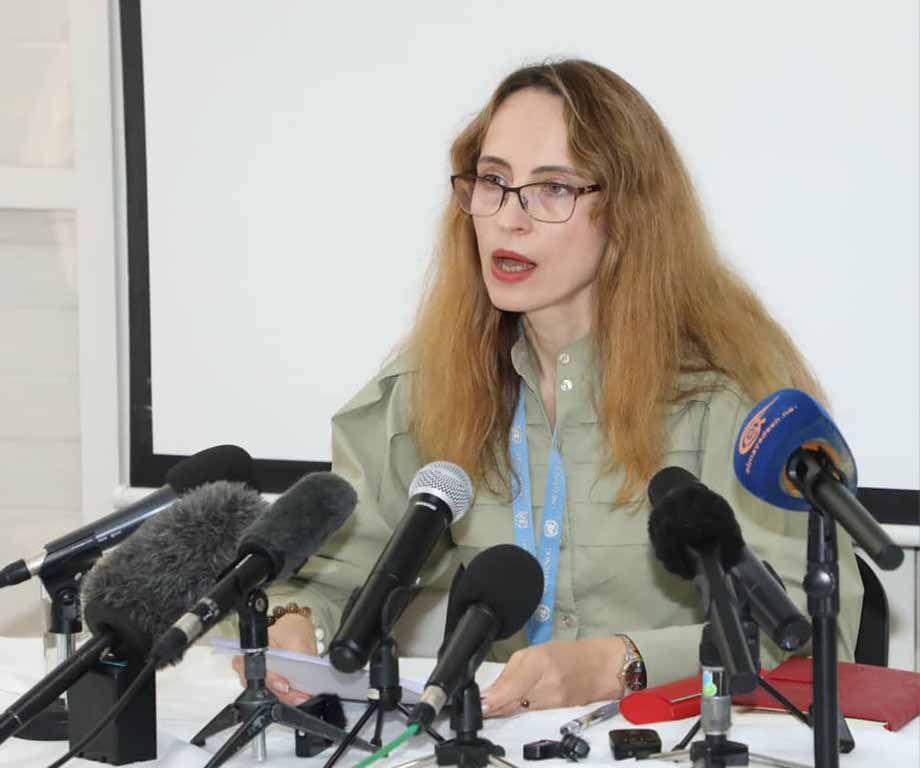
Havana, Nov 21 (Prensa Latina) The UN Human Rights Council’s Special Rapporteur, Alena Douhan, stated here today that the United States’ unilateral measures against Cuba lack legitimacy and affect the human rights of the population.
Photos: Vladimir Molina Espada
In presenting the preliminary findings of her investigations on the island to the national and foreign press, the official noted that such coercive actions affect all spheres of national life and directly harm its inhabitants, especially the most vulnerable groups.
He pointed out that these are especially damaging amid the problems the Caribbean nation is facing due to the international crisis, the onslaught of climate events, and internal economic difficulties.
He emphasized that the harmful effects of these are deepened by the politically motivated inclusion of the island in the State Department’s list of countries that allegedly sponsor terrorism.
Douhan recalled that since 1962 Cuba has suffered the US embargo, and this year that power extended the country’s presence on the aforementioned list, which causes serious economic damage and significantly hinders the efforts of the Caribbean nation to guarantee basic services and develop social policies.
In his visits and exchanges held since November 11 with various sectors of the country’s economic, political and social life, organizations, institutions and projects, Douhan witnessed firsthand the real impact of the blockade on the human rights of Cubans.
Such measures limit the State’s capacity to develop public policies, threaten the rights to food and a dignified life, hinder academic exchanges, affect the supply of energy, drinking water, and medicines, and violate the right to life in general, he pointed out.
In this regard, the report on the subject that it will present in September 2026 to the UN Human Rights Council will urge the United States to cease this unilateral policy “without international legal basis”, including secondary sanctions and the over-compliance with them.
It will also call on states and international organizations to adopt measures to guarantee the full enjoyment of the rights of Cubans, and to allow the development of programs that benefit other countries.
In his speech, Douhan thanked the Cuban government for the facilities provided to exchange with leaders, representatives of civil society, specialists, academics, international organizations and personalities from various sectors of the country’s economic, political and social life.
But with so many in need, Cubans throughout the country have also stepped up to support each other. The island’s grueling economic crisis makes this solidarity all the more striking.
“The moment we heard a hurricane was coming, we started thinking about how we were going to help,” one donor said. “The least we can do is share what we have.”
Watchour video about how Cubans andthe state are working to rebuild together.
Havana, Nov 18 (Prensa Latina) Cuban Foreign Minister Bruno Rodríguez reiterated today his country’s condemnation of the United States’ attempts to justify a military aggression against Venezuela with false pretexts.
In his profile on the social network X, the top representative of diplomacy for this Caribbean nation pointed out that this purpose of the State Department is being promoted “under the leadership of the corrupt and compulsive liar Secretary of State,” Marco Rubio.
In full view of everyone and with the support of the media, the aim is to normalize and legitimize an aggression against a sovereign nation, he pointed out.
He also stated that, as a dishonest artifice, they intend to implicate the legitimate Venezuelan president, Nicolás Maduro, in drug trafficking and terrorism.
The Cuban foreign minister emphasized that these serious international scourges have only been promoted in the region by the US government, its intelligence and drug agencies, and by individuals associated with all those politicians in Florida who call for attacks on Venezuelan territory.
The US Secretary of State announced last Sunday that the Cartel of the Suns, a criminal network that Washington is trying to link to the Venezuelan government, will be labeled a Foreign Terrorist Organization (FTO), which could lead to military action against that country.
The measure is an escalation of the United States’ stance, which includes the unprecedented deployment in recent history of warships, aerial and maritime robotic vehicles in Caribbean waters near Venezuela, under the pretext of fighting drug trafficking in the region.
Mexico City, Nov 16 (Prensa Latina) Musician Ethiel Failde mentioned the progress made today in Cuba for the cultural practice of danzón to be recognized as Intangible Cultural Heritage of Humanity and thanked Mexico for embracing this genre born on the island.
“As Cubans, we have that right, because the danzón originated in Cuba, because since 2013 it has been declared an Intangible Cultural Heritage of the nation, and we are working with a good team from Matanzas and from all over the country to prepare this dossier, which is already making progress,” he told Prensa Latina.
After participating in a discussion at the Museum of Mexico City, the great-great-grandson of Miguel Failde, creator of the rhythm in the 19th century, commented on the awareness workshops carried out in the largest of the Antilles.
“These activities will continue because this process of raising awareness among people about what cultural practice is, of feeling like a community that carries this cultural practice, is important so that everyone understands their role and their part in what we are achieving,” he explained.
When discussing how deeply rooted this rhythm is in Mexico, Failde expressed his pride, as it demonstrates, in his opinion, that a genre created in Cuba “has traveled the world and has come to conquer hearts.”
“It’s great that people know he’s Cuban, and that he hasn’t lost his essence. I’m very grateful to the Mexicans who have embraced him. Here in Mexico, he has his own repertoire and style, without ignoring that it’s a cultural practice” born in Matanzas, he noted.
Furthermore, the director of the Failde Orchestra expressed his satisfaction that Mexico City recognizes the genre as heritage, as it is something that has been inherited from generation to generation and the city is one of the places where these pieces are most danced and played.
“Thank you to Mexico for embracing our very Cuban danzón and for allowing many more people to discover it, fall in love with it, and experience it,” said the young flautist, who shared experiences in the country, such as seeing people dancing to that rhythm in a subway station.
Although he highlighted this North American nation as the “second most important focus in the world”, he also mentioned other territories, such as Colombia, Puerto Rico and the United States, where the genre is also heard.
This afternoon, the Failde Orchestra, along with the Mexican groups Acerina and La Playa, will provide entertainment for the Grand Danzón Dance in the emblematic Zócalo, a special event leading up to the declaration of Intangible Cultural Heritage in the city, promoted by the capital’s Ministry of Culture.
Organizers expect hundreds of couples from the 16 municipalities and the interior of the country to join together to celebrate this rhythm in a massive choreography.
Havana, Nov 12 (Prensa Latina) Cuba denounced today that the United States government is organizing, financing and executing a comprehensive program of economic warfare with the purpose of destabilizing the constitutional order in the Caribbean nation.
According to the challenge, revealed on the program Razones de Cuba, one of the cornerstones of this hostility is the scheme of currency trafficking and tax evasion on the island, with the use of operators of Cuban origin based in the United States and other countries.
The accusation directly targeted El Toque, a supposedly independent digital media outlet specializing in economic, legal, and public service information for Cuban communities, and emphasized that American taxpayer money was used in this operation.
The space revealed reports about the allocation of funds to the companies Media Plux Experience and Mas Voces Foundations, registered precisely in the name of the director of El Toque, José Jasán Nieves.
A portion of those funds, it was revealed, is used to promote leaders among non-state economic actors and to guarantee the illegal trafficking of freely convertible currencies in the Caribbean country.
Furthermore, actions from 2024 were presented involving the deputy head of Public Relations at the United States Embassy in this capital, Xavier Billingsley, and evidence of the participation of several citizens in operations to provoke an inflationary crisis in Cuba.
The complaint, those present asserted, confirms that, as announced at the end of last October by Foreign Minister Bruno Rodríguez, Cuba investigated the national inflationary phenomenon and gathered evidence of the comprehensive economic warfare program perpetrated from the United States.
Razones de Cuba is a web platform founded 15 years ago, oriented towards practicing journalism against the communicative matrices imposed by hegemonic media.
President Nicolás Maduro has been monitoring the support and assessment operations in real time. Photo: @JLBrocheLorenzo
November 11, 2025 — teleSUR
On Tuesday morning, the ALBA ship “Manuel Gual” arrived at the “Guillermón Moncada” port in Santiago de Cuba (east) , coming from La Guaira, Bolivarian Republic of Venezuela , with a cargo of 5,000 tons of humanitarian aid destined for the areas most affected by Hurricane Melissa , a gesture that deepens the solidarity and cooperation between both sister nations.
The docking maneuver took place at 06:45 local time at the container terminal in the harbor , as part of the coordinated actions between both Governments to strengthen solidarity cooperation in the face of natural emergencies .
The ship transported 102 containers with essential supplies, including 74 containers with food and 28 with medicines , drinking water , basic household items such as sheets, mattresses and bags, clothing, toys , water storage tanks , and electrical material intended for repairs and maintenance of the energy system in the eastern region.
On the deck of the ship, the flags of Cuba and Venezuela flew together , a symbol of the brotherhood and historical cooperation between both nations .
In an exclusive interview with teleSUR , the governor of Santiago de Cuba, Beatriz Johnson , president of the Provincial Defense Council , highlighted that this is the second shipment from Venezuela received after the passage of the meteorological phenomenon.
“ From the bottom of our hearts, as people of Santiago and Cuba, we are grateful for this help that comes to us at such an important and strategic moment for the life of the country ,” the official said.
Present at the event were Jorge Luis Broche Lorenzo , head of the Department of Attention to the Social Sector of the Central Committee of the Communist Party of Cuba (PCC), as well as the Venezuelan ambassador to Cuba, Orlando Maneiro Gaspar , and the Venezuelan vice-minister of Public Works, Domiciano Graterol , along with representatives of the PCC and local authorities.
Graterol reported that, in addition to the humanitarian aid, a Venezuelan brigade of 22 specialists in electricity, roads and transportation arrived, who are already working on the repair of critical infrastructure .
According to the official, after an aerial assessment tour , 17 destroyed bridges were identified , along with more than 100 kilometers of damaged roads and 14,000 affected homes , of which 5,000 were completely destroyed .
Venezuelan President Nicolás Maduro has been following the support and assessment operations in real time, requesting updated reports on the impacts and the progress of the joint tasks.
For his part, President Miguel Díaz-Canel Bermúdez toured the eastern regions just 24 hours after Hurricane Melissa (which struck Cuba as a Category 3 storm) passed through, accompanied by rescue teams, electrical brigades, and medical personnel. The Cuban head of state publicly thanked the Venezuelan people for their solidarity during what he described as a crucial time for national recovery.
Ambassador Maneiro Gaspar emphasized that the shipment represents ” the highest expression of humanity and brotherhood that has always characterized our peoples ” and recalled that Venezuela has been present in other times of emergency on the island .
Hurricane Melissa has been described by Civil Defense authorities as one of the most intense and devastating weather events to hit the Caribbean in recent decades . Within hours, the rains and winds caused severe flooding, destruction of homes and critical infrastructure, and disruption of transportation routes in Cuba’s eastern provinces.
Emergency operations allowed for the evacuation of nearly one million people with the support of helicopters, trains, buses, trucks, and boats . This preserved lives and resulted in no reported fatalities despite the devastation caused by the hurricane.
UN rapporteurs and bodies have expressed concern about the humanitarian consequences of the US blockade, considered the biggest violation of the human rights of the Cuban people.
November 11, 2025 — teleSUR
The United Nations Special Rapporteur on the negative impact of unilateral coercive measures on the enjoyment of human rights , Alena Douhan , began an official visit to Cuba on Tuesday, from November 11 to 21 , with the purpose of assessing the effects of the US economic, commercial and financial blockade and other unilateral sanctions imposed against the island on the enjoyment of those rights.
During his stay, Douhan will hold meetings with Cuban government authorities , as well as with representatives of international organizations, financial institutions, the business sector, academia and civil society organizations , according to the Office of the United Nations High Commissioner for Human Rights (OHCHR) .
The rapporteur’s mission will focus on identifying the sectors most affected by the sanctions , including secondary sanctions and cases of overcompliance , as well as analyzing policies and strategies implemented to mitigate their effects . The main objective is to assess the impact of these measures on the enjoyment of the economic, social, and cultural rights of the Cuban population .
At the close of the visit on November 21 , Douhan will hold a press conference at the International Press Center (CPI) in Havana , where he will present his preliminary observations . The final report will be submitted to the UN Human Rights Council in September 2026 .
This visit comes in a context marked by the persistence of the United States blockade , in place for more than six decades, which has intensified after the inclusion of Cuba on the US list of State Sponsors of Terrorism , a measure that the United Nations and various experts have requested be reversed.
On previous occasions, UN rapporteurs and mechanisms have expressed concern about the humanitarian consequences of these sanctions. In January 2024, several experts called for the lifting of the unilateral coercive measures , arguing that they directly affect the Cuban people’s access to essential goods, financial services, and technologies .
Alena Douhan , a Belarusian national, was appointed by the UN Human Rights Council as Special Rapporteur on unilateral coercive measures . Her mandate focuses on assessing the impact of unilateral sanctions on the enjoyment of human rights , particularly in countries of the Global South.
"The right to food is a vital right for survival and living in dignity for every individual around the world every day."
The special rapporteurs and independent experts of the Human Rights Council are not United Nations officials and do not receive remuneration for their work. They act independently and in their personal capacity , although they receive technical support from the Office of the High Commissioner for Human Rights (OHCHR) .
In recent statements, experts from the UN human rights system have expressed their dismay at Washington’s decision to maintain sanctions and the designation of Cuba as a “State Sponsor of Terrorism ,” considering that these measures violate the fundamental rights of the Cuban population .
Author: teleSUR – cc – JDO
Source: Cuban Ministry of Foreign Affairs – UN – Prensa Latina
Santa Marta, Colombia, Nov. 7 (Prensa Latina) The Cuban delegation attending the Latin America and Caribbean-European Union Civil Society Forum held here will defend the right to live without coercive measures, one of its members affirmed here today.
According to Norma Goicochea, president of the Cuban Association of the United Nations (ACNU), who spoke to Prensa Latina, representatives of the Caribbean nation will advocate for an end to the blockade imposed by the United States and will call for respect for the rights of Cuban families and all members of the population.
He added that the delegates will also denounce Cuba’s inclusion on the list of alleged state sponsors of terrorism and will seek solidarity to remove the Caribbean territory from that designation, which he described as illegal.
The official stated that they are attending the meeting with the aim of establishing links and further strengthening cooperation with civil society organizations in Latin America and Europe because there are many common points on which they can work together.
“We also believe that the forum should include statements that take into account the realities of our regions,” he noted.
Half a dozen delegates attend the meeting representing the Cuban Society of Agricultural and Forestry Technicians, the coordinator of the Network of Men Who Have Sex with Men, a member of the secretariat of the National Association of the Blind, and a member of the Martin Luther King Center.
Goicochea acknowledged that although it is a small group, it reflects the Cuban citizenry which, he stressed, is “plural, diverse, committed to the country project and which acts under the first article of the unitary Constitution with all and for the good of all.”
Colombia’s Foreign Minister, Rosa Yolanda Villavicencio, led today’s opening session of the Latin America and Caribbean-European Union Civil Society Forum, a space that seeks to strengthen citizen participation in global decisions.
The meeting, which concludes tomorrow and is being held at the Irotama Hotel, constitutes a space for dialogue prior to the celebration of the IV Celac-EU Summit, which will officially take place next Sunday the 9th with the attendance of 62 delegations representing both blocs.
Representatives of indigenous peoples, youth organizations, feminist movements and activists from the Lgbtq+ community, Afro-descendant leaders, as well as networks, platforms and non-governmental organizations, are invited to this meeting of civil society.
According to reports, the participants will put their conclusions into a Joint Declaration of Civil Society, which will be presented to the heads of state and government during the IV CELAC-EU Summit.
Harsh US sanctions push Cuba’s healthcare system to breaking point | People & Power Documentary
November 5, 2025 — Belly of the Beast
In our latest documentary, we speak with Cuban patients and healthcare workers who are struggling to get vital drugs and medical equipment – and look at the toll of the U.S. embargo inside Cuba’s hospitals.
Health Under Sanction looks at specific examples of medicines that companies have refused to sell the Cuban Ministry of Public Health since so-called “maximum pressure” U.S. sanctions were imposed by the first Trump administration.
The 25-minute film is directed by Ed Augustin and Reed Lindsay and produced by Belly of the Beast for People & Power, Al Jazeera’s award-winning investigative documentary program. Watch it now!
Cuba’s healthcare system was once a paragon, held up as an example of what was possible in the developing world. But all that has changed. Harsh US sanctions, reimposed by the first Trump administration, are making it difficult, if not impossible, for healthcare workers to access the drugs and equipment they need. Although designed to apply political pressure to the communist government, in reality, the sanctions hurt civilians the most. The infant mortality rate is rising, and life expectancy is falling.
The Trump admin pressured countries to oppose a UN General Assembly resolution calling to end the illegal US embargo against Cuba. Only 7 voted against it. 165 member states (85%) supported the measure.
A study by the firm Reputation Lab polled people in 60 major countries, and found that the United States has a very bad reputation. The US ranking fell from what was already a low rank of 30 out of 60 in 2024 to an even worse 48th place in 2025.
A clear demonstration of the political isolation of the US government can be seen in votes at the United Nations.
The vast majority of countries on Earth voted at the UN General Assembly on 29 October to demand an end to the illegal US blockade of Cuba, which has been maintained in blatant violation of international law for more than six decades.
165 countries, representing 85.5% of the UN’s 193 member states, voted in support of a resolution that emphasized the “necessity of ending the economic, commercial and financial embargo imposed by the United States of America against Cuba”.
Just seven nations, or 3.6% of the total, opposed the measure. These included the US and Israel — which vote against the resolution every single year — as well as Argentina, Hungary, Paraguay, North Macedonia, and Ukraine.
Another 12 countries, or 6.2% of UN member states, abstained. These were Albania, Bosnia and Herzegovina, Costa Rica, Czechia, Ecuador, Estonia, Latvia, Lithuania, Moldova, Morocco, Poland, and Romania.
The vote would have been 166 in favor, given that Venezuela expressed strong support for the resolution. However, the South American nation lost its voting rights, because it has not been able to pay the fees it owes to the UN, due to illegal, unilateral US sanctions and an embargo that have prevented Venezuela from accessing its foreign reserves and blocked it from the US-dominated financial system.
The United States has ignored these overwhelming UN votes for more than three decades.
In 2024, support for the resolution was even more overwhelming, with 187 votes in favor, and just two against (the US and Israel), with one abstention (Moldova).
Trump administration fails to pressure most countries to support the blockade of Cuba
Although it seems like the US got a few more countries to join it in voting against the resolution in 2025, this was in fact a big diplomatic loss for the Trump administration, symbolically showing how isolated the United States is on the global stage.
The Trump administration put a lot of energy and resources into pressuring countries around the world to vote against the resolution.
Reuters reported that the State Department, under the leadership of neoconservative war hawk Marco Rubio, ordered US diplomats in dozens of foreign countries to try to force their host nations to follow Washington at the UN.
This effort ultimately failed. Just six countries went along with the Trump administration.
This issue is a particular obsession of Marco Rubio, the second-most powerful person in the US government, who is simultaneously serving as both secretary of state and national security advisor.
Rubio’s parents were immigrants from Cuba, although he has repeatedly lied about their life story. Rubio long claimed that his parents fled communism. That is not true. They actually moved to the United States in 1956, years before the victory of the socialist revolution in 1959.
The US government did have some success in convincing several Eastern and Central European countries to abstain in the vote, in protest of Cuba’s alliance with Russia. Representatives of these governments falsely accused Cuba of sending troops to fight in Ukraine. This is not true. There are reportedly Cuban volunteers who have joined Russian forces in the proxy war against US/NATO-backed Ukrainian forces, but they were not sent by the Cuban government; they went of their own accord, seeking an opportunity to fight against the US empire that has long oppressed them.
Goal of US embargo against Cuba: “hunger, desperation, and overthrow of government”
The United States has waged a brutal economic war against Cuba for roughly 65 years.
The Associated Press noted that, “Of Cuba’s nearly 10 million residents, 80% have spent their entire lives under sanctions, which increased significantly during Trump’s first term, continued under his successor, President Joe Biden, and were tightened again after Trump returned to office this year”.
Less than two weeks after Trump returned to office as US president in January 2025, Marco Rubio published a press release announcing that he was “restoring a tough U.S.-Cuba policy”, by further tightening the suffocating blockade.
In June, Trump signed an executive order boasting of increasing harsh US punitive measures aimed at destabilizing what he called Cuba’s “Communist regime”.
US government officials have admitted that the goal of the US sanctions and embargo is “to weaken the economic life of Cuba” and “to bring about hunger, desperation and overthrow of government”, through “economic dissatisfaction and hardship”.
In a 1960 State Department cable published by the Office of the Historian, the US deputy assistant secretary of state for inter-American affairs, Lester D. Mallory, wrote the following (emphasis added):
The majority of Cubans support Castro.
…
There is no effective political opposition.
…
The only foreseeable means of alienating internal support is through disenchantment and disaffection based on economic dissatisfaction and hardship.
…
every possible means should be undertaken promptly to weaken the economic life of Cuba. If such a policy is adopted, it should be the result of a positive decision which would call forth a line of action which, while as adroit and inconspicuous as possible, makes the greatest inroads in denying money and supplies to Cuba, to decrease monetary and real wages, to bring about hunger, desperation and overthrow of government.
CIA terrorist war on Cuba
In addition to the economic war, the United States has waged a terrorist war against Cuba for decades.
The CIA and other US agencies tried to assassinate Cuba’s revolutionary leader Fidel Castro at least 638 times, according to official documents.
In 1961, the CIA launched a failed assault on Cuba, known as the Bay of Pigs invasion.
The US also planned to use terrorist tactics to violently overthrow Cuba’s government, in a shadowy scheme called Operation Northwoods.
In the early 1960s, America’s top military leaders reportedly drafted plans to kill innocent people and commit acts of terrorism in U.S. cities to create public support for a war against Cuba.
Code named Operation Northwoods, the plans reportedly included the possible assassination of Cuban émigrés, sinking boats of Cuban refugees on the high seas, hijacking planes, blowing up a U.S. ship, and even orchestrating violent terrorism in U.S. cities.
The plans were developed as ways to trick the American public and the international community into supporting a war to oust Cuba’s then new leader, communist Fidel Castro.
America’s top military brass even contemplated causing U.S. military casualties, writing: “We could blow up a U.S. ship in Guantanamo Bay and blame Cuba,” and, “casualty lists in U.S. newspapers would cause a helpful wave of national indignation.”