Since Donald Trump assumed the presidency, the State Department has prevented dozens of Cuban athletes from competing in tournaments in the United States.
“No U.S. president has ever gone to such lengths to target Cuban athletes,” said Gisleidy Sosa, international relations director of Cuba’s National Institute of Sports, Physical Education and Recreation (INDER).
In June, for example, all 17 members of Cuba’s national women’s volleyball team were denied U.S. visas for a major tournament in Puerto Rico, according to INDER. Hear from the players themselves in OUR LATEST VIDEO.
Athletes or Terrorists?
The letter the Cuban women’s volleyball team received from the U.S. embassy in Havana said the denial was to “protect the United States from foreign terrorists and other national security threats.”
They were just the latest athletes to have their dreams punctured by a Cold War-era policy of hostility toward Cuba orchestrated by Secretary of State Marco Rubio.
Other victims include table tennis players, Cuba’s national men’s basketball team, senior track-and-field athletes, and a softball team composed of nine and ten-year-old girls…
ReadtheFULL ARTICLE on the de facto travel ban written by Dariel Pradas and Reed Lindsay.
Moscow, Sep 11 (Prensa Latina) The president of the Russian Society of Friendship with Cuba (SRAC), Alexei Lavrov, participated today in Crimea in activities commemorating the centenary of the leader of the Cuban Revolution, Fidel Castro.
According to Prensa Latina, the professor at the Higher School of Economics met in Simferopol with students from Crimea’s leading universities and active members of the SRAC, who discussed the Association’s 60th anniversary.
Lavrov, for his part, emphasized that 2026 will be a unique year for its memorable dates in Cuban history and Russian-Cuban relations.
First, the 65th anniversary of the manned space flight of Gagarin, the society’s first president, and his first visit to Cuba on July 26, 1961, will be commemorated.
The foundations of Russian-Cuban friendship were then laid, he stated, adding that a major cultural and historical festival will be held to celebrate this event, including photo exhibitions, documentary screenings, and other events.
Furthermore, on August 13, 2026, the entire progressive world, including the Russian Federation, will celebrate the centenary of Fidel Castro, Lavrov noted, emphasizing that the Crimean branch of the SRAC is the most active in Russia, and its activities are known even abroad.
It also meant that Crimean youth have a great interest in the culture, history, science, and art of the Island of Freedom.
“It’s very important to us that our young people are so active and want to develop grassroots diplomacy,” he noted.
In this regard, the head of the association on the peninsula, Irina Kiviko, noted that young people from that territory submitted more than 160 entries to the contest organized to commemorate the SRAC’s 60th anniversary.
The students not only wrote creative works about Cuba, but also drew pictures and sang popular Cuban rhythms.
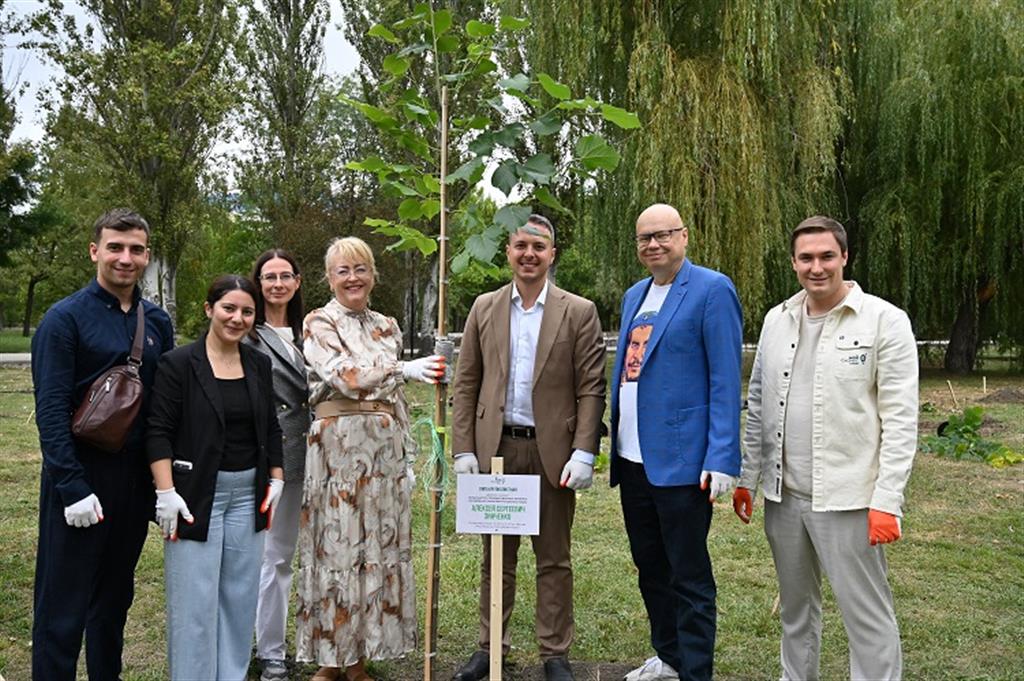
At the conclusion of the meeting in Simferopol, the participants headed to Gagarin Park in the Crimean capital, where they planted a linden tree symbolizing the growth and prosperity of Russian-Cuban friendship.
Alejandro Gomez Vega, Vice President of Cuba’s Prensa Latina news agency and Editor-in-Chief of Vietnam Pictorial Nguyen Thang sign a cooperation agreement on printing and distributing the Spanish-language edition of Vietnam Pictorial on September 25, 2023. (Photo: VNA)
Alejandro Gomez Vega, Vice President of Cuba’s Prensa Latina news agency, has hailed the Vietnam News Agency (VNA) as a bridge of friendship, fostering friendship and mutual understanding between Vietnam and nations worldwide, including Cuba.
09/09/2025
Havana (VNA) – Alejandro Gomez Vega, Vice President of Cuba’s Prensa Latina news agency, has hailed the Vietnam News Agency (VNA) as a bridge of friendship, fostering friendship and mutual understanding between Vietnam and nations worldwide, including Cuba.
Talking with Vietnam News Agency (VNA) correspondents in Havana on the occasion of the VNA’s 80th founding anniversary and the 65th anniversary of Vietnam–Cuba diplomatic ties, Vega recalled that since Vietnam’s fight against French colonialism, the VNA has been a key information bridge for the Vietnamese Party, State, and people.
He noted the VNA is not only a national news agency with an extensive network of bureaus at home and abroad, but also an important source of information covering Vietnam’s major events and achievements across various areas.
He praised the VNA’s role in raising mutual understanding among peoples, particularly the enduring friendship between Vietnam and Cuba, which has been reinforced through various training and media exchanges.
Vega spoke of Vietnamese journalists who studied in Cuba, describing them as trailblazers who have kept this fraternal bond alive. One of the VNA’s important missions, he said, is to continue advancing this close relationship.
On the global stage, he underscored the VNA’s standing in international and regional media ecosystems, especially in Latin America. With bureaus in 30 countries and coverage across Vietnamese localities, the VNA delivers fast, trustworthy updates on global and regional developments. In Latin America, it enjoys a large readership, with hundreds of thousands hooked on its news wires and special publications, including the Vietnam Pictorial section of the news website.
The partnership between the VNA and Prensa Latina, Vega recounted, is a story of endurance, born in the crucible of wartime solidarity and sustained through current cooperation agreements. He acknowledged the successes they have shared but was quick to point out the untapped potential, particularly in the exchange of news, photos, videos, and other media that could amplify the reach of both agencies.
Looking forward, Vega struck a note of optimism, urging the two news agencies to deepen their partnership and explore new opportunities to serve their audiences and contribute to global development./.
Hanoi, Sep 10 (Prensa Latina) The Vietnam Red Cross expressed its gratitude today for all the support received for its fundraising campaign, which, it noted, has made Cuba the most popular trend on social media these days.
According to the latest report from the agency, as of 8:00 p.m. local time on Tuesday, two million seven thousand 375 contributions totaling 410.6 billion VND (approximately $15.5 million) had been received into the bank account set up for such purposes.
These gestures are not only a demonstration of support for the Cuban people, but also vivid proof of the unity, mutual friendship, and loyalty that unites both countries, the humanitarian social organization reflected on its Facebook page.
The organization itself emphasized that “every transfer of love had an impact on achieving these heartwarming numbers” and in a separate post stated that “the journey continues: may Cuba clearly feel Vietnam’s friendship.”
With the goal of raising 65 billion dong (2.47 million dollars), the campaign began on August 13, on the occasion of Commander-in-Chief Fidel Castro’s 99th birthday and in the context of the Vietnam-Cuba Friendship Year and the 65th anniversary of the establishment of diplomatic relations.
However, just 30 hours after starting, it reached the initially proposed goal.
According to Nguyen Hai Anh, President of the Vietnam Red Cross Society, this is the first time that an international campaign led by the Vietnam Red Cross Society has reached such a magnitude, both in terms of funds raised and number of participants, in such a short period of time.
Transparent and timely information on the amounts, the number of donors, and the active collaboration of national and local media outlets, as well as digital platforms (in Vietnamese, Spanish, and English), have been key to the program’s widespread dissemination, the VNA news agency reported.
At the campaign launch ceremony, Do Van Chien, a member of the Political Bureau of the Communist Party of Vietnam (CPV) and Chairman of the Vietnam Fatherland Front, emphasized that this action demonstrates the Vietnamese people’s tradition of humanity and the deep friendship between the peoples of both nations.
The program not only seeks to provide material support to overcome the immediate difficulties Cuba is facing, but also to strongly spread a message of empathy and international solidarity, Van Chien noted, reiterating that, under any circumstances, the Vietnamese people always stand with the Cuban people.
This, he emphasized, is a traditional connection of affection that spans 65 years and in which “fraternal affection has overcome all geographical distances and economic conditions to become an enduring spiritual value.”
Cuba’s Paris 2024 gold medallist Erislandy Alvarez made an impressive first appearance in the World Boxing Championships 2025 today on another day of top-class action that featured 64 bouts across six men and women’s weight classes.
Alvarez was never troubled as he cruised to a comfortable 5-0 victory over Oier Ibarreche Conde of Spain without losing a round on any of the five judges’ scorecards and will meet Orozbekov Almaz of Kyrgyzstan in the round of 16 on Tuesday evening.
His victory provided a boost to a Cuban team that has endured an uncharacteristically difficult start to the competition with five of their eight boxers having exited the competition.
The early session on day four saw the men’s light heavyweight (M80kg) competition ramp-up with 16 bouts in the round of 32.
The majority went to form as seven of the top eight seeds progressed to the next round however Bulgaria’s William Cholov sprung a surprise when he defeated Japan’s number five seed Go Wakaya. The see-saw contest was in the balance after two rounds, but a strong final round from the Bulgarian saw him win it 10-9 on all of the judges’ score cards to secure a unanimous 5-0 victory.
He will meet Aminiasi Saratibau of Fiji in the last 16 who progressed after his opponent Taj Essoghene Kagho of New Zealand was disqualified in the third round following repeated warnings from the referee.
It was followed by a classic contest between long term rivals USA and Cuba which saw America’s Bobby Gonzales secure a 3-2 split decision victory over Jorge Manuel Soto Napoles. The fight could have gone either way but an assertive round three from Gonzales, saw him get the nod from four judges to secure the narrowest of victories and set-up a last 16 clash with Croatia’s number four seed, Gabrijel Veocic.
Earlier in the session, the round of 32 in the men’s bantamweight session went to form as all eight seeds won.
The number one seed and Paris 2024 bronze medallist, Junior Alcantara Reyes of the Dominican Republic overcame a potentially tricky challenge from Tokyo 2020 flyweight silver medallist, Carlo Paalam of the Philippines, to move into the last eight where he will face Omid Ahmadisafa who is representing the Boxing Refugee Team.
Ahmadisafa, who is based in Germany, became the second member of Refugee team to win as he eased past Mohammed Almuwallad of Saudi Arabia to set-up a medal bout against the number one seed.
The evening session opened with eight bouts in the women’s featherweight (W57kg) division which has the potential to be one of the most exciting categories in the Championships and featured a number of boxers with impressive CVs.
In the first bout of the evening, Poland’s Paris silver medallist Julia Szeremeta showed why she is the number one seed in the weight class with a unanimous victory over Yan Cai of China.
Although she did not have it all her own way in round one, Szeremeta upped her game in the second and third and her constant switching between orthodox and southpaw frequently bamboozled her opponent and enabled the Pole to repeatedly cuff Cai with a series of left and right hands. She will meet Khazakhstan’s Karina Ibragimova in the quarter finals.
On her switching style, Szeremeta said: “It helps me to be able to change my stance, even though I didn’t utilize it much in today’s match, it certainly does hinder my opponents when I do this. They don’t know how I will attack. The battle played out just as I imagined, I was in full control, having fun with boxing like I always do, fighting from afar.”
One of the most highly anticipated fights of the evening saw two of this year’s World Boxing Cup winners, Jasmaine Jasmaine of India take on Brazilian number three seed, Jucielen Cerqueira Romeu.
The clash of styles, with both fighters preferring to counter punch, meant the contest never caught fire. In the end, Jasmaine, used her height and reach advantage to pick off her opponent as she secured a unanimous 5-0 victory and a place in the quarter-final against Uzbekistan’s Khumorabonu Mamajonova.
Speaking in the mixed zone after her bout, Jasmaine said: “In this fight we both focused on counter punches so my strategy was to use long punches whether I was going backwards or forwards.”
The evening session finished with 16 men’s welterweight (M65kg) contests across two rings.
Alvarez’s slick victory was the standout performance as once again the more established names dominated with seven of the top eight seeds progressing to the next round at welterweight.
In between the women’s featherweight and the men’s welterweight contests, the round of 16 in the women’s light-middleweight (W70kg) stuck to the form book with three of the four top seeds progressing.
The only one that failed to make it through was Polish number three seed, Barbara Marcinkowska, who lost on a 3-2 split to Chantelle Reid of England. Reid will box China’s Mengge Zhang for a guaranteed bronze medal in Wednesday’s quarter finals.
Tomorrow sees 64 bouts take place across the afternoon (12:00 GMT) and evening sessions (18:00 GMT).
Havana, Sep 8 (Prensa Latina) The Canto de Todos event will continue today at Casa de las Américas in Havana, a prestigious Cuban cultural center linked to promoting the best of Latin American song for six decades.
This Monday morning, the celebration includes a theoretical event with speakers from Cuba and Latin America, while in the afternoon, guests from nearly 10 countries will meet with writer Abel Prieto, president of Casa de las Américas.
Then, at 4:00 p.m. local time, the albums “Canto de todos (Concert Cycle at the Casa del Alba),” “Horizontes blancos (White Horizons)” by Jesusin, and “Yo quiero un país” (I Want a Country) by Amaury del Rio will be presented.
Another special moment in the commemoration of the 25th anniversary of Canto de Todos will be the presentation of the CD produced by the Ojalá label “Heréticas,” by Vicente Feliú (1947-2021), one of the main promoters of these gatherings.
According to the program, this Tuesday, an exhibition celebrating the 50th anniversary of the Nueva Trova Movement will be inaugurated at the José Martí National Library. The event will be accompanied by a concert by singer-songwriters Augusto Blanca and Mario Sergio Mora.
Over the years, Canto de Todos has promoted cultural exchange through song in Latin America, and this time it returns to honor its founder: the prominent Cuban troubadour Vicente Feliú, whose 78th birthday is on November 11.
According to the event’s organizers, several institutions will be present at this event, which will include guests from Chile, Colombia, Peru, Argentina, Brazil, Venezuela, Costa Rica, Paraguay, Spain, Mexico, and their hosts from Cuba.
Concerts, presentations, thought-provoking gatherings, and community visits are included in the program for the event, which will be held at the Casa del Alba Cultural, the José Martí National Library, the National Museum of Fine Arts Theater, and the Casa de las Américas itself.
The event opened at the National Museum of Fine Arts theater last Saturday, with an opening concert featuring Brazilian singer-songwriters Pedro Luis and João Cavalcanti, sponsored by the Network of Intellectuals, Artists, and Social Movements in Defense of Humanity.
Under Feliú’s leadership, the Ibero-American Song Encounter took place in Cuba in 2000, which went down in history as Canto de Todos.
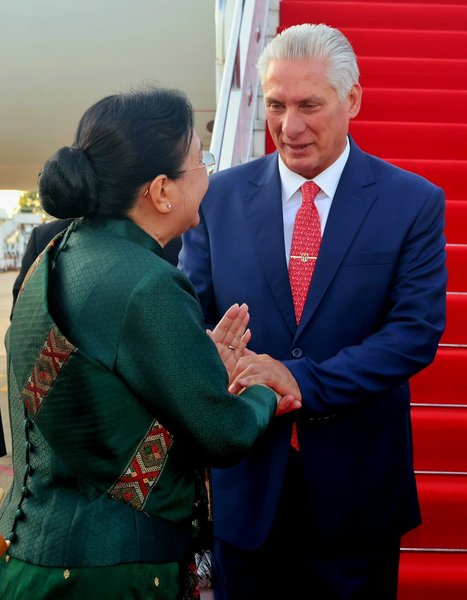
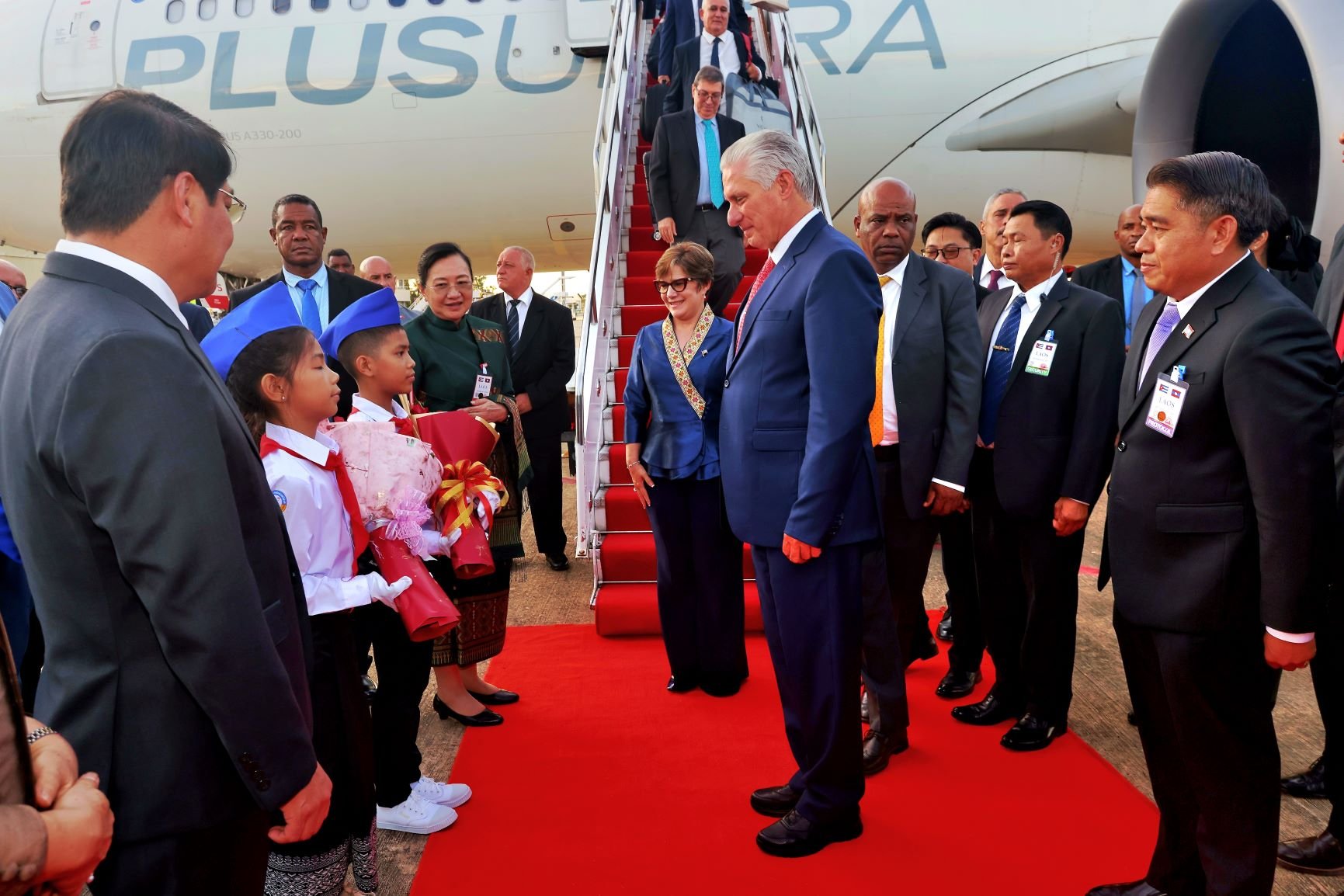
Vientiane, Sep 6 (Prensa Latina) Thousands of children and young people waving Cuban and Laotian flags greeted the arrival here today, for an official visit, of the first secretary of the Central Committee of the Communist Party (PCC) and president of the Republic, Miguel Díaz-Canel.
The Cuban president “was warmly and honorably received at the foot of the plane’s steps” by the head of the Presidential Office of this Indochinese nation, Khemmani Pholsena, according to Laotian media outlets.
Díaz-Canel’s visit, his first to the capital as the party’s top leader and head of state, is in response to an invitation from his counterpart, the secretary general of the People’s Revolutionary Party (PPRL) and Laotian president, Thongloun Sisoulith, with whom he will hold official talks tomorrow.
According to an official statement from the Cuban Ministry of Foreign Affairs, this trip by the Cuban president to Laos, as part of a tour that began in Vietnam and continued in China, confirms “the priority that Cuba places on fraternal and friendly relations with that sister, socialist country.”
Last July, the first deputy minister of that portfolio, Gerardo Peñalver, also traveled here on a working visit, where he co-chaired the Inter-Ministerial Political Consultations with his counterpart, Maythong Tammavongsa.
Both sides then emphasized the systematic nature of the political dialogue based on mutual trust, the broad common ground on approaches to the international agenda, and the ongoing willingness to exchange experiences on building socialism.
They also emphasized the valuable contribution of their foreign ministries to bilateral cooperation and the importance of political consultations, as well as the existing exchange mechanisms at the party and parliamentary levels.
On the occasion, Peñalver reiterated the gratitude of the Communist Party of Cuba, the Cuban government, and the Cuban people for Laos’ constant and unwavering support in the battle against the economic, commercial, and financial blockade imposed by the United States, and for denouncing Cuba’s unjust inclusion on the spurious list of state sponsors of terrorism.
This visit, the Foreign Ministry emphasized, reaffirmed the deep brotherhood and shared desire to continue strengthening the historic ties of friendship and cooperation between Cuba and Laos.
The fraternal ties between the two countries, which established diplomatic relations in early November 1974, date back to the late 1960s and early 1970s, when the first Cuban medical brigade arrived at the Viengsay caves in Houapanh province.
Havana, Sep 5 (Prensa Latina) Cuban Ambassador Alina Aldama and the Deputy Minister for Institutional Strengthening of Timor Leste, José dos Reis Magno, signed today the Cooperation Agreement between the two countries.
Also present at the signing of the agreement for the continuation of Cuban medical collaboration were Narciso Fernández, head of the Cabinet of the Political Plan for Cooperation and Development of East Timor, and senior officials from the East Timorese Ministry of Health, as well as Sergio Rabell, head of the Cuban Medical Brigade, and Minister-Counselor Pablo Romero.
According to statements from the Timorese embassy, this historic collaboration “has its genesis in the 2003 meeting in Kuala Lumpur between (the historical leader of the Cuban Revolution) Fidel Castro Ruz and Kay Rala Xanana Gusmao, the first Timorese president and current prime minister.”
Once again, the legacy of the Commander-in-Chief is confirmed, as well as the desire of the people of Timor-Leste to maintain collaboration in healthcare and education in this sector. This includes the training of professionals and specialists in both capitals through the exchange of experiences from the Cuban healthcare model, as a beloved symbol of the friendship between the two nations.
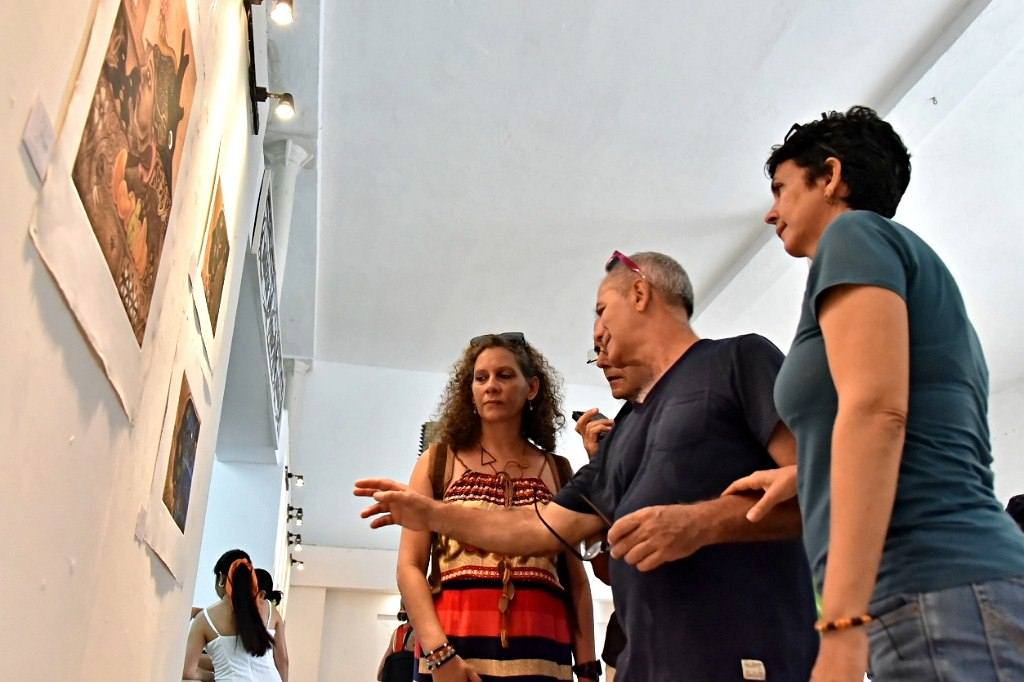
Havana, Sep 5 (Prensa Latina) The exhibition “Women of the Island,” by Mexican artist Enrique Flores, opened today in Old Havana. In it, the artist reflects his feelings of love for Cuba and the women born here.
The Experimental Graphic Arts Workshop received Flores’ works, and they are now on display in its Main Gallery as a tribute, celebration, and respect for the women of this country.
My work always keeps this being in mind, and the theme of them predominates in my work, as they play a predominant role, Flores noted.
I dedicate the exhibition to the Cuban people, but above all, to the women of the island because, as everyone knows, they are the driving force of society, he said.
I come from the generation of the 1960s in Mexico, and we grew up hearing news from the sister nation of this island. As time went by, we wanted to learn about the people here and their customs, but it was only a few years ago that I discovered Cuba, and I loved it, he commented.
The idea of exhibiting in this country is because the artist has joint works with Cuban institutions.
I want the people here to know my work, which isn’t anything special, but it’s made with a lot of love; for me, women are an important part of every society and every era, she noted.
There are historical passages that have been defined by women, and unfortunately, sometimes they don’t get the prominence they deserve, but they have made crucial decisions, and that has captivated me, she declared.
I don’t know when they coined the term “weaker sex,” because it’s quite the opposite, Flores concluded.
The Mexican artist plans to return to Cuba in January or February to work on several productions at the Taller Experimental de la Gráfica.
Mexico City, Sep 5 (Prensa Latina) Details of the 41st edition of the Jazz Plaza International Festival, scheduled to take place in Cuba from January 25 to February 1, 2026, were announced in this capital by its president, Víctor Rodríguez.
The prestigious event, under the artistic direction of Roberto Fonseca, will extend its performances to venues in different Cuban provinces, especially Havana, its main venue, and Santiago de Cuba, according to a press conference.
Also participating in the meeting were Samuel Fonseca Martínez, executive director of the Benny Moré Mexico-Cuba Cultural Center; Mario Escalona Serrano, general director of Prelasa; and Norma Rodríguez Derivet, cultural advisor at the Cuban Embassy in Mexico.
The organizers emphasized that Jazz Plaza has established itself as the most important event of its kind in the Caribbean nation, bringing together prestigious international figures and young talents each year in spaces that foster creativity, musical diversity, and dialogue between cultures.
According to reports, among the most anticipated offerings of the 2026 edition is an inaugural concert by maestro Frank Fernández, a symbol of Cuban piano, alongside students from the country’s art schools, on January 25 at the National Theater of Cuba.
Also considered top-notch performances are the concerts promised by pianists Ernán López-Nussa and Dayramir González, as well as composer and guitarist Héctor Quintana.
During the festival, a special tribute will be paid to the legendary Arsenio Rodríguez Group, and performances by Havana D’Primera, Alain Pérez, Isaac Delgado, and other renowned artists are expected.
The event will also include a wide range of musical genres, as was the case in the last edition, where more than 400 artists and five symphony orchestras participated.
The official poster for this 41st edition of Jazz Plaza is the work of maestro Sosabravo, one of Cuba’s greatest visual artists, who will celebrate his 95th birthday on October 25.
During her address, Norma Rodríguez Derivet, Cultural Counselor at the Cuban Embassy in Mexico, recalled that Cuba is known as “the Island of Music” and emphasized that, despite the difficulties imposed by the U.S. blockade, the Festival remains a space of resistance and international outreach.
He noted that the embargo has limited the participation of musicians from other countries, such as Puerto Rico, who will not be able to attend this time, although he reaffirmed the desire to maintain the diversity and spirit of unity that characterizes the event.