Havana, May 31 (Prensa Latina) Cuban President Miguel Díaz-Canel expressed his confidence in the Caribbean nation’s capacity to face and overcome the complex situation it is going through.
“If in difficult times Cuba has responded to great challenges, what can it not do when the context is less adverse,” the president said in his account on social network X.
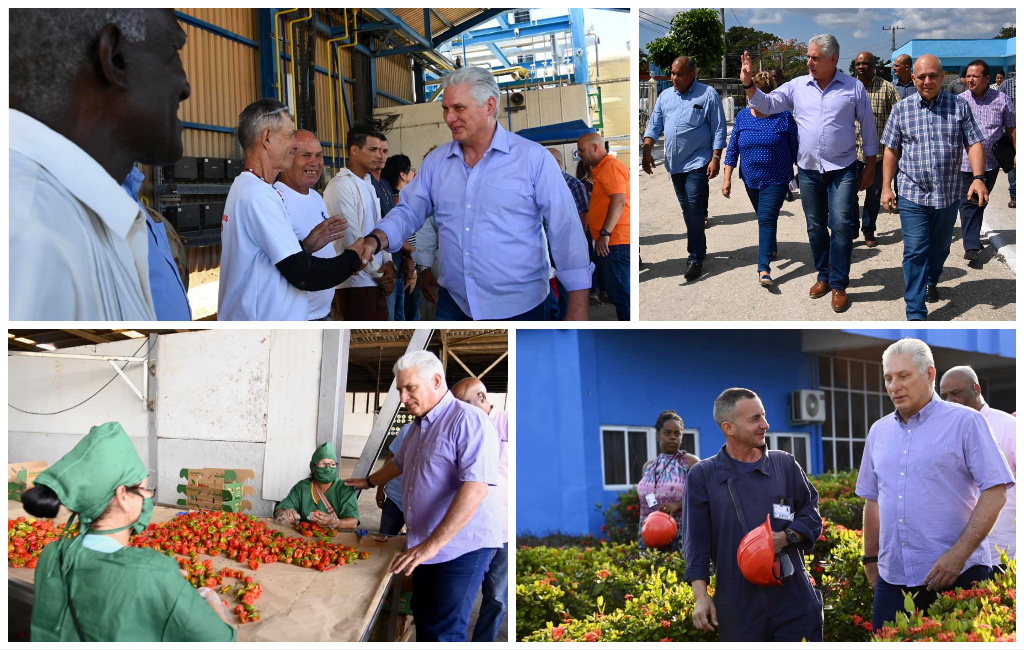
Such conviction, Díaz-Canel noted on the platform, was ratified during the visits that the country’s top leadership makes weekly to municipalities to evaluate good work experiences and learn about the status of economic and social programs in the territory.
This week, accompanied by the Secretary of Organization of the Communist Party of Cuba, Roberto Morales, the president visited the municipalities of Santa Cruz del Norte (Mayabeque), Jagüey Grande (Matanzas), Yaguajay (Sancti Spíritus), and Sagua la Grande (Villa Clara).
Colombo, May 29 (Prensa Latina) The Federation of National Organizations (FNO) of Sri Lanka sent a letter to the United States Ambassador to this country, Julie Chung, on Wednesday demanding Cuba’s removal from allegedly states-sponsor-of-terrorism (SSOT) list.
Every time the United States Department of State adds a country to that list, it is not with noble intentions but to lead to its destruction, says the letter signed by FNO Director Gunadasa Amarasekara and published on the Lankaleader website.
The Federation pointed out that Washington is playing the role of the world’s policeman to destroy Cuba in retaliation for being an example of government to the United States in the interest of the people.
It also considered that the unjust designation by the White House on Cuba also shows the fear of the US elite class that Cuba will become a banner of struggle for the economically, socially, and politically oppressed US people.
The Federation of National Organizations recalled Chung that Cuba’s greatest strength to stand firm is international solidarity.
It also stressed that it would always support Cuba’s claim until it is finally removed from that arbitrary list.
Havana, May 29 (ACN) The Cuba-related measures recently announced by the US government are limited, restrictive and do not affect the main core of the US blockade against our country, or other US high-pressure policy sanctions, said Cuban President Miguel Diaz Canel.
On his X account, the Cuban head of state wrote that the recently announced US moves do not eliminate or change the coercive measures affecting Cuban economy and public services, which have a hard impact on the wellbeing of the Cuban people.
The fact that such measures aim at a segment of the people reveals the historic intention to break the unity of Cubans, said Diaz-Canel.
He also said that the US concern on the development of the Cuban non-state sector is not genuine policy, which is in tune with a subversive design marked by well-known strategies like the manipulation and use of the non-state sector as a potential agent for change in the country.
As far as the strengthened US blockade continues to affect the Cuban people, the United States will not be able to prevent the world condemnation against that genocide using no bombs but aimed at devastating the admirable resistance of Cuba, Diaz-Canel noted.
The Cuban government will continue to promote the increasing integration of all local economic actors, which make up the milestone for the development of the country and the wellbeing of all Cubans.
On Tuesday, May 28, the US government announced a group of measures which, according to the release by the US Office for Foreign Assets Control (OFAC), aim to favor the private sector in Cuba.
HAVANA, Cuba, May 28 (ACN) During his official visit to Antigua and Barbuda, Cuban VP Salvador Valdés Mesa met with Gaston Alphonso Browne, Prime Minister of that Caribbean nation.
During the meeting, in which Valdés Mesa presented his host with a letter of invitation to visit Cuba and thanked him for Antigua and Barbuda’s continued opposition to the U.S. blockade, both leaders talked about the current state of bilateral relations and agreed to keep strengthening the thirty-year-old historic ties of friendship, solidarity and cooperation between the two countries.
On his end, Browne expressed his gratitude to Cuba for participating in the IV Conference of Small Island Developing States, as well as for the cooperation given to Antigua and Barbuda in terms of health care and human resource training.
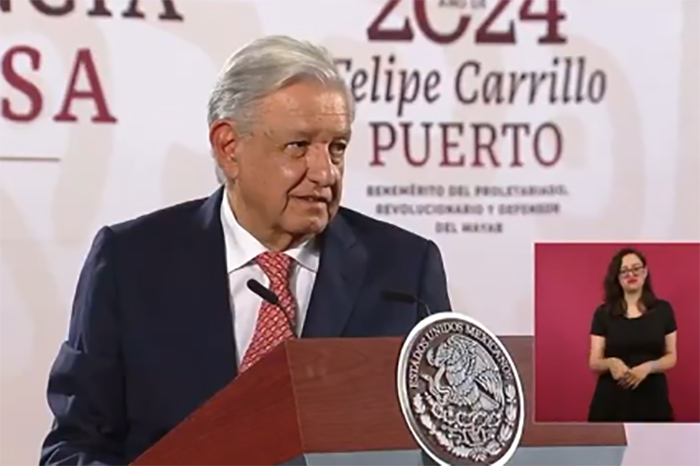
HAVANA, Cuba, May 28 (ACN) In a post on X, the Cuban Ministry of Foreign Affairs thanked Mexican President Andres Manuel Lopez Obrador for his pronouncement against the inclusion of the island on the spurious list of state sponsors of terrorism.
In its message, the Foreign Ministry shared a fragment of the Mexican leader’s usual morning press conference where he expressed his solidarity and support to the Caribbean nation and decried the U.S. blockade.
“What terrorism? Just an excuse (…) There are some people in the U.S. that get a lot out of the suffering of the Cuban people (…) and have made a lot of money with this extremist policy,” López Obrador said. “What I would like, as all the countries of the world have requested, is the end of the blockade of Cuba.”
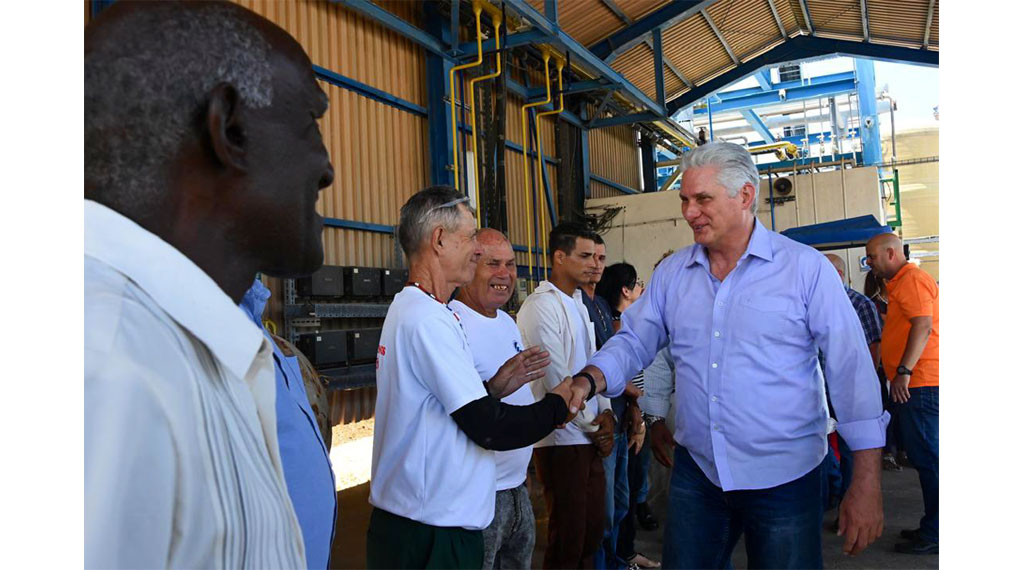
Havana, May 31 (Prensa Latina) Cuban President Miguel Díaz-Canel toured economic centers in Sagua la Grande municipality, in the central Villa Clara province on Thursday to learn about the status of local economic and social programs.
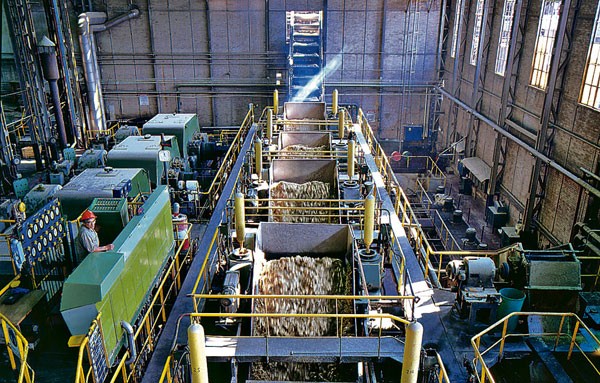
The Cuban Presidency reported on its X profile that the head of State visited the facilities of the Héctor Rodríguez Sugar Agri-Industrial Enterprise. He was accompanied by the organization secretary of the Communist Party of Cuba (PCC), Roberto Morales.
During a meeting with managers and workers, Díaz-Canel learned that the Villa Clara sugar mill is not fulfilling its production plan due to fuel and lubricant shortages, and the weather conditions at the beginning of the harvest.
The president was interested in the mill’s prospects, and its managers and workers committed to milling sugar as long as possible and contributing 2,000-3,000 tons of sugar, in addition to 7,000 tons already produced, the source noted.
“You have to mill all the old crops,” Díaz-Canel said.
The tour also included the Electrochemical Company (Elquim), the only one of its kind in Cuba, which produces chlorine and its byproducts for sectors like health care, aqueducts and tourism.
The managers of Elquim explained to Díaz-Canel the actions that have been taken to increase exports to the Caribbean.
The president inquired about the installed technology, which makes it impossible for chemicals to escape, so that the smell of chlorine cannot to be felt in the production plant, which surprised the visitors.
He also spoke with the workers about the stability of the workforce, the difficulties in obtaining packaging for some of the products and the production of food, the Cuban President wrote on X.
Díaz-Canel learned that although there are profits above the plan, it has not been possible to pay the profits to the workers, due to the expenses of the workers’ dining room area.
Faced with this problem, the group requested land for self-consumption and they have already planted 31 hectares.
On the other hand, at the UEB Taller Ferroviario 9 de Abril, the president praised the company’s new ways of doing things and its high technological capacity.
That company currently assumes the reconversion of buses known as Diana to be used as railway buses, and the first one is already traveling in Artemisa.
Saint John, May 28 (Prensa Latina) The imbalances of the international financial system do not provide the necessary stability to achieve the objectives of sustainable development and meet the needs of Small Island Developing States (SIDS), Cuban Vice President Salvador Valdés Mesa asserted today.
During his speech at the high-level meeting on resources mobilization for SIDS, based in this country, he stressed that the challenges presented are exacerbated exponentially for Cuba, due to the economic, commercial and financial blockade imposed by the United States for more than six decades.
Also due to the country’s arbitrary inclusion in the unilateral list of alleged state sponsors of terrorism, he added.
The Cuban minister indicated that in the current context, comprehensively addressing the financing deficit will require, among other actions: recapitalizing the Multilateral Development Banks and improving their loaning conditions.
Furthermore, it is necessary to fulfill, once and for all, the commitment of first world countries to Official Development Assistance, through allocations based on vulnerabilities, not just income, he noted.
He added that it is important to define SIDS’ access to concessional financing and technical cooperation and to comprehensively review the International Monetary Fund’s surcharge policy, including its suspension, significant permanent reduction or elimination.
In relation to this, he mentioned another action: implementing a specific service to support the sustainability of the debt of these countries, involving multilateral, official bilateral and private creditors, under the auspices of the United Nations.
The only viable solution lies in rethinking the unjust and unequal international economic order and the current bases that define North-South relations and life on the planet, highlighted the Cuban vice president.
During the day, the Cuban vice president also held a meeting with the Foreign Minister of St. Kitts and Nevis, Douglas Denzil, during which he highlighted the excellent state of bilateral relations, based on friendship and cooperation.
Valdés is attending, leading a delegation from the Island, to the IV International Conference of SIDS, which brings together senior dignitaries until next Thursday, to discuss the priorities and objectives in terms of progress and sustainability for this specific category of countries, of which Cuba is part of.
At the same time, the Cuban vice president makes an official visit, on the occasion of the 30th anniversary of diplomatic relations between both these nations.
As part of the bilateral program, he holds meetings with country authorities, representatives of solidarity, Cuban residents and aid workers.
Victoria, May 28 (Prensa Latina) The withdrawal of Cuba from the spurious list of countries that support terrorism was demanded today by the Seychelles-Cuba Friendship Association in a statement circulated here to the media.
The Republic of Seychelles is an archipelago of 115 islands in the Indian Ocean, in West Africa, and the text was issued to coincide with the non-inclusion of Cuba on the list of countries that do not fully cooperate with U.S. anti-terrorism efforts, announced by U.S. Secretary of State Anthony Blinken recently.
Cuba was added to the list of countries that support terrorism during former President Donald Trump’s term in office as a gift to his supporters from Republican politicians who control the majority of the electorate in the state of Florida.
We believe that it is a contradiction to remove Cuba from the list of countries that do not cooperate in the fight against terrorism, and at the same time maintain it on the list of countries that “sponsor terrorism.”
The text adds that this relation “is used to increase the economic sanctions against Cuba: This is a great injustice, which causes much harm and suffering to the Cuban people.”
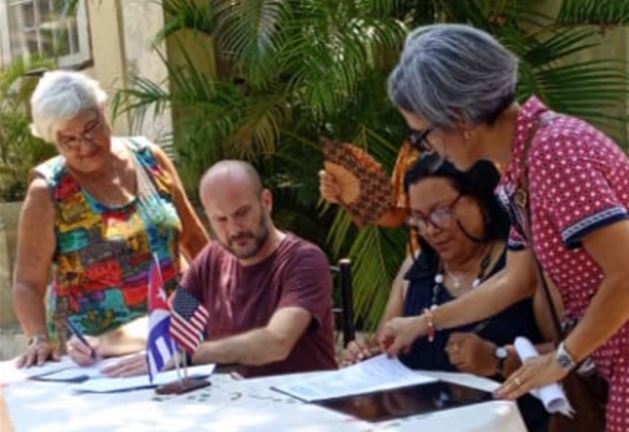
Havana, May 29 (Prensa Latina) The Hemingway-Pfeiffer Museum of the U.S. University of Arkansas and the National Council of Cultural Heritage (CNPC) recently signed in Havana a memorandum of understanding to strengthen ties with the Ernest Hemingway Museum in Cuba.
The Cuban Ministry of Culture informed today that this step will intensify academic contributions between the foreign institution and the museum dedicated to preserving Hemingway’s legacy on the island.
The executive director of Hemingway-Pfeiffer, Adam Long, who signed the agreement on the U.S. side, thanked the authorities of the Ministry of Culture, the CNPC, the Ernest Hemingway Museum and the Foreign Ministry for welcoming him.
He referred to his visit to Cuba in 2013 to participate in the Ernest Hemingway Colloquium and added that he was impressed by the work carried out by the Museum.
He stressed that this visit to sign the document, which is endorsed by the Arkansas University dean, is the beginning of future collaborations between the two institutions.
Also the president of the CNPC, Virgen Perez, signatory for the Cuban side, said the memorandum respects the strengths of those involved in its content, guided by the joint desire to promote the work they do.
These include research, training and cooperation in academic disciplines of mutual interest and benefit.
The exchange between professors and students is another way of socialization that can be carried out and become a platform to promote the Ernest Hemingway International Colloquium (organized in Havana) through the results of their research.
The president of the CNPC added that the most important thing is the opening of a new opportunity for collaboration between Cuba and the United States, whose main objective is to preserve the work and historical legacy of the American writer Ernest Hemingway, Nobel Prize in Literature.
Havana, May 28 (Prensa Latina) Religious institutions in this capital are celebrating on Tuesday the 83rd anniversary of establishing the Council of Churches of Cuba (CIC) with a gala that will bring together several Christian artists at Miramar Theater.
The non-governmental, non-profit institution will assemble more than 50 percent of Cuba’s evangelical churches immersed in the effort to promote meeting spaces and actions for churches and other Christian institutions to develop their social vocation.
It has 28 full-member denominations, in addition to 14 ecumenical centers and movements, which comprise an estimated 42 member institutions, to which another nine are added in the status of fraternal associates.
The CIC is legally established and recognized with its legal personality in the Registry of Associations at the Ministry of Justice of the Republic of Cuba. It is in tune with the country in the search for its sustainability, the development of social services, and the rescue of values.
It also promotes dialogue with all players in society and its relations with it to offer better community services, with the legal guarantees granted by the Constitution of the Republic.
As a responsibility of its secular State, the Constitution establishes the recognition, guarantee, and respect for religious freedom and confirms that different beliefs and religions enjoy equal consideration.
Article 57 of the Constitution guarantees everyone’s right to profess religious beliefs or not, to change them, and to practice the religion of his or her preference, with due respect for others and under the law, and protects against conduct related to any discrimination based on religious beliefs.