The vessel departed the Pajaritos Petrochemical complex, operated by state-owned Petroleos Mexicanos (Pemex) on Jan 5 | Image: Bloomberg
Mexico has become a key supplier of oil to Cuba after Venezuela’s exports fell, drawing criticism from US lawmakers and adding strain to ties with President Trump
A tanker carrying between 85,000 and 90,000 barrels of oil arrived in Havana from Mexico amid growing tensions with the US over the shipments after the fall of Venezuela’s ousted President Nicolás Maduro last week.
According to shipping reports and vessel movements tracked by Bloomberg, the tanker Ocean Mariner was last seen en route to the Cuban capital at 2.39 p.m. UTC on Friday and was expected to arrive at its destination at 3 a.m.
The vessel departed the Pajaritos Petrochemical complex, operated by state-owned Petroleos Mexicanos (Pemex), in Mexico’s Veracruz state on Jan. 5. The news was reported earlier by Agence France-Presse.
Neither President Claudia Sheinbaum’s office nor Pemex responded immediately to a request for comment outside of office hours.
Mexico has become a key supplier of oil to the Caribbean island after the US captured Maduro, generating criticism from American lawmakers and further straining ties between Sheinbaum’s administration and President Donald Trump.
On Wednesday, Sheinbaum said that Mexico will continue supplying oil to Cuba, describing the shipments in part as humanitarian aid.
“With the current situation in Venezuela, Mexico has become an important supplier,” she told reporters at her daily press conference on Wednesday. “Previously it was Venezuela, but it’s part of what has historically been sent.”
Sheinbaum said some of Mexico’s oil exports to Cuba are covered by contractual obligations.
The Cuban government has now confirmed that 32 of its nationals were killed in Venezuela trying to protect President Nicolás Maduro and his wife Cilia Flores when they were abducted by U.S. Special Forces last Saturday. Below, we break down what we know so far and talk to Cubans about how they feel about what’s going on.
We also take a deep dive into why these Cubans were in Venezuela in the first place — and why claims that they were an army “propping up” Maduro don’t hold up.
This week’s story was written by Ed Augustin and Reed Lindsay, along with contributions from Amba Guerguerian and Liz Oliva Fernández, in collaboration with Drop Site, an investigative news organization dedicated to exposing the crimes of the powerful.
“No Country Has the Right to Invade Another”
Cubans observed two official days of mourning earlier this week after a contingent of its security forces were massacred guarding Venezuela’s President Nicolás Maduro. Flags were flown at half-mast, and concerts were canceled.
“No country has the right to invade another,” one woman told us on the streets of Havana. “Those Cubans were there at the request of the Venezuelan government to protect Maduro…The blood we’ve shed unites us.”
Are people on the island afraid that Cuba could be next?
“What’s happening in Venezuela can happen to any Latin American country, so I’m afraid,” said Adriannys Poll, a 19-year-old college student studying microbiology. “I want to graduate, but you don’t know what could happen in the next three years of Donald Trump’s presidency.”
“Everyone knows it’s about oil. I don’t think they’ll come and bomb Cuba,” hoped one person.
“We’ve lived under threat our entire lives, even [of] an invasion. And we defeated them,” said another.
One hundred people, including civilians and security forces, were killed in the U.S. attack on Venezuela, according to Venezuela’s Interior Minister Diosdado Cabello.
The Guardian reports it took the U.S. two hours and twenty-eight minutes from the time its helicopters touched down in Maduro’s compound in Caracas at 2:01 a.m. to seize the former president and his wife. Maduro, the paper reported, had tightened his security measures leading up to his abduction and was relying more heavily on Cuban bodyguards.
But the lack of a response from the Venezuelan military and the disparity in the death toll — the U.S. reported no casualties — have fueled speculation about betrayal.
Venezuela’s interim President Delcy Rodríguez fired General Javier Marcano Tábata, who headed the Directorate General of Military Counterintelligence and was responsible for Maduro’s security. Rodríguez herself has come under question due to a report that she and her brother, President of the National Assembly Jorge Rodríguez, had been leading talks in Qatar with the Trump administration about a “more acceptable” alternative to Maduro in the months leading up to the U.S. attack.
But the imbalance in casualties may have more mundane explanations.
“The casualty rate may reflect the superior U.S. technology and a clear order for U.S. troops to fire at anything or everything they see,” said Fulton Armstrong, former U.S. national intelligence officer for Latin America, who emphasized how U.S. forces, arriving undetected, had the element of surprise on their side.
“The Americans obviously came in with a great deal of firepower and simply overwhelmed them,” said Hal Klepak, Professor Emeritus of History and Strategy at the Royal Military College of Canada and a former NATO analyst who also served as an advisor to that country’s foreign and defense ministers. “That’s an American tactic throughout Latin American history over almost two centuries. You don’t go in with the minimum; you go in with the maximum.”
Venezuela’s Defense Minister Vladímir Padrino on Sunday read a statement from the Bolivarian Armed Forces, accusing the Trump administration of “murdering in cold blood a large part of their security team, soldiers and innocent citizens.”
On Tuesday, Cuba published the headshots, names, ranks and ages of the 32 Cuban officers killed by the U.S.
The list included colonels, lieutenants, majors, captains and reservists ranging in age from 26 to 60.
But questions remain about how the Cubans were killed.
What Were Cuban Security Forces Doing in Venezuela?
After the election of socialist President Hugo Chávez in 1998, Venezuela quickly became Cuba’s closest ally. Early in his term, Chávez signed alongside Fidel Castro the Cuba-Venezuela Comprehensive Cooperation Agreement that saw Cuban specialists lend their expertise in Venezuela in the fields of culture, education, health and more.
Venezuela has the largest oil reserves in the world, but its healthcare system had always faced medicine and staff shortages. Cuba sent thousands of doctors and nurses to work in Venezuela, where they were paid many times the tiny salaries they earned in Cuba. In exchange, Venezuela shipped oil to the island.
For years, U.S. officials complained that Venezuela was propping up Cuba with subsidized oil. Then, in 2019, the first Trump administration flipped the script.
That year, Trump called Maduro a “Cuban puppet.” Vice President Mike Pence accused Cuba of keeping the Venezuelan people “hostage.” U.S. Special Representative for Venezuela Elliott Abrams said Venezuela was a “colony” of Cuba, and Secretary of State Mike Pompeo claimed the island was “the true imperialist power in Venezuela.”
Trump’s National Security Advisor John Bolton, who oversaw a failed effort with then Senator Marco Rubio to bring about regime change in Venezuela, claimed there were 20,000 Cuban “thugs” propping up the Maduro government. “Maduro would fall by midnight” if not for the Cubans, Bolton told reporters in April 2019. (For more, see the second episode of our award-winning documentary series, The War on Cuba).
That narrative gained new traction in recent months as the Trump administration ramped up political and military pressure on Venezuela.
In October, Venezuelan opposition leader María Corina Machado likened the presence of Cuban advisors inside Venezuela to an “invasion” and made it part of her push for U.S. military intervention.
“I don’t think it’s any mystery that we are not big fans of the Cuban regime, who, by the way, are the ones that were propping up Maduro,” Rubio told NBC’s “Meet the Press” on Sunday.
No credible evidence that Cuba had thousands of troops in Venezuela has been presented.
What has been verified is that thousands of Cubans have gone to Venezuela to work as doctors and nurses, as well as teachers and sports coaches.
One of them is Dr. Lyhen Fernández Baez, a urologist who is the mother of Belly of the Beast journalist Liz Oliva Fernández. (Liz conducted a mother-daughter interview with her, asking about her experience serving on a medical mission in Venezuela in Episode Two of the War on Cuba.)
Manufacturing a Security Crisis
For months, the Trump administration said its deadly boat strikes and military buildup in the Caribbean were aimed at fighting “narcoterrorism.” The Justice Department claimed Maduro was leading a drug trafficking organization called “Cartel de los Soles.”
But this week, the administration quietly dropped that claim in a revised indictment, acknowledging that Cartel de los Soles isn’t a real cartel — even as Maduro still faces narcoterrorism and cocaine trafficking charges in a federal court.
Concocting far-fetched accusations to legitimize hostility has been the U.S. government’s go-to playbook for decades when it comes to Venezuela and Cuba. For example, the island occupies multiple State Department blacklists, accused of carrying out human trafficking via its medical missions and even sponsoring terrorism despite consensus to the contrary in the U.S. intelligence community.
The close relationship between Cuba and Venezuela has also provided fodder for neoconservatives like Abrams and Bolton, who both have decades of experience scheming up ways of overthrowing governments around the world.
Abrams, convicted for “withholding information from Congress” during the Iran-Contra Affair, was “the crucial figure” in Washington during the bungled Venezuela coup d’état that briefly deposed President Hugo Chávez from power in 2002, according to The Guardian. (The New York Times on Wednesday released a 52-minute interview with Abrams to help their readers understand “what is actually happening in Venezuela.”)
Bolton, who once falsely claimed that Cuba was developing biological weapons, argued in 2019 that Cuba, Nicaragua and Venezuela form a “troika of tyranny” and a “triangle of terror” in the Western Hemisphere, reminiscent of the “axis of evil” rhetoric employed during the George W. Bush years.
Led by Bolton and Abrams, the Trump administration did not abandon the claim that Venezuela propped up Cuba; it simply doubled down on the reverse accusation.
U.S. officials have toggled between portraying Caracas as Havana’s benefactor and Havana as Caracas’s puppet master — contradictory narratives that nonetheless converged on the same policy goal: sweeping “maximum pressure” sanctions on both countries, including measures aimed at cutting Venezuelan oil exports.
“Patently False” Claims
Security experts say U.S. government claims about Cuba’s influence in Venezuela are grossly exaggerated.
Ben Rhodes, a former U.S. deputy national security advisor who played a key role in negotiating the normalization of U.S.-Cuba relations during President Barack Obama’s second term, has disputed the claim that Cuban military personnel in Venezuela numbered in the tens of thousands.
“The only way you get to those numbers is to count doctors as security officials,” Rhodes said in an interview conducted in 2019.
“The number of Cuban security officials alleged by the U.S. government was patently false,” said Armstrong. “The vast majority are civilian doctors, teachers and coaches, and many are women.”
“We know that there were indeed Cubans in Maduro’s security detail, but perhaps now, we can also put to rest that the Cubans ‘ran’ Venezuela’s security plan because they apparently didn’t have any indication of the attack until it was upon them,” he added.
Cuban-Venezuelan cooperation deepened after the 2002 coup, with the Cubans assisting in the creation of security services and military intelligence capacity in Venezuela, according to Klepak.
He added that Cuban officers posted within the Venezuelan armed forces’ command system have also long been connected to natural disaster relief efforts.
“The UN has often hailed Cuba’s [disaster response] system as the best or one of the best in the world and a model for other countries. Venezuela is prone to natural disasters, but its forces had a dismal record for dealing with them. Thus, asking Cuba for assistance was obvious,” he said. “But the idea that this tiny military presence is in any way an occupying army or that it is anything like 1,000 people, never mind 25,000 people, is simply politically motivated.”
Cuba’s Long History of Resisting U.S. Intervention
It’s not surprising that Venezuela would turn to Cuba for help in defending itself from U.S. aggression.
The island has weathered a U.S.-backed invasion, acts of sabotage, repeated terrorist attacks and numerous assassination attempts on Fidel Castro. Cuba’s intelligence service is renowned, in particular for repeatedly outmaneuvering the CIA.
Decades ago, Cuba was also known for an internationalist military that punched above its weight, sending military contingents to face off against U.S.-backed forces in Africa, the Middle East and Latin America.
While Abrams was secretly arming right-wing paramilitaries to overthrow the left-wing Sandinista government in Nicaragua in the 1980s, Cuba sent their Marxist allies military advisors.
When the leftist New Jewel Movement came to power on the tiny Caribbean island of Grenada after it won independence from Britain, Cuba sent military personnel to support the fledgling government. The Reagan administration called Grenada a “Cuban-Soviet colony” in 1983 and invaded it.
Cuba’s most successful foreign military intervention was in Angola, where Cuban soldiers fought with the left-wing People’s Movement for the Liberation of Angola (MPLA). From 1975 to 1991, Cuba deployed hundreds of thousands of troops to the country — by far the largest overseas military engagement ever conducted by a Latin American country. Cuba was also credited with helping bring about the fall of apartheid in South Africa.
“The Cuban internationalists have made a contribution to African independence, freedom and justice unparalleled for its principled and selfless character,” said Nelson Mandela during a visit to Cuba in 1991.
But when the Soviet Union disintegrated, Cuba’s economy went into a tailspin, and its military internationalism ended.
“The Cuban armed forces were cut massively from between 270,000–290,000 in the 1980s to between 55,000–60,000,” said Klepak, adding that Cuba’s military has been reduced to home defense with little to no capacity to project force beyond the island.
An Inconvenient Truth for Regime Changers
Over the years, Cuba has become one of the U.S. government’s most reliable security partners in the Caribbean.
Since the 1990s, Cuban and U.S. armed forces have collaborated closely on counternarcotics operations and efforts to stop illegal migration, according to Klepak. Cuba’s strategy, Klepak argues, has been “to create a body of people in the U.S. government who see Cuba as a natural and effective ally in security issues.”
With the days of large-scale Cuban military internationalism long gone, regime change proponents are left with an inconvenient truth.
According to Klepak, “however much both sides try to downplay it, until the first Trump administration, the closest security relationship that Cuba had was with the United States of America.”
Now, with Maduro out of the picture and nearly three dozen Cubans dead, the claims that Cuba is propping up Venezuela appear more absurd than ever.
The opposite claim — that Venezuela is propping up Cuba — may also no longer be true.
In 2025, Venezuela was shipping less than 30,000 barrels a day to the island, about 70% less than what it was sending a decade earlier. This fuel lifeline has been further cut in recent weeks as the Trump administration ordered “a total and complete blockade” of sanctioned oil tankers. In December, the U.S. started seizing Venezuelan oil tankers at gunpoint.
In recent years, Mexico has become a major supplier of oil to Cuba, with President Claudia Sheinbaum portraying the shipments as part of her government’s humanitarian efforts in the Caribbean and a longstanding policy of Mexico.
The U.S. is pressuring the interim administration in Venezuela to stop oil shipments to Cuba, but it is not clear yet what will happen to other aspects of the two countries’ relationship or whether the Cuban doctors, nurses and teachers who are serving on humanitarian missions in Venezuela will be forced to return home.
If they are, they may be replaced by U.S. oil executives.
Rubio said on Wednesday that the administration was about to finalize a deal with the Venezuelan government to “take all the oil,” adding that the U.S. had “a lot of leverage” because of its continuing blockade on Venezuelan oil exports.
Meanwhile, the heads of Exxon Mobil, Chevron and ConocoPhillips met with Trump Friday to discuss his plans to “run” Venezuela and control its oil industry.
At the meeting, Trump continued to vex those looking for an end-game behind his assault. “We are open for business,” he said. “China can buy all the oil they want from us, there or in the United States. Russia can get all the oil they need from us.”
Monterrey, Mexico, Jan 9 (Prensa Latina) The Committee of Solidarity with Venezuela, in the Mexican city of Monterrey, the solidarity movement with Cuba and the National Association of Democratic Lawyers of the Nuevo León state section, condemned the US military aggression against Caracas.
Similarly, last night solidarity groups reaffirmed their commitment to peace on the continent.
“The political-military actions we have just seen in Venezuela, based on cyber and technological air-space warfare, as well as the threats of the application throughout our America of the Monroe Doctrine developed by Donald Trump and the clique that governs today in the United States, openly represent a threat to all of humanity.”
“They also generate destabilization, death, destruction, looting, theft and exploitation of natural and economic resources of the peoples of the world,” said activist María de la Paz Quintanilla on Thursday night.
At the event, held in the Plaza del Colegio Civil in the city of Monterrey, located about 800 kilometers north of this capital, de la Paz Quintanilla, a member of the Martí Alternative for Our America (Mexico chapter) and of the Mexican movement of solidarity with Cuba in Monterrey, denounced the hegemonic power for “opening war fronts throughout the world and deepening the genocide in the attempt to solve the crisis of the capitalist system.”
“Trump’s threat,” the Monterrey-based activist added, “reflects the context of a social and environmental catastrophe (…) and is symptomatic of a crisis whose promoters ignore the most basic principles of international law.”
He also made an urgent call to take steps to articulate a broad front of social movements and political forces, acting not from a defensive position, but from a revolutionary offensive, which requires profound transformations to confront imperial domination.
“Let all of us who fight for a just society, free from exploitation, oppression, exclusion and discrimination, commit ourselves to agreeing on what we have in common in order to face the threat of the war that is intended to be waged against our peoples in Latin America and the Caribbean, and against the peoples of the global south in other continents, a war that in its extreme reaches genocide, as in Gaza, and brings the planet closer to a conflagration of global dimensions,” he emphasized.
In an exclusive interview with Prensa Latina, Ernesto Villareal Landeros, representative of the National Association of Democratic Lawyers from the Nuevo León state section, asserted that “Latin Americans have the need and the obligation to study the historical interventionist role of the US, trampling on the dignity and development of our peoples, at the mercy of the exploitation of their natural resources.”
“It’s not just about knowing history, but about becoming aware of the predatory attitude of the United States. There are many examples of this in Mexico, Panama, the Dominican Republic, the shameful and outrageous economic blockade against Cuba for more than 60 years, and the current criminal actions of Donald Trump against the legal structure of Venezuela. This compels us to reaffirm our struggles, following the example of our liberators,” Villareal Landeros emphasized.
Among other speakers, representatives of the Monterrey-based “People to People” Brigade, in solidarity with Cuba, took the floor.
Mexico City, Jan 8 (Prensa Latina) Mexican President Claudia Sheinbaum reiterated today that blockades harm nations and reaffirmed her commitment to providing humanitarian aid to Cuba, which is under attack from an economic, commercial and financial embargo imposed by the United States.
“From our perspective, blockades harm people, beyond governments, and we seek to provide humanitarian aid,” the president asserted in response to a question about the island during her regular meeting with the media.
From Cuernavaca, in the central state of Morelos, the head of the Executive Branch stated that after the damage caused by the powerful Hurricane Melissa in the eastern region of the largest of the Antilles, Mexico “provided support, as it has provided support to many other countries.”
Sheinbaum reaffirmed yesterday that her nation sends oil to Cuba as part of contracts and humanitarian aid, noting that no more is being sent than has been sent historically.
On December 22nd, the leader emphasized the historical relationship between her country and the island.
In mentioning energy cooperation and visits by Cuban leaders to Mexico and vice versa for decades, regardless of the political affiliation of the leaders in this North American nation, Sheinbaum stressed that the ties with the Caribbean country are not something new.
“This is not a new situation, and everything is done within the framework of the law and also for humanitarian reasons,” she noted, reiterating Mexico’s sovereignty and mentioning that it is continuing a series of support measures that his nation has historically provided to Cuba.
According to the most recent data, the US blockade against the Caribbean country caused damages estimated at seven billion 556.1 million dollars between March 2024 and last February, an increase of 49 percent compared to the previous period.
In the health sector alone, that policy resulted in losses of nearly $300 million in one year, while the impact in the energy sector exceeded $496 million due to restrictions on importing fuels and spare parts.
On October 29, Cuba achieved a new victory in the United Nations General Assembly by obtaining 165 votes in favor of the resolution calling for an end to the blockade.
Havana, Jan 8 (Prensa Latina) Cuban Foreign Minister Bruno Rodríguez denounced today that the latest statements by high-ranking US officials confirm that the alleged “Cartel of the Suns” was a “mendacious pretext” fabricated to justify the aggression against Venezuela.
Through his account on the social network X, the Cuban foreign minister pointed out that the recent statements by the US Secretaries of State and War reveal that such a drug trafficking group never existed, thus dismantling one of the main narratives used to attack the South American country.
“They confirm what we have always denounced: the Cartel of the Suns never existed, it was a mendacious pretext to justify the aggression against Venezuela, with the objective of seizing Venezuelan resources, neocolonially controlling that territory and overthrowing the Bolivarian and Chavista Revolution,” Rodríguez wrote.
The Cuban foreign minister also questioned: “Will those who claimed the existence of this alleged drug trafficking group apologize for supporting such a lie? Will they denounce the outrage, the usurpation, and the piracy that the U.S. government intends to impose on the Venezuelan people?”
In his message, Rodríguez demanded an end to the “double standard” in international politics and called for respect and defense of International Law.
Mexico City, Jan 5 (Prensa Latina) Members of the Cuban Embassy in Mexico paid tribute today to the 32 Cuban fighters who lost their lives on January 3 during the United States military attack against Venezuela.
“The staff of the @EmbaCuMex paid tribute to the combatants who fell heroically in the sister land of Venezuela, facing the cowardly imperialist aggression that reinforces threats to Our America,” the diplomatic mission stated on its social media account.
During the ceremony, the island’s ambassador to this capital, Eugenio Martínez, stated that the greatest tribute would be to honor their example of loyalty and redouble the work, dedication and sacrifice “to live up to the standards that internationalist heroes, the people of Cuba and their Revolution deserve.”
The meeting concluded with a minute of silence in honor of the comrades and with the reaffirmation of firm support for the legacy of Commander-in-Chief Fidel Castro; Army General Raúl Castro; President Miguel Díaz-Canel; the Communist Party of Cuba and the Revolution.
The government of the Caribbean nation reported yesterday that 32 Cuban citizens died during the military attack perpetrated by the United States against Venezuela.
The combatants were carrying out missions on behalf of the Revolutionary Armed Forces and the Ministry of the Interior, at the request of their counterparts in the South American country. Authorities in the Caribbean nation stated that the Cubans “fell in direct combat against the attackers or as a result of the bombing of the facilities,” after offering “fierce resistance.”
In honor of the fallen combatants, President Miguel Díaz-Canel declared national mourning.
Hours after the news broke of Venezuelan President Nicolás Maduro’s abduction by U.S. special forces in Caracas, thousands of Cubans gathered in front of the U.S. embassy in Havana in protest.
Belly of the Beast journalist Liz Oliva Fernández was on the ground covering the demonstration. Watch what Cubans told her in our new video.
It’s all about the oil
Although the U.S. government has invoked drug trafficking as the justification for its military escalation in the Caribbean and abduction of Maduro, Trump made clear in his Saturday press conference that the primary motivation was oil.
“We’re going to take back the oil that frankly we should have taken back a long time ago,” Trump said. “We’re going to have our very large United States oil companies, the biggest anywhere in the world, go in, spend billions of dollars, fix the badly broken oil infrastructure and start making money for the country.”
Secretary of State Marco Rubio told CBS News on Sunday that the U.S. “quarantine” on sanctioned oil tankers will remain in place as leverage until the Venezuelan government opens the doors to U.S. oil companies.
Delcy Rodríguez, Venezuela’s new interim president, struck a defiant tone on Saturday.
“We are ready to defend our natural resources,” Rodríguez said in her first public statement after Maduro’s ouster. “We’re never going to be a colony of any empire.”
But both Trump and Rubio have expressed confidence that Rodríguez would accede to U.S. demands.
“We’ve spoken to her numerous times, and she understands, she understands,” Trump told the New York Post.
For now, that confidence rests less on persuasion than on gunboat diplomacy.
“If she doesn’t do what’s right, she is going to pay a very big price, probably bigger than Maduro,” Trump toldThe Atlantic this morning.
Meanwhile, Trump snubbed Nobel Peace Prize winner María Corina Machado to the apparent consternation of Rubio’s hardliner friends in Miami.
“I think it would be very tough for her to be the leader,” Trump said. “She doesn’t have the support or the respect within the country.”
Beyond Venezuela, the brazen kidnapping of an elected head of state signals the administration’s willingness to impose power in the region by force — a stark reassertion of U.S. imperialism that is in line with what Trump has framed as a return to the Monroe Doctrine (or as he now calls it, the “Don-roe Doctrine“).
“The message is clear to any progressive forces in Latin America,” Miguel Tinker Salas, emeritus professor of history at Pomona College and author of “Venezuela: What Everyone Needs to Know,” told Democracy Now!. “The message is clear to Brazil. The message is clear to Mexico and Claudia Sheinbaum. The message is clear to Cuba, that it will be in the crosshairs next. This is about reimposing U.S. military and economic dominance in Latin America, starting in the Caribbean, starting with Venezuela.”
What does this mean for Cuba?
Cuba and Venezuela have been close allies since former President Hugo Chávez came to power in 1999. Venezuela became one of Cuba’s main sources of oil, and tens of thousands of Cubans, mainly doctors and nurses, have served on medical and educational missions to Venezuela.
For more on this relationship, watch Episode 2 of our award-winning documentary series The War on Cuba.
Venezuelan oil shipments have sharply reduced in recent years as the U.S. has pounded both countries with sanctions, including measures aimed at blocking the flow of petroleum to the island.
In 2025, Venezuela was shipping around 30,000 barrels a day to the island, about 70% less than what it was sending a decade earlier. This fuel lifeline has been further cut in recent weeks as the Trump administration ordered “a total and complete blockade” of sanctioned oil tankers. U.S. forces have already seized two tankers after they left Venezuela.
Since the U.S. began its “maximum pressure” campaign against Cuba and Venezuela in 2019, Cuba has been ravaged by a fuel crisis that has resulted in daily blackouts. This policy, which has remained in place throughout the Biden administration and into Trump’s second term, is designed to cause so much hardship and suffering in Cuba that the government will collapse or be overthrown from within.
This strategy apparently remains unchanged — 65 years after it was created under the Eisenhower administration (see former Vice President Richard Nixon articulate the U.S. government’s regime change plans in 1960 in the documentary we produced for Al Jazeera, Health Under Sanction).
United Nations, Jan 5 (Prensa Latina) Cuba today rejected unfounded accusations made by the United States delegation during an emergency meeting of the UN Security Council on Venezuela.
Cuba’s permanent representative to the UN, Ernesto Soberón, said that his delegation was forced to speak a second time to respond to those accusations.
“It is outrageous,” he emphasized, “that those who have perpetrated unilateral aggressions and systematic violations of International Law seek to act as judges of other sovereign states, which is an absolutely immoral, disrespectful, and irresponsible attitude.”
“We categorically reject the slanderous claims that Cuba has an intelligence presence in Venezuela. Such accusations lack any factual basis and constitute a clear attempt to divert attention from the aggressive and criminal conduct of the United States in the region,” the diplomat added.
Cuba strictly respects the sovereignty, independence and inalienable right of the Venezuelan people to decide their own destiny, as established by the Charter of the United Nations, he said.
Soberón recalled that cooperation between Cuba and Venezuela in multiple spheres, including the military, has legitimate bases and is supported by bilateral agreements signed sovereignly by both parties.
The diplomat reiterated that, as declared by the Revolutionary Government, the 32 fallen combatants, victims of a criminal act of aggression and state terrorism perpetrated by the United States, were carrying out missions representing the Revolutionary Armed Forces and the Ministry of the Interior at the request of Venezuelan counterpart bodies.
“These patriots, through their heroic actions, embodied the solidarity of millions of Cubans,” Soberón emphasized, adding that “this delegation (from the United States) is disrespectfully attempting to label Cuba as an interventionist in Venezuela, which we categorically reject,” the Permanent Representative to the UN concluded.
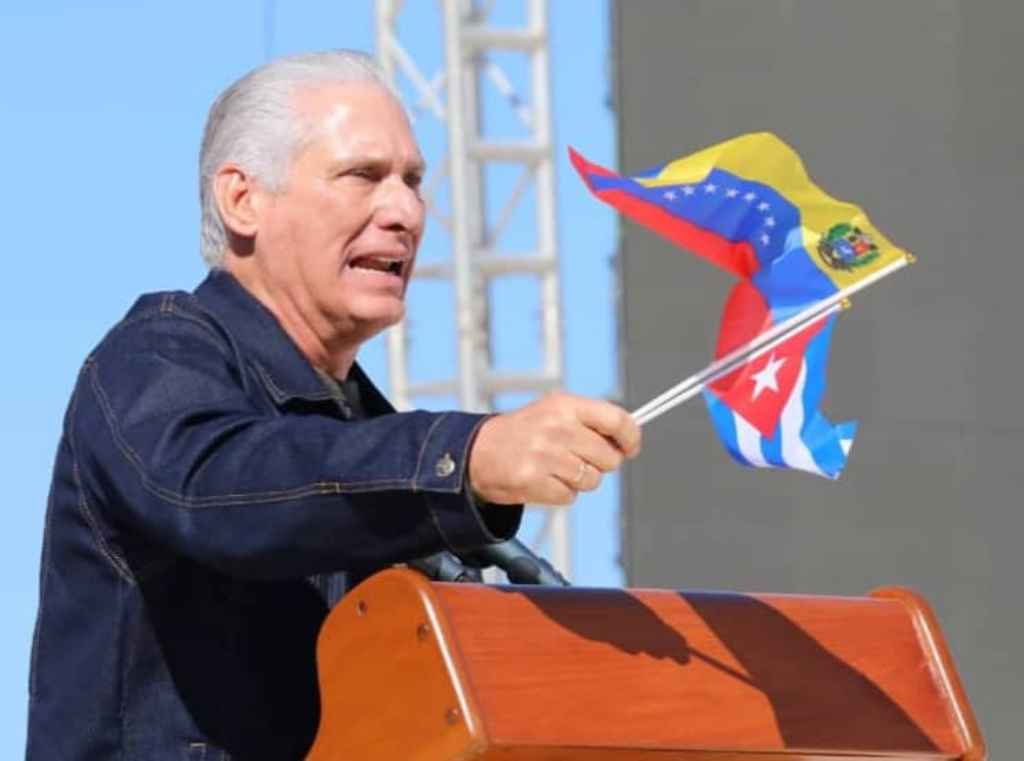
Havana, Jan 3 (Prensa Latina) Cuban President Miguel Díaz-Canel today urged the international community to condemn the United States’ bombing of Venezuela and the kidnapping of President Nicolás Maduro and his wife Cilia Flores.
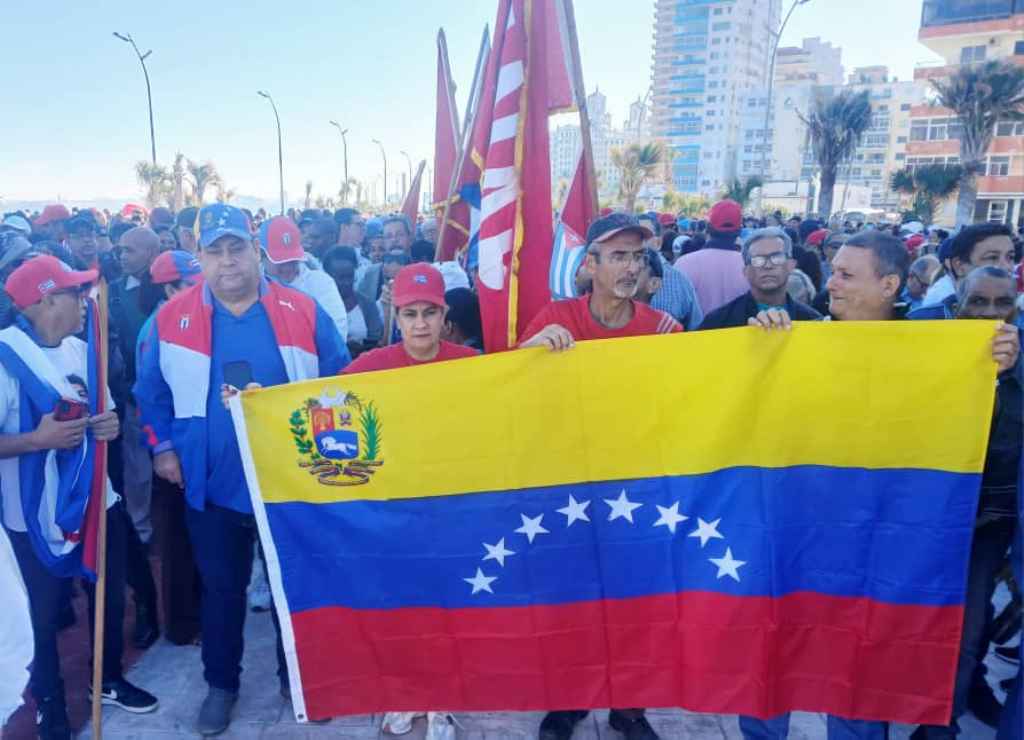
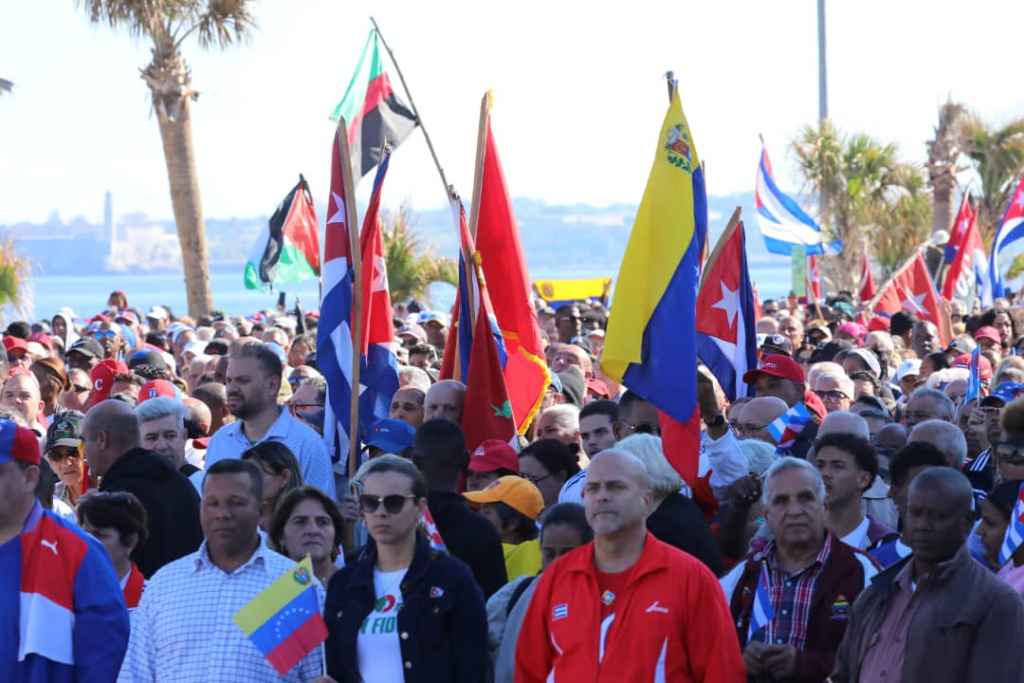
In a massive show of support for the attacked South American nation, held in Havana, the Cuban head of state affirmed that the mobilization, articulation and coordination of the world is urgently needed against what he described as a brutal and treacherous attack against a sovereign country, as well as a vulgar kidnapping of its president.
He stated that the alleged fight against drug trafficking is a fallacy with which Washington tries to hide the true purpose of its actions: to seize Venezuela’s natural resources.
The objective is also to extinguish that bastion of resistance against imperialism and of national independence that is the Bolivarian revolution.
In his speech, Díaz-Canel expressed his conviction that the Venezuelan people will take to the streets to demand their rights and the return of the president, as they did previously with the revolutionary leader Hugo Chávez.
He stated that “the United States has no moral, legal, or any other kind of authority to forcibly remove the Venezuelan president from his country, but it is responsible to the world for Maduro’s physical integrity.”
He recalled that US federal agencies, analysts, and researchers offered opinions and information that dismiss the false narrative of narco-terrorism and refute these accusations against Venezuela and its president.
It is outrageous that Trump and his cronies don’t care about the truth; they are the ones who should be condemned by an international anti-fascist tribunal, the Cuban president pointed out.
He stressed that the attack against Venezuela is an assault against Latin America, declared a Zone of Peace since 2014, and a violation of International Law.
We do not accept the Monroe Doctrine, Bolívar’s land is sacred, and an attack on his sons is an attack against the worthy sons of this region, he pointed out.
These are not times for half measures, these are times for defining ones and taking a stand against fascism and imperial barbarism, Díaz-Canel said, and called on Latin Americans to close ranks against the neocolonialist and fascist practices of the United States.
It’s been a rough year for Cuba. Rather, a rough few years. And with Donald Trump in the White House and Marco Rubio calling the shots on U.S. foreign policy, there’s little reason to believe things will improve anytime soon.
“Maximum pressure” sanctions imposed during the first Trump administration have resulted in an all-encompassing crisis. Medicine is scarce, rolling blackouts and long lines at gas stations are the norm and inflation has put basic necessities out of the reach of many Cubans.
But even in the face of all this, Cuba remains home to extraordinary people who persist in building a future for themselves, their loved ones and their country as a whole.
We’ve reported on this resilience throughout 2025.
When Hurricane Melissa destroyed parts of eastern Cuba, neighbors rallied around each other in its aftermath and solidarity initiatives poured in from across the island.
Cuban doctors and scientists continue to do all they can to save lives, farmers find innovative ways to feed their communities, entrepreneurs strive to grow their businesses and activists band together to protect stray animals. We’ve witnessed Cubans time and time again face overwhelming challenges with a deep sense of humanity — and that humanity is at the heart of our work.
So what are Cubans hoping for in 2026?
Watch our latest video in which Belly of the Beast journalist Liz Oliva Fernández asks Cubans how they’re feeling about the year ahead.