
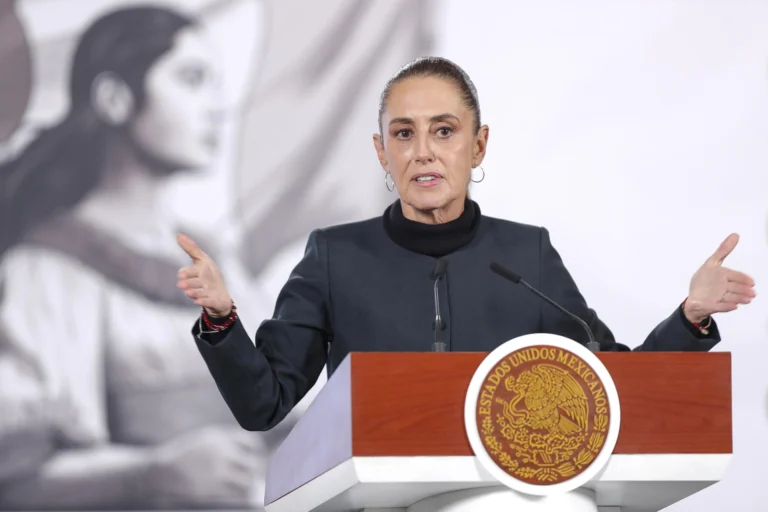
Mexican President Claudia Sheinbaum clarified that the continued shipments of crude oil to Cuba are based on contractual agreements and a firm humanitarian commitment.
January 21, 2026 — teleSUR
Mexican President Claudia Sheinbaum confirmed this Wednesday, January 21, in a press conference, the continuation of oil shipments to Cuba, aimed at mitigating the obstacles imposed by the US economic, commercial and financial blockade, in place for more than six decades.
This decision reaffirms the Latin American country’s solidarity with the Cuban people, who are facing a severe energy crisis. “If Mexico can help create better conditions for Cuba, we will always be there. It is a relationship with the Cuban people under very difficult circumstances,” declared the head of state, who emphasized that the crude oil supply is carried out “both by contract and for humanitarian reasons.”
RELATED:
Mexico Continues Supplying Oil to Cuba Despite U.S. Warnings
The Mexican president underscored the nature and impact of the blockade, established in 1962, which has been escalating its sanctions against countries that support Cuba. “You can’t import and export freely, so the conditions for a country’s development are very difficult,” Sheinbaum pointed out. She also recalled that Mexico has historically opposed this coercive measure, which is condemned by the vast majority of nations in the United Nations General Assembly. “When there is an extreme blockade, people are experiencing hardship, and Mexico has always shown solidarity,” the president added.
Sheinbaum maintained that Mexican diplomacy is governed by strict constitutional principles, which limit the suspension of relations with another country only to situations involving coups d’état or direct affronts against Mexico or its people.
Despite the information published in January by the British newspaper Financial Times, which indicated that Mexico would be Cuba’s main oil supplier by 2025, and the criticism from right-wing sectors questioning these shipments, the president considered them to represent a small portion of Mexico’s total crude oil production.
“It’s a very small amount that is sent, but it is a show of solidarity in a situation of hardship, of difficulty that a people are experiencing,” Sheinbaum stated.
Information shared by the British newspaper Financial Times indicates that exports to Cuba registered a significant increase, reaching an average of 12,300 barrels per day according to international estimates.
However, in December 2025, Petróleos Mexicanos (Pemex), the state-owned oil company, reported to the US stock exchange shipments of 17,200 barrels of crude oil and an additional 2,000 barrels of petroleum products to the island. According to the same British newspaper, these shipments of Mexican oil to Cuba represented a 56 percent increase compared to 2024 and constituted approximately 44 percent of Cuba’s crude oil imports.
The president emphasized that Mexico is a fraternal nation and that, just as the country receives international solidarity in times of crisis, it has a moral obligation to reciprocate. Sheinbaum emphasized that the essence of the Mexican people is to be in solidarity with those facing hardship, assuring that her administration will always be willing to create better conditions for Cuba.
In this context, she defended the export of crude oil to the island as an act of self-determination in the face of external pressures.
Impact of the US Blockade on the Development of Cuba
According to the most recent data, Washington’s economic, commercial and financial blockade to Cuba has caused an estimated $7.5561 billion in damages between March 2024 and February 2025, representing a 49 percent increase compared to the previous period.
In the health sector, this policy resulted in losses of nearly $300 million in a single year, while in the energy sector, the impact amounts to more than $496 million due to restrictions on the import of fuels and spare parts.
On October 29, Cuba achieved a new victory in the General Assembly of the United Nations (UN) by obtaining 165 votes in favor of the resolution requesting the lifting of the embargo.

