
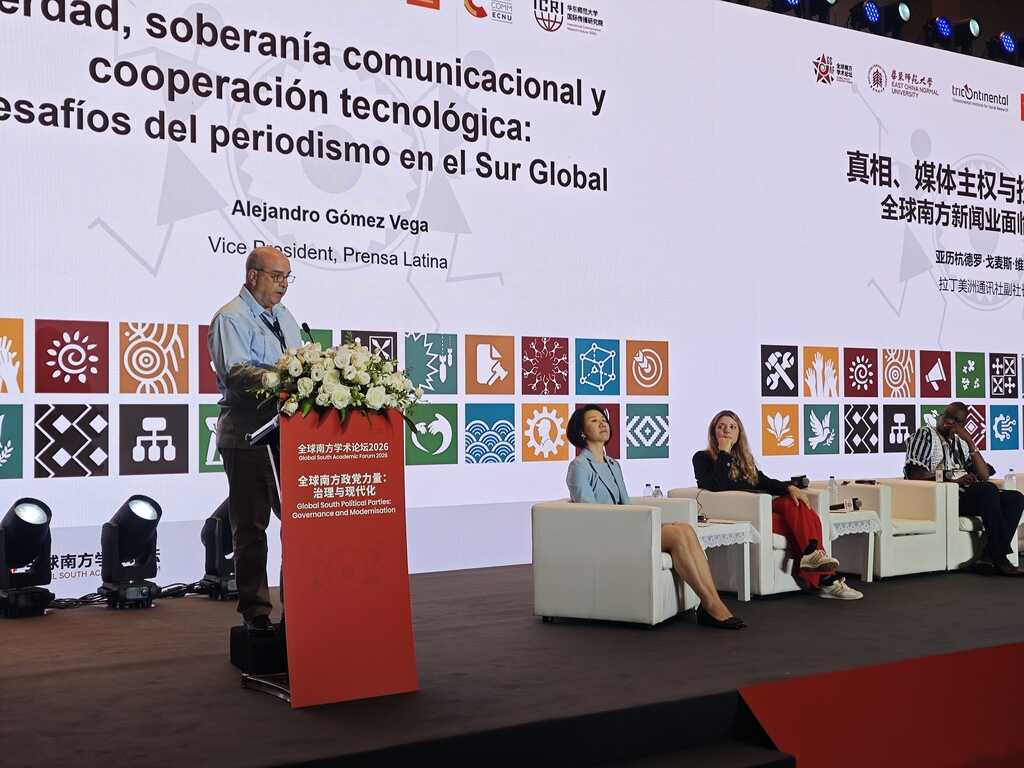
Shanghai, China, Oct 18 (Prensa Latina) Prensa Latina today proposed establishing a permanent professional training mechanism in artificial intelligence (AI) for journalists and media outlets in the Global South, through cooperation with Chinese institutions and other specialized actors.
The agency’s vice president, Alejandro Gómez, presented the initiative during a speech at the Global South Academic Forum, which brings together more than 200 representatives from developing countries in this city to discuss governance and cooperation.
Gómez highlighted the importance of uniting wills, resources, and talents to tell our own stories and work together in service of the truth.
The executive pointed out that AI poses challenges that transcend the ethical debate about its use and encompass technological sovereignty, informational independence, and the communicational autonomy of peoples.
Gómez pointed out that the major language models mainly respond to developments from the United States and China, so he considered it necessary to expand the capabilities of the Global South to participate in the creation of technologies adapted to their realities.
In that regard, he stressed that cooperation with China can contribute to the exchange of knowledge, specialized training, and the development of solutions that preserve the diversity of languages and perspectives.
The vice president of Prensa Latina stated that the proposal seeks to move from dialogue to a practical and permanent mechanism that allows for the sharing of experiences, strengthening the technical capacities of communication professionals, and promoting the responsible use of these tools.
He also stressed that the objective should not be limited to learning about technologies developed by third parties, but should include acquiring the skills to participate in their development.
Gómez recalled that the Chinese president has pointed out on several occasions that the world is going through a period of unprecedented change in the last century, and considered that the media, especially those from the Global South, still need to explain the scope of these transformations and their impact on daily life.
The executive stated that truth has become a collateral victim of conflicts and power struggles, which reinforces the responsibility of the media to provide contextualized information and contribute to a comprehensive understanding of events.
Referring to Cuba, he denounced the impact of the US economic blockade and argued that this policy limits the acquisition of fuel for electricity generation and hinders the arrival of basic medicines intended for children and the elderly.
The vice president of Prensa Latina questioned the narratives that attribute responsibility for the island’s difficulties to the Cuban government and stated that certain international media outlets present a biased view of the country’s reality.
Gómez also criticized the coverage of Cuba’s economic and social difficulties by the hegemonic US media, as well as the portrayal of the international cooperation of its doctors, teachers, and athletes under accusations of human trafficking and smuggling.
In his opinion, these representations respond to political and editorial interests that condition the information about the island, so he called for strengthening the capacity of the media in the Global South to build their own narratives and offer diverse perspectives on international reality.
kmg/idm
