

New York, March 15 (Prensa Latina) The U.S. blockade of Cuba continues to be a cruel, unjust, immoral, and anachronistic reality that attempts to subdue the will of a people who have chosen to be free, said Noemí Rabaza, first vice president of ICAP, today.
Rabaza, who is attending the International Conference for the Normalization of U.S.-Cuba Relations here representing the Cuban Institute of Friendship with the Peoples (ICAP), expressed his gratitude for the energy and drive of the movement supporting the island, especially in Cuba.
“You have been a beacon of light in the darkest moments, voices rising against injustice, and arms reaching out to build bridges of friendship,” the official said at the in-person and virtual meeting, held at the iconic Malcolm X Center in New York.
Rabaza said that ICAP turns 65 in 2025, and the institution’s history “is intertwined with the solidarity activism of movements like the one you represent,” and more than six decades later, it remains “a bridge between Cuba and the world.”
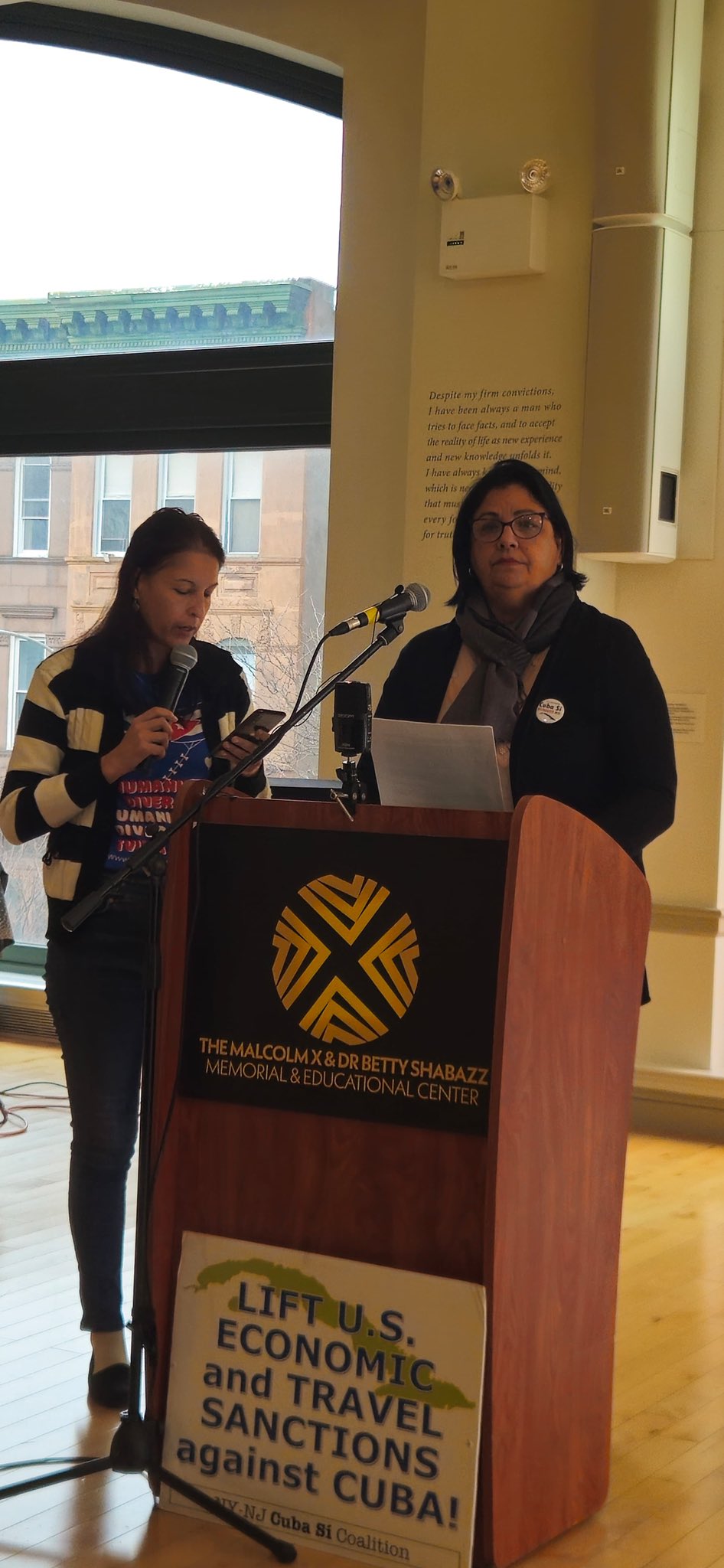
Looking back on the time that has passed, “we cannot help but recall the figures of two giants whose struggles and legacies inspire us: Fidel Castro and Malcolm X. Both, from different positions but with a shared purpose, dedicated their lives to the fight for social justice, equality, and human dignity,” he emphasized.
On his social media profile, Cuba’s alternate permanent ambassador to the UN, Yuri Gala, described the event as an “important event organized by solidarity groups with the Cuban nation. #CubaIsNotAlone.”
The forum, which concludes tomorrow and was first held in 2017, features diverse participation and the collaboration of solidarity networks in the United States, Canada (Quebec), and the Latin American and Caribbean Continental Network of Solidarity with Cuba and Just Causes.
A final statement outlining the solidarity movement’s work objectives is expected in the immediate future, taking into account—as a brochure from the National Network on Cuba points out—that there is a two-way U.S. blockade that dramatically affects the lives of tens of millions of Cuban and U.S. residents.
Many point out that if the unilateral siege that has survived 12 administrations in the executive mansion did not exist, collaboration could be achieved in fields such as medical advances.
Figures highlighted by solidarity indicate that the embargo prevents, for example, some 80,000 American diabetics who undergo amputations each year and 550,000 lung cancer victims from accessing unique Cuban treatments for their condition.
They also point out that there are nearly 50 million adults in this country who are illiterate and cannot benefit from Cuba’s global literacy campaign “Yes, I Can,” which has helped 11 million people in 30 countries around the world learn to read and write.
They also emphasize that, due to the embargo, U.S. citizens have fewer opportunities to visit a beautiful Caribbean island and share experiences with its wonderful people.
rob/dfm
