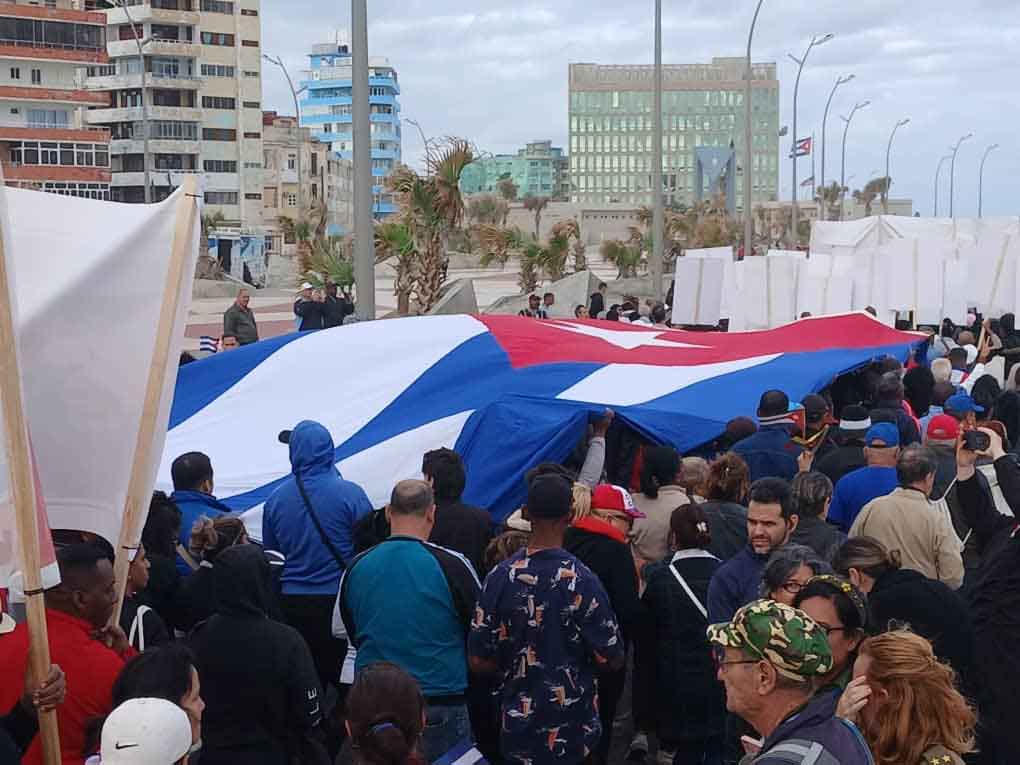
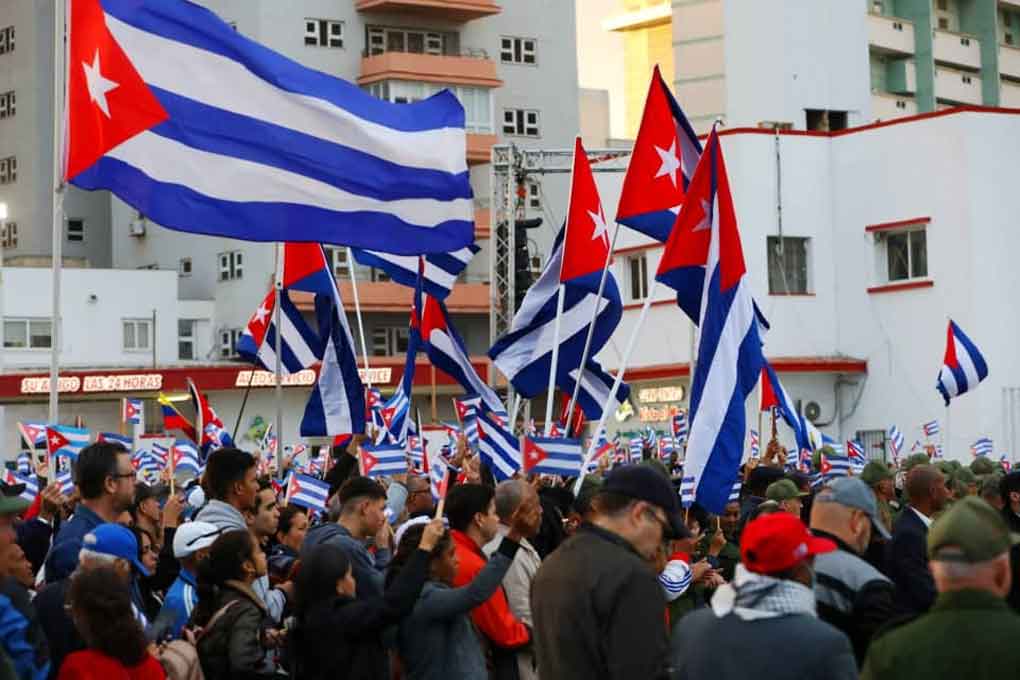
Jazz Plaza Festival in Cuba: A blend of arts and a passion for music

Havana, Jan 20 (Prensa Latina) More than 1,500 national and foreign artists will converge in Cuba from January 25 to February 1 for the 41st International Jazz Plaza Festival, which will take place in four provinces of the country, organizers announced today.

The event, which focuses each year on the diversity of expressions and artistic excellence, will be present in Havana, Santiago de Cuba, Santa Clara and for the first time, in Holguín.

Concerts, visits to educational institutions, thought meetings and other initiatives distinguish this edition, which will be attended by relevant Cuban artists, some residing abroad, and others from more than 20 countries.
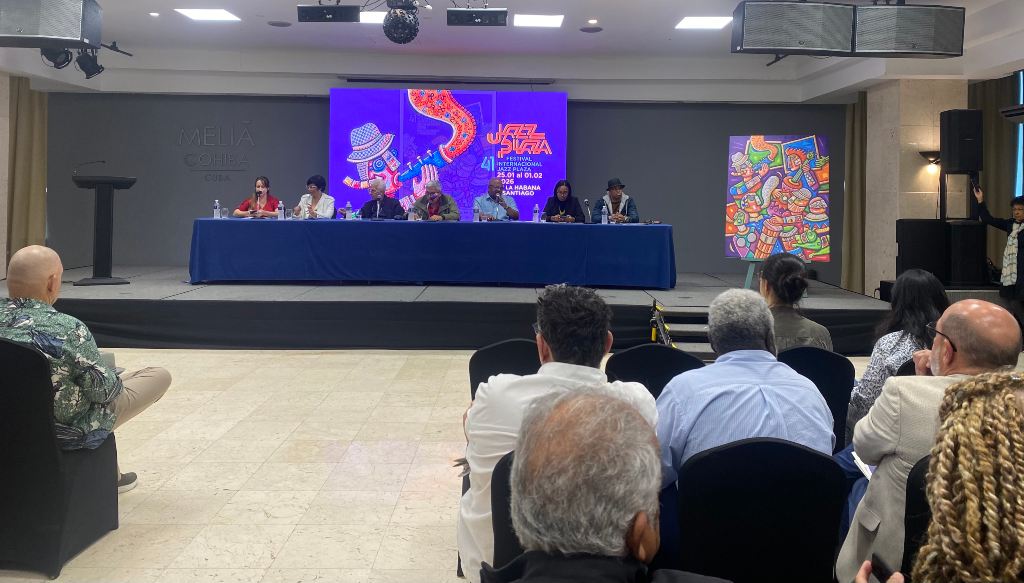
The president of Jazz Plaza, Victor Rodriguez, told the press from the Meliá Cohiba Hotel in the capital that the new generations are the main protagonists this year, while praising the organization in the host provinces and the satisfaction of hosting the event.

He also highlighted the participation of 286 international artists, in addition to the national artists and more than 23 Cuban musicians residing abroad, including Ignacio “Nachito” Herrera, Yosvany Terry, Jorge Luis Pacheco and Dayramir González.

The festival’s artistic director, Roberto Fonseca, spoke about the intention to hold it throughout the country, and thanked the musicians for making each concert a unique experience, different from the rest.

The closing show, titled “Selección de Maestros,” will feature the virtuoso Cuban pianist, accompanied by other prominent artists such as Pedrito Calvo, Alexander Abreu, Haila María Mompié, and Yasek Manzano.

In another meeting with the press, Fonseca expressed the possibility of involving film in his artistic proposal, and his intention with it is to touch the spirit and emotions of the people.

This new edition holds many joys: the celebration of the 50th anniversary of the Síntesis group, a concert by the outstanding Cuban pianist and composer Frank Fernández entitled Maestro de Juventudes, the Gala Cuba Vive, and the initiative to reflect the atmosphere of the festival through images, the call for which was launched today at the press conference.

Another attraction of the event lies in its visual aspect, created by the Cuban artist Alfredo Sosabravo, winner of the National Prize for Plastic Arts in 1997.
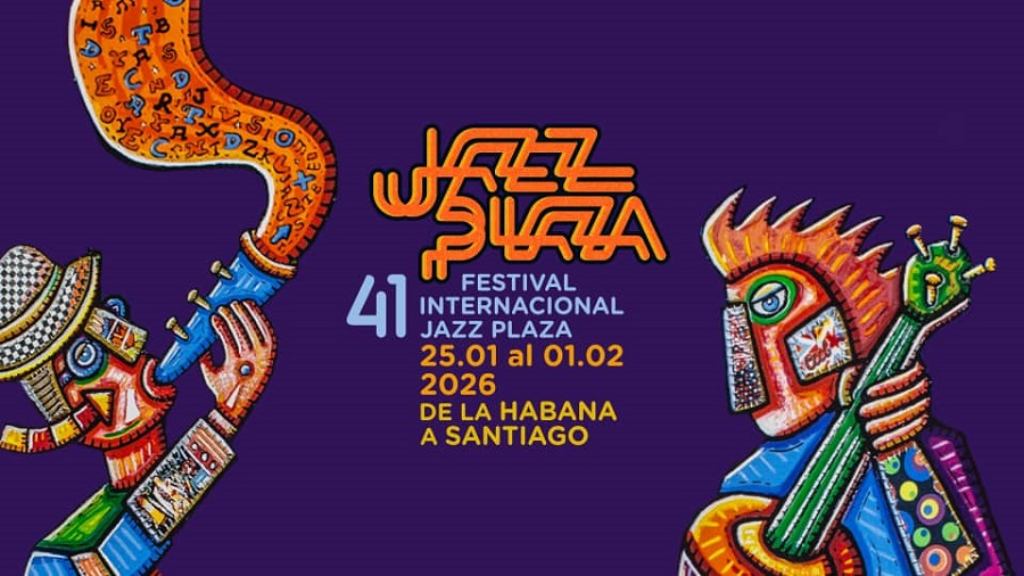
Also noteworthy are the performances by musician Bobby Carcassés, Honorary President of the festival; as well as the holding of the XXI International Colloquium Leonardo Acosta In Memoriam, in Havana, and meetings for reflection and debate in the other host provinces.

The president of the Cuban Institute of Music, Indira Fajardo, highlighted the diversity of spaces hosting the event and the work of Sosabravo, while the Deputy Minister of Culture of Cuba, Fernando León Jacomino, emphasized that this is the first edition after the declaration of the practice of Cuban Son as Intangible Cultural Heritage of Humanity.
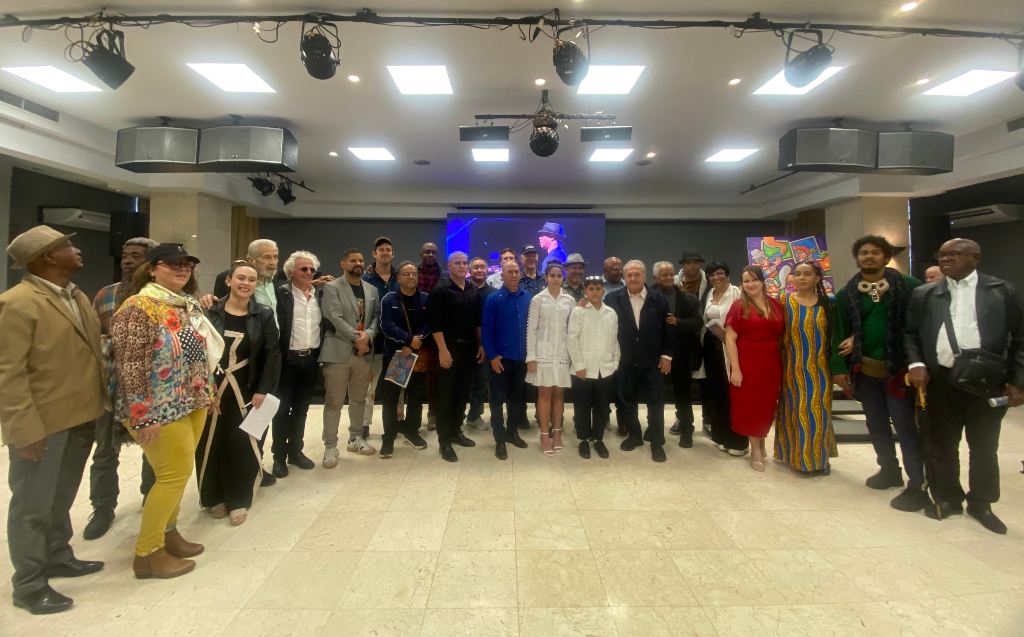
The International Jazz Plaza Festival is emerging as a cultural offering where passion for music and creative talent converge.

According to the artistic director, it is a space where all the arts are mixed together, to the delight of its admirers, performers and the public.

rgh/amr

Posted in Cultural | Leave a comment

Cuban government reiterates gratitude to China for rice donation

Havana, 20 (Prensa Latina) Cuban Foreign Minister Bruno Rodríguez today thanked China from this capital for the arrival of a first batch of rice as part of the Asian giant’s aid to the island.

In X, the Cuban foreign minister reciprocated the Party, the Government and the people of China for sending the first batch of a donation of 30,000 tons of the grain officially received the day before.

The aid intended to supplement the basic food basket for Cubans “is a sign of the close brotherhood and the historic bonds of friendship and solidarity that unite both nations,” Rodríguez highlighted on the social network.

During the welcoming ceremony this Monday, Cuba’s Deputy Prime Minister, Óscar Pérez-Oliva, noted that two shipments, both of 2,400 tons, are already on Cuban soil, arriving through the Mariel container terminal and the port of Santiago de Cuba.

He also reported that two more shipments will arrive in Cuba in the first half of this year, completing the total amount donated by the Chinese people and authorities.

China’s ambassador to Cuba, Hua Xin, also attended the ceremony, where he noted that it “not only embodies the deep and special bonds of friendship between both nations, but also demonstrates the unwavering commitment to remain united even in difficult times.”

mem/jqo

Posted in Exchanges, The Blockade? | Leave a comment

Op-ed: The U.S. blockade on Cuba is economic warfare, we must name it

Courtesy Asiah Quattlebaum
Photo of Cuban street

By Asiah QuattlebaumThe Tufts Daily — The Tufts Daily is the entirely student-run newspaper of record at Tufts University in Medford, Mass. 

Published Tuesday, January 20, 2026

The U.S. justifies its economic terrorism against Cuba by claiming that it is defending democracy and protecting freedom. But I have to ask: What kind of freedom are we protecting that starves children and violates a people’s sovereignty? That is something every single American with a conscience should question.

Before I went to Cuba, I believed I had a full grasp of what economic warfare meant. I had read about the U.S. embargo and followed the headlines about its harmful impacts on everyday Cubans. But when I was on the ground in Cuba, everything I thought I knew faded. I saw the reality — ration lines, defiant optimism and a revolution still breathing through struggle. The United States’ blockade is a deliberate strategy of harm, and if we cared about justice, we must recognize it and challenge it. The United States has been able to efficiently mask the horrors of its blockade on Cuba, and it is our responsibility as Americans to ensure that Cubans can live with dignity and self-determination. Genuine solidarity with Cuba begins with bringing the blockade to attention as a source of the crisis and recognizing how U.S. narratives distort the reality of Cuba to keep Americans passive.

I had the incredible opportunity to travel to Cuba with the Democratic Socialists of America’s Cuba Solidarity Working Group. I saw how the U.S. blockade shapes everyday life: empty grocery shelves, shortages of hygiene products, classrooms missing basic materials and hospitals having to reuse medical supplies. All of these conditions exist because the U.S. restricts Cuba’s access to global markets. Yet people fight to maintain their universal healthcare, keep education affordable and support one another through neighborhood networks and ration sharing.

There were moments when I could feel the U.S. blockade within my body. I got sick from food that Cubans rely on every day — not because Cubans cannot cook or preserve food, but because the sanctions force the country into fragile supply chains with unstable refrigeration and inconsistent imports. What passed for me for a couple of days is what Cubans have to navigate for their entire lives under a policy designed to break them.

Throughout this trip, I saw the tensions between pride and exhaustion. We were shown around Havana by people who still fight for the revolution’s promises, even as they navigate the exhaustion that comes with living under the U.S. blockade. In between tours, we had the opportunity to speak with locals at bars, restaurants and on the streets. People talked openly about the pressure they feel, the contradictions they live with, their commitment to the revolutionary project and the exhaustion of daily scarcity. They described searching for tampons and toilet paper, the rising difficulty of obtaining antibiotics and the financial strain from inflation exacerbated by U.S. sanctions. Even simple things like toilet paper reflected this pressure. I had to carry my own because so many public bathrooms could not reliably stock it. It is yet another reminder of how U.S. sanctions turn basic goods into luxuries. Yet every single person we spoke to explained that they were able to share rations and receive community support to survive together.

Despite the horrors of U.S. economic domination, people in Cuba find ways to survive, laugh and love each other. Seeing this up close made me far angrier than reading about it ever could.

I always knew that the blockade was inhumane, but hearing directly that hospitals have to reuse supplies because the U.S. blocks Cuba from purchasing medical equipment deepened my understanding of how intentional this harm is.

When I was walking around Old Havana, I saw children begging for money. I didn’t have any cash on me, so I gave a child some pistachios I’d bought at Target for 50 cents. His excitement startled me. This was not about Cuba’s failures; it was about how U.S. policy manufactures poverty by design. Cuba is not poor by nature. Cuba is kept poor in retaliation for building a socialist state and refusing U.S. domination. It made me think about how the U.S. leftist movement has failed to meet the demands for internationalist solidarity.

The U.S. justifies its economic terrorism against Cuba by claiming that it is defending democracy and protecting freedom. But I have to ask: What kind of freedom are we protecting that starves children and violates a people’s sovereignty? That is something every single American with a conscience should question.

I will admit that the Cuban problem is very complex. But one thing is clear: The U.S. blockade creates hardship and forces people in Cuba to endure unnecessary suffering.

The government implements the blockade to make daily life unbearable so Cubans turn against their government. The shortages the U.S. cites as proof of socialism’s failures are, in fact, symptoms of the blockade it designed to coerce political change. And yet Cuba continues to provide universal healthcare, free education, childcare for all and free gender-affirming care. They don’t do this because it is easy; they do it because it is central to the revolutionary ethic of collective survival.

During this trip, DSA leadership asked us to help with a solidarity project, and for me, it starts with writing this op-ed. One thing is clear: The U.S. blockade must end. We need to rebuild real international solidarity because what is happening in Cuba is not accidental. It is a direct result of U.S. choices and the very basis of U.S. global hegemony. The Cuban people deserve compassion, dignity and sovereignty. They don’t deserve punishment.

This experience has made me think deeply about what we, as young people in the United States, should do. It made me question our role in confronting U.S. imperialism, and how often our society and culture teach us to see the world through an “America First” lens that hides the suffering of others. The blockade is a weapon in our name, as Americans, whether we choose to acknowledge it or not.

If we truly believe in justice, then solidarity cannot stop at our borders. We need to understand how U.S. actions shape life and death in the Global South. We must reject the lie that American prosperity must come at someone else’s expense. Young people have always been at the forefront of movements for change, from the Greensboro sit-in to the Kent State University students protesting the Vietnam War.

Ending the U.S. blockade on Cuba, building real internationalist solidarity and rejecting the “America First” mindset are not abstract political ideas. They are material obligations. If we want to confront U.S. imperialism, we have to build communities of resistance here on this campus. That includes student groups that educate, organize, take coordinated action, run campaigns that pressure our representatives to end sanctions and build coalitions that connect our struggle with Cuba’s. Ending the blockade starts with refusing to let the violence of U.S. policy go unchallenged. Our liberation is bound together, and we have a duty to act as if it is.

Posted in The Blockade? | Leave a comment

“We’re Not Afraid”: Voices From Cubans’ March to U.S. Embassy

January 20, 2026 — Belly of the Beast

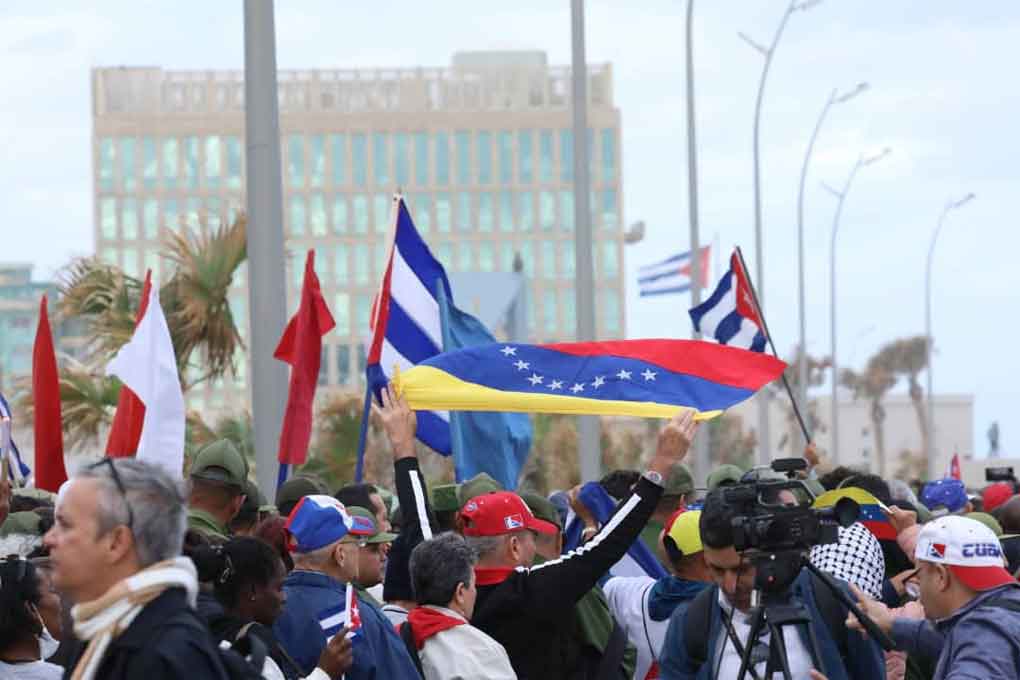
Tens of thousands of Cubans marched to the U.S. Embassy in Havana on Friday to denounce U.S. imperialism following the attack on Venezuela and the abduction of President Nicolás Maduro. People from all walks of life — military officers, retirees, workers, students — took to the streets to show their willingness to defend their country in the face of U.S. aggression. Watch our report on the march to the U.S. embassy.

The “March of the Fighting People” honored the 32 Cubans who were killed in Venezuela during the January 3 U.S. attack and reaffirmed their support for the Cuban Revolution in the wake of Trump’s threat that Cuba “make a deal” with the United States the ongoing economic war the U.S. is waging on the island.

“No one can mess with us. We don’t accept threats. Cuba deserves respect!” said one protester.

“We came to demand that Cuba remains free, that U.S. imperialism stays out of our affairs,” said another.

Posted in The Blockade? | Leave a comment

Cuba thanked China for its donation of 30,000 tons of rice

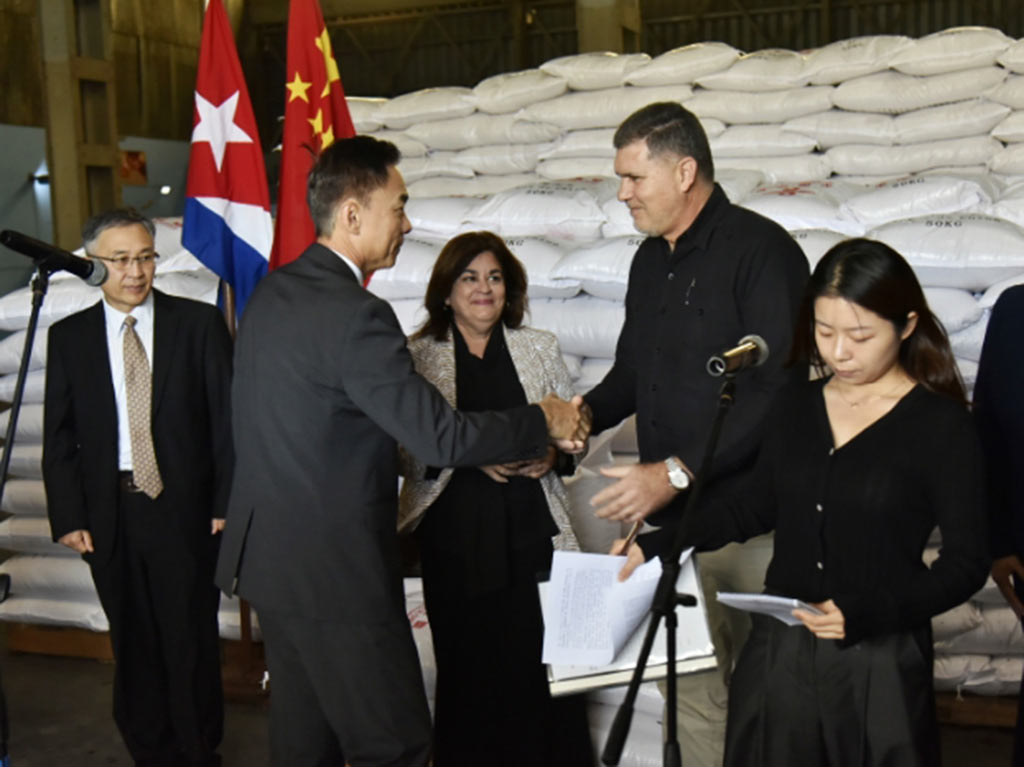
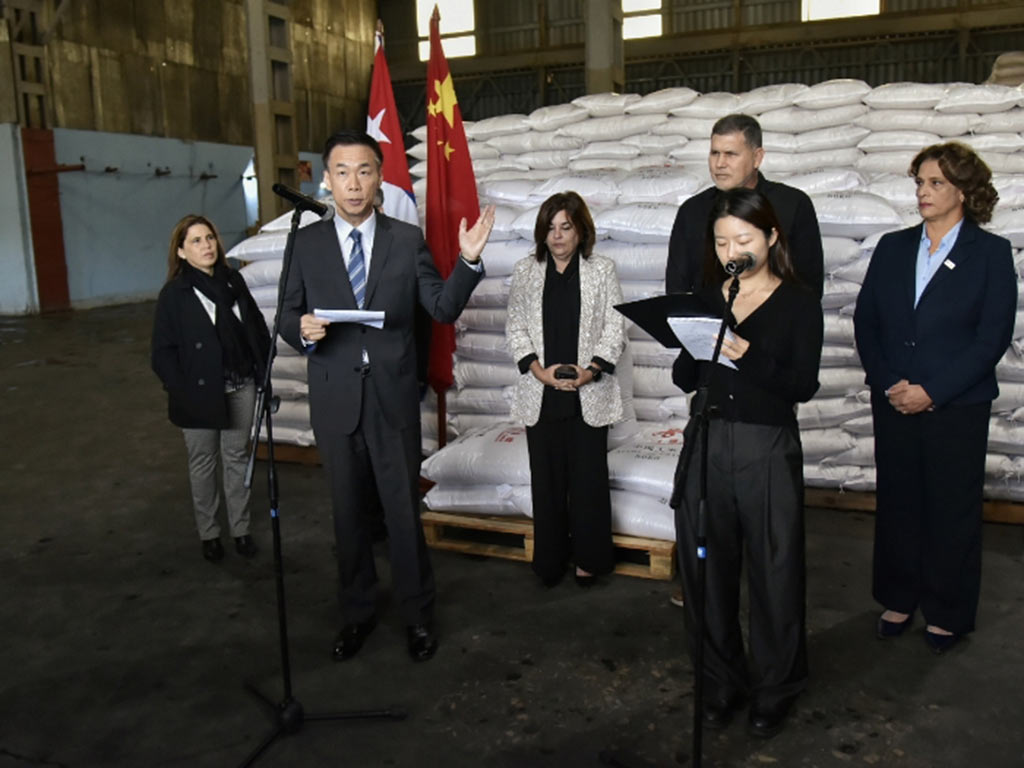
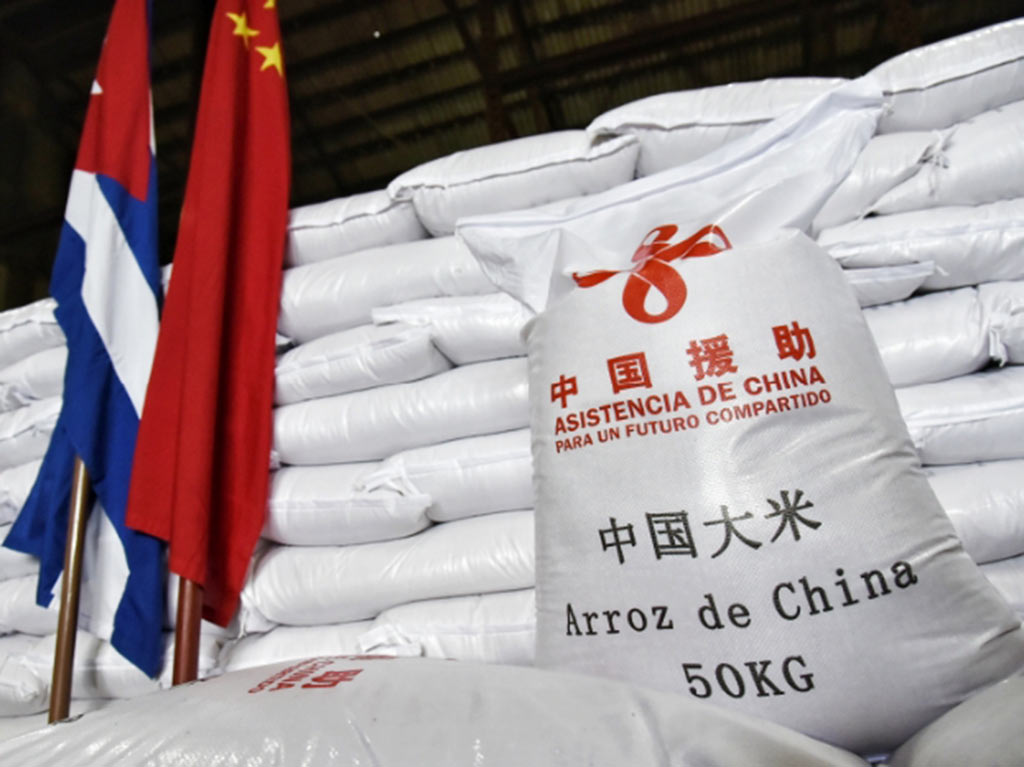
Havana, January 19 (Prensa Latina) Cuba officially received today the first batch of the donation of 30,000 tons of rice from China, sent in the emergency modality to complement national efforts to meet the food demand of the population.

Photos by Abel Rojas

In a ceremony of gratitude held this Monday at the Loading and Unloading Center of the Ministry of Domestic Trade, in Havana, the Deputy Prime Minister of Cuba, Óscar Pérez-Oliva Fraga, pointed out that this donation is a concrete expression of the exemplary, unconditional and selfless cooperation of the People’s Republic of China with the Caribbean country.

He emphasized that China not only cooperates with Cuba in sending food and in the energy sector and many other fields, but also effectively cooperates with Cuba to increase national rice production and achieve food self-sufficiency.

“We deeply recognize and appreciate this help at a complex time when levels of aggression are rising and the economic, commercial and financial blockade of the United States against the Cuban people is intensifying in an unprecedented way,” said Pérez-Oliva.

“We greatly appreciate this gesture, which is a concrete expression of building a community with a shared future between the peoples of Cuba and China,” he concluded.

For his part, China’s ambassador to Cuba, Hua Xin, said that these are the first supplies from his country’s government’s emergency food assistance project for the largest of the Antilles.

“This assistance not only embodies the deep bonds of special friendship between both nations, but also demonstrates the unwavering commitment to remain united even in difficult times,” the diplomat noted.

During the event, Pérez-Oliva noted that two shipments, both of 2,400 tons of the grain, had already been received through the Mariel container terminal and the port of Santiago de Cuba, and that they would be distributed immediately and free of charge to the Cuban population.

During the first half of this year, two more shipments will continue to arrive in Cuba, completing the total amount donated by the Chinese people and authorities, the official noted.

The Chinese government is pushing this aid project forward at maximum speed, and a third batch of 15,600 tons is already ready for shipment, while a fourth batch of 9,600 tons will be dispatched in mid-February to benefit the entire population of the island, explained the Chinese ambassador.

Meanwhile, assistance to the areas of Cuba affected by Hurricane Melissa is progressing efficiently, the diplomat from the Asian country said.

He recalled that in November 2025, six batches of food were urgently sent to Cuba by air, in addition to essential supplies such as solar lamps, roofing materials, and mattresses, which arrived this month in two batches by sea to the port of Santiago de Cuba, which will guarantee the reconstruction and recovery after the disaster in the eastern provinces.

“We deeply understand that true friendship is revealed in times of greatest need,” the Chinese ambassador emphasized in his speech.

Faced with the current complex international situation, China has always been Cuba’s strongest partner, he emphasized.

“Every grain of rice delivered today embodies the unwavering commitment of the Chinese people to never abandon the Cubans,” he added.

“We are convinced that with the joint efforts of both countries, no blockade will be able to extinguish the light of hope, nor will any difficulty be able to hinder the path forward,” he added.

In the future, China is willing to further strengthen cooperation with Cuba, overcoming difficulties together and promoting the building of a China-Cuba community with a shared future, concluded the diplomatic representative of the Asian giant.

jha/abm

Posted in The Blockade? | Leave a comment

Thousands Gather in Havana to Honor Cubans Killed by U.S.

January 16, 2026 — Belly of the Beast

Thousands of Cubans gathered in Havana to express their condolences and pay tribute to the 32 Cubans who lost their lives during the U.S. attack on Venezuela.

“We’re here to recognize the bravery of those who sacrificed their lives,” said Dailene Dovale, a university professor.

“If there are 32 no longer with us, there are millions of Cubans today who are ready to follow the path of those 32,” said a Cuban doctor who previously served on a medical mission in Venezuela.

TRANSCRIPT

“Thousands of Cubans have gathered at the headquarters of Cuba’s Ministry of the Revolutionary Armed Forces to express their condolences and pay tribute to the Cuban men who died during the U.S. attack on Venezuela,” said Liz Oliva, a journalist with Belly of the Beast.

“This is a moment of infinite sadness and deep pain,” said Dailene Dovale, a university professor. “We’re here to recognize the bravery of those who sacrificed their lives.”

“The country is receiving them with pride because they fulfilled their duty,” stated Deysi Medina, an accountant.

“I remember my parents telling me back in the 1980s about the terrorist attack on a civilian airliner in Barbados,” recalled Duniel Abreu, a professor of neurosurgery. “Fidel Castro, standing at that podium, said that when a strong, brave people weeps, injustice trembles. Today, that pain is felt by all Cubans.”

“Neither rain nor long lines stopped people from showing solidarity with the fallen soldiers and their families,” Oliva explained.

“Did the rain make people leave?” Oliva asked.

“No, no, no,” responded Solanch Espinoza. “You see us soaked, but here we are.”

“It’s a duty, too, because we are Cubans,” said journalist Danna Márquez. “They are our compatriots, and we owe this to them. It’s our responsibility.”

“They are my former comrades,” said Jorge Luis. “I knew many of them from civilian life. They fought like the lions they were.”

“During the ceremony, families and friends of the fallen soldiers had the opportunity to say goodbye to their loved ones,” Oliva continued.

“We feel a mix of pride and a deep pain,” said Marbelis Sánchez, sister of Orlando Osoria López.

“He didn’t die in vain,” said the father of Orlando Osoria López. “He died defending Latin America.”

“What is their legacy for Cuba?” Oliva asked Alberto Luzón, a relative of Andy González.

“That the Cuban people won’t surrender,” Luzón answered. “We will die before surrendering.”

“Orlando Osoria López was my brother, the only one I had,” Sánchez added. “He was such a good man.”

“How would you respond to statements by U.S. officials who say the Cubans who died were mercenaries sent by Cuba and were propping up the Maduro government?” Oliva asked Solanch Espinoza.

“I’ll be honest,” Espinoza replied. “They are cynics. They send U.S. troops to many countries, and all they do is destroy.”

“It is the right of every nation to collaborate for its own security,” said Teishan Latner, a history professor at Thomas Jefferson University. “Cuban soldiers were breaking no law. The claims of the Trump administration are entirely fraudulent. Cuban soldiers had every right to be in Venezuela and every right to defend it against U.S. aggression.”

“We’ve always said that we will defend Venezuela, and we’ve stuck to that,” reaffirmed Alberto Luzón.

“Internationalism is deeply rooted in the Cuban people,” he continued. “Venezuela is part of the Americas. Just as we are children of the Americas, we owe ourselves to Venezuela.”

“Cuba has a long tradition of internationalism and solidarity, not only with Latin America but also with Africa and Asia, since the beginning of the Revolution,” explained Pedro, a Brazilian historian. “That internationalism is a pillar and an intrinsic part of the revolutionary project.”

“How do you feel seeing all this popular support and this mobilization to pay tribute?” Oliva asked.

“I feel hope and faith,” Espinoza said. “Faith that the Cuban people can be counted on.”

“If there are 32 who are no longer with us today,” concluded Abreu, “there are millions of Cubans who are ready to follow in the path of those 32.”

“After their deaths, the fallen Cubans were promoted in rank,” Oliva reported.

“The remains of the 32 Cubans will be laid to rest in the Pantheon of Fallen Soldiers in their respective communities on Friday,” she added. “The funeral honors began today and are expected to last 48 hours.”

Posted in The Blockade? | Leave a comment

What Would a Trump Deal With Cuba Look Like?

Belly of the Beast – January 15, 2026

The same dynamic played out in Cuba, where Trump imposed “maximum pressure” measures that effectively expelled U.S. companies, destroyed the island’s economy and fueled unprvecedented migration to the United States.

Now, Trump says the U.S. will take control of Venezuela’s oil industry and is warning Cuba to “make a deal…BEFORE IT IS TOO LATE.”

This week, we look at what this deal might look like and how Trump’s foreign policy in his first term created the crises in Venezuela and Cuba that he now claims to be trying to solve.

Creating the Crisis, Claiming the Cure

Donald Trump invented a drug cartel to justify abducting Venezuela’s president so U.S. oil companies could get back into the country. The irony is that his own sanctions were a reason they were forced out in the first place.

“We left under the sanctions in 2019,” Halliburton CEO Jeff Miller told Trump at a gathering of oil executives at the White House on Friday. “We had intended to stay, and then when the sanctions went into place, we were required to leave.”

Trump began imposing new sanctions on Venezuela in 2017 and strengthened them in 2019, leading to a decline in average caloric consumption among Venezuelans, rising rates of illness and death, and the displacement of millions due to deteriorating economic conditions, according to a study by the Center for Economic and Policy Research.

Cuba was being squeezed at the same time. Sanctions drove out U.S. companies, destroyed the economy, impoverished the population and pushed more than a million Cubans to migrate to the United States. Now, Trump is claiming Cuba is on the verge of collapse, but his own policies have created the very crisis that is being used to justify Washington’s calls for regime change.

“I have a future here”… then Trump won

Despite the history of acrimony between the two countries, Cuba has long shown a desire to normalize relations. Just over a decade ago, in December 2014, the two countries began doing just that after Barack Obama and Raúl Castro brokered a historic detente. The countries “re-established diplomatic relations,” and Obama became the first sitting U.S. president to visit Cuba since 1928.

The deal brought in both U.S. companies and visitors to the island, boosting the economy and giving many Cubans hope for a better future.

“I hardly had time to rest,” Havana taxi driver Oscar Álvarez told Belly of the Beast. “We picked up passengers at the cruise ship terminal, and we didn’t stop all day.”

“Havana was overcrowded: celebrities, musicians, politicians — everybody. Chanel runway, Fast and Furious shooting, Rolling Stones concert,” Cuban fashion designer Idania del Río told journalist Liz Oliva Fernández in our documentary series The War on Cuba. “The mood was ‘anything is possible,’ all this sense of change, and finally to be aware of: ‘I have a future here. I can stay here. I don’t have to leave my country.’ But then Trump won the election.”

Since 2017, Cuba has been subject to a barrage of “maximum pressure” sanctions imposed by Trump and largely kept in place by Joe Biden. Some of the measures, like the 2019 U.S. ban on cruise ship visits, battered Cuba’s economy and the fledgling private sector.

“You could really see the difference when the American cruise ships stopped,” said Álvarez. “They left a big hole, and not just for us. They gave life to the whole city.”

Now, after forcing U.S. companies out of Cuba just like he did with Venezuela — and blocking all shipments of Venezuelan oil to the island — Trump has warned that Cuba is about to collapse and better make a deal “BEFORE IT IS TOO LATE.”

“We’re talking to Cuba, and you’ll find out pretty soon,” he told reporters Sunday on Air Force One. Cuba on Monday denied any negotiations were underway.

What would a Trump deal with Cuba look like?

It’s not clear whether Trump’s endgame in Cuba is wholesale political change, which has long been Washington’s take-it-or-leave-it approach, or striking a deal that opens the island to U.S. companies while leaving the political system intact, as he did with Venezuela’s acting president, Delcy Rodríguez.

Marco Rubio and his fellow hardliners have not been subtle about their aspirations for Cuba. Rep. Carlos Giménez (R-FL) last week posted a map on X, showing U.S. company logos scattered across the island with the accompanying text: “POV: Cuba soon.” He wrote: “When the inevitable happens in #Cuba & the narcoterrorist dictatorship is no more, there won’t be a company that won’t want to invest in the stunning, beautiful island of my birth.”

Fact check: Far from a “narcoterrorist dictatorship,” Cuba is arguably the U.S. government’s most reliable security partner in the Caribbean. See Liz Oliva Fernández’s report on Cuba’s counternarcotics efforts.

video preview

While Cuban-American hardliners have long salivated at the prospect of the U.S. recolonizing Cuba, Trump in the past seemed interested in investing in the island without regime change. In 2008, Trump’s brand name was registered with Cuba’s Office of Industrial Property for hotels, casinos, beauty contests, television programs and golf courses. And Trump Organization executives have visited Cuba on different occasions, smoking cigars, playing golf and scoping out business opportunities.

“Trump does not have a principled opposition to Cuban socialism,” said William LeoGrande, professor of government at American University. “He was willing to go and work with the socialist government of Cuba to build a hotel and a casino.”

Trump endorsed Obama’s detente in March 2016. “After 50 years, it’s enough time, folks,” he said at a Republican primary debate in which he faced off against Rubio, then a senator.

But after winning the presidential primary, Trump cut a deal with Rubio, getting his support both in Florida and in the Senate in exchange for endorsing Rubio’s hard-line policy toward Cuba.

Trump, who once called Rubio a “lightweight choker” and “corrupt politician,” now seems intent on making him and his Cuban-American allies happy.

When a reporter asked Trump on Sunday what kind of deal he was looking for with Cuba, he responded: “One of the groups I want taken care of are the people that came from Cuba that were forced out or left under duress.”

Posted in The Blockade? | Leave a comment

Cuba honors its 32 heroes at the José Martí Anti-Imperialist Tribune

Havana, January 16 (Prensa Latina) Honor and glory to our heroes who fell in combat on January 3, 2026, Cuban President Miguel Díaz-Canel said today in a solemn ceremony at the José Martí Anti-Imperialist Tribune in this capital.

Photos: Vladimir Molina Espada (PhotosPL)

Courage is the word everyone uses to describe the confrontation with the attack against Venezuela; they defended peace, the dignity of Cuba and of our America, the president added, referring to the 32 combatants who lost their lives during the US aggression against the South American nation.

The ceremony began with the musical themes Su nombre es pueblo (1994), by singer-songwriter Sarah González and performed by singer Annie Garcés, and Canción urgente nuestroamericana (2025), by troubadours Raúl Torres and Fidel Díaz Castro.

The event was attended by the highest authorities of the Communist Party of Cuba, the Government and representatives of organizations such as the Union of Young Communists, the Association of Combatants, the Ministry of the Interior, the Revolutionary Armed Forces and the University Student Federation.

Thousands of Cubans are currently marching from the José Martí Anti-Imperialist Tribune on the Malecón to the iconic Calle G, both located in Havana’s Vedado district, on the second day of funeral commemorations. Throughout the day, all provinces will pay tribute to the combatants who died during the US attack on the South American nation and the kidnapping of President Nicolás Maduro and his wife, Cilia Flores.

ro/vnl

Posted in The Blockade? | Leave a comment

Despite threats by Trump, Mexico continues supplying Cuba with oil

A vehicle travels along a highway near the Port of Matanzas in Matanzas, Cuba, on Saturday, March 30, 2024. (Yander Zamora/Bloomberg via Getty Images)

by: Salvador Rivera

 Jan 13, 2026 — WOODTV.COM (Grand Rapids/Kalamazoo/Holland, Michigan)

SAN DIEGO (Border Report) — Despite threats by President Trump to keep any oil from flowing to Cuba, Energy Secretary Chris Wright said the U.S. will not interfere with Mexico as it continues to supply the island with petroleum.

During an interview with CBS News, Wright said the U.S. will allow Mexico to deliver oil to Cuba, contradicting Trump’s goal to leave Cuba “with zero oil.”

Wright said the Trump administration is not trying to let Cuba collapse without any oil, and that it is simply looking for Cuba to “abandon its communist system.”Mexico will continue to supply Cuba with oil for ‘humanitarian reasons’

On Jan. 3, U.S. forces took custody of Venezuelan President Nicolás Maduro, seemingly leaving Cuba without its primary source of oil.

Since then, President of Mexico Claudia Sheinbaum has said her country will continue to send oil to Cuba for humanitarian reasons to avoid widespread power blackouts on the island.

She has also said Mexico is prepared to be a liaison to provide better lines of communication between the Cuban and U.S. governments.

Posted in The Blockade? | Leave a comment

Cuba’s President Defies the U.S. as Trump Pressures Cuban Government to Make a Deal

January 14, 2026 — Democracy Now!

Cuban President Miguel Díaz-Canel has said his government is not currently in talks with Washington, remaining defiant as the Trump administration attempts to pressure Cuba into making a deal with the U.S. after the military strike on Venezuela. In a series of posts on X, Díaz-Canel said, “As history demonstrates, relations between the U.S. and Cuba, in order to advance, must be based on International Law rather than on hostility, threats, and economic coercion.” His comments came after Trump announced on Sunday that Cuba would no longer be receiving Venezuelan oil, which has been a lifeline for the island that has been devastated by decades of U.S. economic sanctions.

Posted in The Blockade? | Leave a comment