Havana, April 6 (Prensa Latina) Cuban Foreign Minister Bruno Rodríguez highlighted the discontent of the United States population with the administration of President Donald Trump, local media reported today.
“Hands-Off protests in more than a thousand cities across all 50 states, with nearly half a million people participating, denounce the plutocracy that governs that country,” the foreign minister said.
According to a comment by Rodriguez on the social network X, Trump governs focused on satisfying the interests of “big capital and against the aspirations of the majority of American citizens.”
Thousands of people demonstrated yesterday in the U.S. capital, Washington, as part of some 1,200 demonstrations across the United States and other parts of the world, according to various news reports.
In what is considered the largest day of protests against President Donald Trump, demonstrators also criticized the work of presidential advisor Elon Musk.
The radical reforms and cuts implemented by the government were criticized with the same intensity as outside of North America.
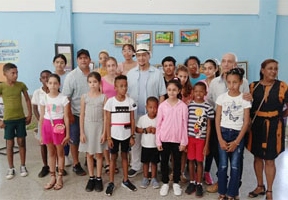
Rome, Apr 6 (Prensa Latina) The Cuban community in Italy and the embassy of the Caribbean country celebrated today in this capital the 64th anniversary of the José Martí Pioneer Organization (OPJM) and the 63rd anniversary of the Union of Young Communists (UJC) of that nation.
As part of the initiatives to celebrate the holiday, a children’s party was held at the Giulio Glorioso sports field in Rome’s San Paolo neighborhood, as well as a softball match between teams from Cuba and the Dominican Republic, comprised of nationals from both countries residing here and diplomatic officials.
The event was presided over by the island’s ambassador, Mirta Granda, who recalled that the Pioneers’ group was founded on April 4, 1961, while the UJC was created on the same date the following year. She emphasized that both play an important role in the formation of new generations committed to the revolutionary process.
For his part, Lázaro Martín, coordinator of the associations of Cubans residing in the center and south of this European nation, spoke about the importance of honoring the children and youth of the Caribbean country, who are part of a heroic people affected by the criminal economic, commercial, and financial blockade imposed by the United States.
Cuba needs “the greatest support and solidarity we can provide” amid difficult conditions, primarily as a result of U.S. government measures, including its unilateral and unfair inclusion on the list of countries that allegedly support terrorism, he emphasized.
Granda thanked the Cubans living in Italy for this initiative, which had the support of the diplomatic mission, and noted that it was one of the events within the framework of the 17th Meeting of Cubans Residing in Europe (ECRE), to be held in Rome from October 24 to 26 of this year.
This event will be a fundamental space for bringing together good-hearted compatriots who support and defend the Cuban Revolution from all over the world. They will be able to exchange ideas on topics of common interest, and new cultural and solidarity projects will be presented there.
At this meeting, various aspects of the relationship between the nation and emigration will be evaluated, including new immigration laws, and potential contributions to the country’s economic development will be discussed, among many other topics.
Also in October, on the sidelines of the 17th ECRE, the Italian capital will host the 4th edition of the Cuba Va Conmigo Festival, for Cuban nationals living abroad. A large presence of artists from all walks of life is expected.
The call for these events invites “Cubans of good will, promoters of peace, and especially those with a deep love for their homeland, because Homeland is humanity, as Martí said, and Cuba unites us from every corner of the world.”
Havana, April 6 (Prensa Latina) Cuban Foreign Minister Bruno Rodríguez today described as infamous the text that laid the foundations for the United States economic blockade of the island, on the occasion of its 65th anniversary.
On April 6, 1960, Assistant Secretary of State for Inter-American Affairs Lester D. Mallory, in a secret memorandum, defined the philosophy of the economic, commercial, and financial blockade imposed shortly after against the Caribbean nation.
“After 65 years of the infamous memorandum, the United States government maintains the same policy against Cuba,” Rodríguez stated through the social network X.
The Foreign Minister denounced the fact that the U.S. government is “making our people suffer” and attacking “their sources of livelihood” with the implementation of this siege.
He also accused Washington of including Cuba on its unilateral State Sponsors of Terrorism List, waging a cognitive and communications war against the Caribbean country, and orchestrating a smear campaign against Cuban medical cooperation.
In the document he sent to Eisenhower, then president of the United States, Mallory suggested destroying Cuba’s economy as “the only foreseeable way to undermine domestic support” for the leader of the Revolution, Fidel Castro.
“We must quickly employ all possible means to weaken Cuba’s economic life,” he declared.
For more than six decades, Cuban authorities have denounced this hostility in various national and international forums.
They have also rejected the White House’s intention to excuse this policy and other sanctions from the shortcomings in this country and, therefore, blame the Cuban government’s actions for them.
Havana, April 4 (Prensa Latina) The Food and Agriculture Organization of the United Nations (FAO) announced today in Havana the conclusion of a capacity-building project to address climate change (CBIT AFOLU).
This training, which benefited the nation’s economy, ended after four years of implementation, according to this Friday’s note.
This initiative by the Ministry of Agriculture, with technical assistance from FAO and funding from the Global Environment Facility, was instrumental in better preparing the country’s agriculture, forestry, and other land use (AFOLU) sector to respond to environmental challenges and the demands of the Paris Agreement.
Implemented since 2021, CBIT has strengthened national technical capacities to measure, assess, and report on greenhouse gas (GHG) emissions and removals in the AFOLU sector.
As a result, the country has, for the first time, an Information System on Climate Change in Agriculture (SICCA), which functions as a platform where various stakeholders collaborate to systematize information on climate change, monitor the progress of climate goals, and facilitate data-driven decision-making.
This system will serve as a recording and reporting tool to systematize climate change mitigation and adaptation actions in agriculture. It will also be essential for reporting at the sectoral and national levels in the context of national plans, policies, and commitments on these issues.
From the SICCA platform, users can also access the National Greenhouse Gas Inventory Management System for the AFOLU sector; the Measurement, Reporting, and Verification System for climate finance and mitigation actions; and a Monitoring and Evaluation System for adaptation actions.
At the end of the project, the agricultural, forestry, and other land use sectors also had an Agrarian Climate Action Plan, a strategic framework that integrates adaptation and mitigation measures into the development programs for the agricultural, livestock, and forestry sectors within the context of the State Plan for Addressing Climate Change in the Republic of Cuba.
This initiative is known as Task Life and fulfills expectations related to the future of agriculture in this nation.
As part of the project, FAO, with funding from the GEF, also provided equipment and technology for more precise measurement of greenhouse gas emissions in agriculture, strengthening national capacities for the development of GHG inventories.
With CBIT AFOLU, Cuba is able to produce more timely reports that allow for transparent monitoring of the implementation of its mitigation measures for submission to the United Nations Framework Convention on Climate Change and meet the requirements established in Article 13 of the Paris Agreement, they emphasized.
Havana, April 4 (Prensa Latina) Cuban Foreign Minister Bruno Rodríguez accused the United States today of hiding for years its intention to damage the Caribbean country’s economy in order to harm its population.
“Now, the State Department envoy publicly confesses it, as if it were legitimate to attack and abuse an entire population to force a change of government,” Rodríguez denounced on the social network X.
In this regard, Cuban diplomats pointed out that, despite the United States’ denials, it is impossible to deny that the blockade is a weapon of aggression, abusive, inhumane, and immoral.
Vice Foreign Minister Carlos Fernández de Cossío also denounced in X that U.S. government officials “no longer hide their goal of destroying the Cuban economy and the results of what they have achieved in causing pain to the people. It used to be a covert policy, and they used to blame the Cuban government for our economic problems.”
According to Johana Tablada, deputy director general of the United States Directorate of the Cuban Foreign Ministry, the U.S. war policy has failed in its political objective, but it has succeeded in causing suffering to Cuban families.
In an interview with the website Cubainformación, he argued that the U.S. nation’s economic warfare measures served to torture the Cuban population, “in a kind of laboratory experiment to suffocate and cut off all their sources of income.”
When asked why President Donald Trump isn’t taking steps toward lifting the blockade, he explained that “the issue of Cuba has been outsourced to sectors in South Florida, which have made a lucrative business out of the policy of aggression against the Cuban Revolution and the economic siege of our country.”
The hypothetical end of the siege on the island, he admitted, would be beneficial for both countries, in areas such as investment, culture, or access to Cuban medications such as Heberprot-P, which prevents diabetic foot amputation, a condition that affects thousands of people in the United States.
Havana, April 4 (Prensa Latina) Cuba and Russia strengthened ties today in the context of the 22nd Meeting of the binational Intergovernmental Commission for Economic-Commercial, Scientific-Technical Cooperation.
Cuban Prime Minister Manuel Marrero and Vice President Dmitry Chernyshenko led the signing of 13 legal instruments establishing commitments for cooperation in the areas of health, education, and science and technology, primarily.
These include the development of a joint Artificial Intelligence laboratory, as part of the ties between Russian and Cuban universities and institutions, and agreements for the technical training of specialists and exchanges in the fields of geodesy and cartography.
According to Cuban Deputy Prime Minister Ricardo Cabrisas, the meeting, held today in the Havana’s El Laguito protocol hall, was productive, frank, and transparent, and confirmed the enormous potential to strengthen and diversify collaboration for mutual benefit.
For his part, Chernyshenko expressed that his country will continue to support the Caribbean nation’s development efforts.
In this regard, he highlighted the existing ties in energy investments and projects, transportation, electronics, tourism, educational exchanges, and the agri-food sector, among others.
Chernyshenko arrived Wednesday night at Antonio Maceo Grajales International Airport in the eastern province of Santiago de Cuba, where he began an official visit to the island.
The Russian delegation’s agenda in Havana includes meetings with the Cuban state and government leadership.
This visit takes place in the year that marks the 65th anniversary of the reestablishment of diplomatic relations between Cuba and the then Soviet Union.
Havana, April 3 (Prensa Latina) The third edition of the International Transport and Logistics Fair (FITL 2025) in Cuba concluded today, and among its results is the signing of some 130 business documents, said the minister of the sector, Eduardo Rodríguez.
From April 1 to 3, more than 200 companies from various countries gathered at the Pabexpo exhibition center to showcase their products, projects, and experiences, demonstrating the global interest in strengthening our logistics capabilities, Rodríguez stated during the closing ceremony of FITL, which was attended by the country’s president, Miguel Díaz-Canel.
Rodríguez specified that the signed documents include contracts, memoranda, and agreements that will boost exports and support the recovery, development, and gradual growth of Cuba’s transportation system.
He added that progress is being made on the project for the first electric bus terminal for public passenger transportation in Havana, as well as on the acquisition of 20 new electric buses for the transportation of aviation workers, which will also support public mobility.
Other results include the national industry’s potential to provide electric hearses, as well as improve maritime passenger transportation to and from the Isle of Youth, he listed.
These days, he said, we have felt the satisfaction of seeing projects conceived in previous editions become reality, and we are certain that this will happen in greater numbers in the fourth edition.
We know we need to do much more, to move forward at a faster pace, he emphasized, while acknowledging the urgency of finding solutions to the challenges, for which new ideas and paths that lead to the recovery of transportation in Cuba are valued.
In Rodríguez’s opinion, the meetings with Fair attendees show the way to what needs to be changed to move forward at a faster pace.
Near the end, he thanked the attendees for their contributions and their belief in the potential of the transportation and logistics system amid the difficult situation the country is facing. He also highlighted the presence at FITL 2025 of the provincial transportation delegates, who face complex problems on a daily basis.
Together, we can continue on the path toward the sustainable development that Cuba and our people need, he stated.
At the end, the Minister of Transportation announced the 4th International Transportation and Logistics Fair, which will be held in 2027.
Havana, April 3 (Prensa Latina) An April for Pediatrics is the motto of a campaign that will take place this month in Cuba to highlight the importance of children’s health and the work of professionals in their care.
Institutions, communities, and social organizations in the Greater Antilles are joining forces with the Ministry of Public Health (MINSAP) to promote various actions that raise awareness about the challenges in pediatric care.
These include educational activities, vaccination days, and cultural events designed to engage families and industry professionals.
They are convened by the Cuban Society of Pediatrics, the National Department of Maternal and Child Care, the National Postgraduate Directorate of the Ministry of Public Health (MINSAP), the national and provincial Pediatric groups, and the National Department of Nursing.
The National Road Safety Symposium will be held today and tomorrow in this capital. Under the slogan “Stop the risks and reach your destination,” the event seeks to raise awareness about accident prevention and the importance of collective responsibility.
From April 7 to 12, quality standards for comprehensive care for adolescents will be monitored in 35 municipalities across the country. This initiative aims to evaluate and strengthen care for this population group.
The calendar continues with a Pediatric Open House, scheduled for April 21-25, where the community is invited to learn more about the world of children’s health and experience firsthand the sensitivity and humanism of the specialists’ work.
Professional training and development also take center stage during this commemoration, as a workshop on methodological preparation for child and adolescent consultations will be held from April 14 to 20.
The organizers also announced the holding of a National Ultrasonography and Hemodynamics Workshop in various Neonatal services, and a virtual course on pediatric surgery that will strengthen technical skills in this field.
In addition, the new Child Sexual Abuse Prevention Protocol will be presented, reinforcing the institutional commitment to protecting children’s rights.
In parallel, a polio vaccination campaign will be carried out starting April 22, a crucial initiative for preventive health care at early ages. Scientific workshops for pediatric residents will be held at regional universities on April 28, promoting the exchange of knowledge and innovative experiences.
The campaign is scheduled to conclude on April 30th, with keynote addresses that will review the achievements, evaluate the impact of the initiatives, and outline challenges and action plans to consolidate future strategies.
Santiago de Cuba, April 3 (Prensa Latina) The Vice President of the Government of the Russian Federation, Dmitry Nikolaevich Chernyshenko, paid tribute today to the historic leader of the Cuban Revolution, Fidel Castro, before the monolith that houses his ashes, in the Santa Ifigenia heritage cemetery.
The Russian leader described the beginning of his official visit to the cemetery as highly symbolic, at the request of President Vladimir Putin, while affirming that his country will always stand by Cuba and assist it in the legitimate defense of its sovereignty.
Chernyshenko mentioned that both nations will celebrate several important dates this year, such as the eightieth anniversary of the victory in the Great Patriotic War, the sixty-fifth anniversary of the restoration of relations between Russia and Cuba, and the five hundred and tenth anniversary of the founding of the city of Santiago de Cuba.
According to the Cuban News Agency, the vice president expressed his honor to “be here and pay tribute to the Cuban heroes who gave their lives for the sovereignty and happiness of future generations.”
He emphasized the importance of remembering Cuban heroes and educating young people with respect and admiration, “so that they remember everything these people did for the country.”
The high-ranking official also laid wreaths at the tomb of Cuban National Hero José Martí, and at those of Mariana Grajales and Carlos Manuel de Céspedes, Mother and Father of the Nation, respectively.
During his stay in Havana, Chernyshenko will co-chair the 22nd Session of the Russian-Cuban Intergovernmental Commission for Economic, Commercial, and Scientific and Technical Cooperation.
Asunción, April 2 (RHC)– A Cuban delegation took part in the World Telecommunications Development Conference for the Americas this week in Paraguay, according to executives from this sector on the Caribbean island.
According to Tania Velázquez, the Executive President of the Cuban Telecommunications Company (Etecsa), the delegates from this Caribbean nation participated in the forums and working meetings organized within the framework of the World Conference to promote the development of new technologies and connectivity in the region.
The event, which ended on Wednesday, April 2nd, in Asunción, the capital of Paraguay, is considered one of the most important in the field of telecommunications and was organized by the National Commission for this sector in that country and the International Telecommunication Union (ITU).
In statements to the newspaper La Nación, Cosmas Zavazava, president of the ITU, noted that the Americas have great potential, which is why the organization believes in innovation in telecommunications.
“The region must not be left behind in terms of telecommunications development and has the capacity to overcome challenges such as the digital divide in each country, the ethical use of artificial intelligence, among others,” he explained.
More than 150 delegates from 33 countries took part in the World Telecommunication Development Conference for the Americas Region.