The Department of Homeland Security announced last week the end of the Family Reunification Parole (FRP) program for nationals from Cuba, Colombia, Ecuador, El Salvador, Guatemala, Haiti and Honduras.
People from those countries who are currently in the U.S. under Family Reunification Parole and had not applied for residency or a change of status by December 15 will have their legal status and work permits revoked.
“The desire to reunite families does not overcome the government’s responsibility to prevent fraud and abuse and to uphold national security and public safety,” the Department of Homeland Security said in a statement.
Family Reunification Parole joins the list of programs under which Cubans could legally enter the U.S. that have been dismantled by the Trump administration. These include Biden’s CBP One and Humanitarian Parole programs, whose termination put many of the over half million Cubans who entered the U.S. through them at risk of deportation.
A partial travel ban on Cubans has been in place since June. Trump earlier this month also suspended pending citizenship, green card and asylum applications for immigrants from countries “of concern,” including Cuba. More than a thousand Cubans have been deported to the island this year.
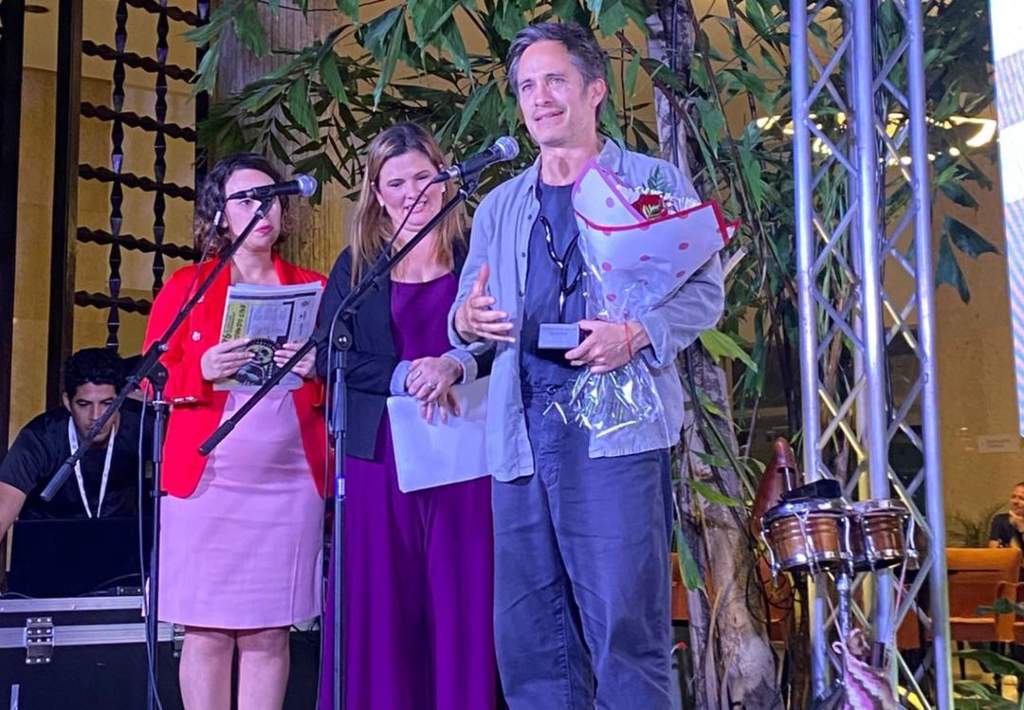
The renowned actor last week received the Honorary Coral at the 46th Havana International Film Festival. Bernal, who has starred in films like Amores Perros, Y tu mamá también and Babel, has several links to Cuba. He studied on the island at the San Antonio de los Baños International Film and TV School, played Che Guevara twice (in the 2002 TV mini series Fidel and the 2004 film The Motorcycle Diaries) and was an actor in Wasp Network, which was partially filmed in Cuba. “I’m moved by this award,” the actor said. “I want to thank Cuba, which has given me so much.”
Cuba solidarity organizations have sent a million dollars’ worth of medical aid and hurricane relief to Cuba from California. The initiative includes the L.A. Hands Off Cuba Committee, the Pan American Medical Association, Global Health Partners and Not Just Tourists. “The immoral policies of the United States toward Cuba only strengthen, which makes this humanitarian effort, unfortunately, all the more important,” said Mike Vera, one of the activists behind the initiative in a video posted on social media.
“The most efficient partner of the United States in security terms in Latin America is Cuba.”
—Hal Klepak, military historian, former NATO analyst and former advisor to Canada’s foreign and defense ministers
December 19, 2025 — Belly of the Beast
Every year, the State Department delivers its International Narcotics Control Strategy Report to Congress. The document is a country-by-country breakdown of “all aspects of the international drug trade.”
The 2024 report states that Cuba is “not a major consumer, producer, or transshipment point for illicit drugs” and notes that its “robust and aggressive security presence reduces domestic demand and severely limits the ability of transnational criminal organizations to establish a foothold.” Drug traffickers, it says, “typically bypass Cuba in favor of neighboring countries.”
The report adds that the Cuban Border Guard has a “long-standing relationship with the U.S. Coast Guard and frequently reports known or suspected drug trafficking.”
This year, under the supervision of Secretary of State Marco Rubio, whose brother-in-law was convicted of smuggling cocaine into the U.S. in the 1980s, the State Department excised Cuba from the entire International Narcotics Control Strategy Report.
No explanation was provided and the State Department did not respond toBelly of the Beast’s requests for comment.
Could it be that the section on Cuba was cut because the State Department’s own analysis undermines the administration’s narrative?
We reported on the island’s counternarcotics efforts in eastern Cuba two years ago. Liz Oliva Fernández interviewed members of the Cuban Border Guard as well as a U.S. embassy official and a U.S. Coast Guard official who were meeting with their counterparts. Watch Liz’s video.
“The Coast Guard has always maintained very close relations with the Cuban government, and especially with the Interior Ministry and the Cuban Border Guard,” said U.S. Coast Guard Lieutenant Commander Alejandro Collazo. “I would dare say we speak to each other more than once a week.”
Despite Cuba’s erasure from the State Department’s 2025 counternarcotics report, Cuba says it continues to collaborate with the United States.
“We’re providing the U.S. with information in real time,” Colonel Ybey Carballo, chief of Cuba’s Border Guard, said at a recent press conference. “We tell them the characteristics of the boats, how many engines they have, the number of crew members.”
But the U.S. government’s willingness to reciprocate Cuba’s counternarcotics efforts may not be the same as it was a year ago.
Colonel Juan Carlos Poey, head of the Interior Ministry’s anti-drug unit, said that despite a 2016 counternarcotics agreement between the two countries, the U.S. is cooperating with Cuba “sporadically.”
Poey said the main source of drugs entering Cuba is the United States.
Nonetheless, Cuban counternarcotics officials continue to cooperate with their U.S. counterparts.
Last week, Cuban authorities announced they had detained 24 people involved in a network that trafficked drugs from the U.S. into Havana. The operation seized “more than a million doses” of the synthetic cannabinoid known as el quimico (the chemical). According to the Ministry of Interior, Cuba has submitted evidence of U.S. residents’ involvement in the operation to the Trump administration.
Mexico City, Dec 18 (Prensa Latina) President Claudia Sheinbaum affirmed today that Mexico’s position regarding Cuba is sovereign and will be maintained even if it results in a difference with the United States government, which imposes an economic blockade on the island.
“Our position regarding Cuba will remain the same, as it has been since (former president Adolfo) López Mateos,” he asserted, recalling the consistent relationship with the Caribbean nation during previous administrations, regardless of political affiliation.
The dignitary noted that this has been a constant issue in the Mexico-United States relationship since the triumph of the Cuban Revolution in 1959 and said that the connection with the island “has always been a point of difference” between the administrations of the two neighboring countries.
“Therefore, it shouldn’t affect Mexico-United States relations. And our position is sovereign, it’s a sovereign decision, and it has a lot to do with the humanism we represent. People shouldn’t have to suffer,” he said regarding the blockade.
The head of the Executive stressed that it is the citizens of the island who suffer the economic, commercial and financial blockade imposed by Washington for more than six decades.
According to the most recent data, that US policy against the Caribbean country caused damages estimated at seven billion 556.1 million dollars between March 2024 and last February, an increase of 49 percent compared to the previous period.
Considered the main obstacle to Cuba’s development, the blockade resulted in losses of almost $300 million in one year in the health sector alone, while the impact on the energy sector exceeded $496 million due to restrictions on importing fuels and spare parts.
On October 29, Cuba achieved a new victory in the United Nations General Assembly by obtaining 165 votes in favor of the resolution calling for an end to the blockade.
United Nations, Dec 17 (Prensa Latina) Cuba reaffirmed its unwavering commitment to defending peace and condemned the threats from the United States government against Venezuela, including the extraordinary military deployment in the Caribbean under the false pretext of the fight against drugs.
During the recent Security Council open debate on “Maintaining international peace and security: leadership for peace,” the Chargé d’Affaires ai of the Permanent Mission of Cuba to the United Nations, Ambassador Yuri Gala, denounced the persistent interference with Venezuelan airspace.
The Cuban diplomat also deplored the psychological warfare and discrediting campaigns against that country, as well as other actions that also constitute flagrant violations of the UN Charter and International Law, such as unilateral coercive measures and economic strangulation.
Expressing solidarity with the people and government of Venezuela on behalf of his country, Gala denounced that, on December 10, US military forces attacked an oil tanker in international waters.
Such an act “represents an act of piracy and maritime terrorism that constitutes a serious violation of international law, including the United Nations Convention on the Law of the Sea and the Convention for the Suppression of Unlawful Acts against the Safety of Maritime Navigation,” the ambassador emphasized. He warned that these actions are part of the United States’ escalating efforts to impede Venezuela’s legitimate right to freely use and trade its natural resources with other nations, including hydrocarbon supplies to Cuba.
He added that these actions have a negative impact on Cuba and intensify the United States’ policy of maximum pressure and economic strangulation, with a direct impact on the national energy system and, consequently, on the daily lives of our people.
“This blatant act of applying the Trump corollary to the Monroe Doctrine violates the Proclamation of Latin America and the Caribbean as a Zone of Peace and demands universal condemnation,” Gala emphasized.
He opined that speaking today “of leadership for peace inevitably forces one to think about Palestine and condemned Israel’s genocide against the Palestinian people, with the complicity and impunity granted by the United States government.”
He also stressed that the new US National Security Strategy validates the dangerous doctrine of “peace through strength,” reflecting the enormous challenges facing humanity, and in particular, the Latin American and Caribbean region.
The ambassador noted that “there can be no talk of leadership for peace while unilateral coercive measures continue to be applied against sovereign states as weapons of political pressure, as is the case with the intensified economic, commercial and financial blockade of the United States against our country.”
Video of soldiers boarding the tanker from helicopters, posted by U.S. Attorney General Pam Bondi.
December 12, 2025 — Belly of the Beast
The Trump administration on Wednesday commandeered a Venezuelan oil tanker reportedly headed to Cuba, escalating its regime change efforts against both Caracas and Havana.
U.S. Attorney General Pam Bondi posted on X that the vessel was captured “off the coast of Venezuela” by the Department of War, the FBI, the Department of Homeland Security and the U.S. Coast Guard. The operation, she wrote, was aimed to disrupt “an illicit oil shipping network supporting foreign terrorist organizations.”
Asked what would happen to the oil, Trump said, “We keep it, I guess.”
Venezuelan President Nicolás Maduro yesterday accused Trump of ushering in a new “era of criminal naval piracy.” Cuba has likewise described the move as “an act of piracy” in breach of international law.
Sanctions at sea: the escalating oil war
The U.S. pressure campaign includes doubling the bounty on Maduro’s head to $50 million, authorizing the CIA to conduct covert operations inside the country, deploying more military assets to the Caribbean than at any time since the 1962 Cuban Missile Crisis, and expanding “maximum pressure” sanctions aimed at both Venezuela and Cuba.
The Department of Treasury yesterday hit six crude oil supertankers and the shipping companies linked to them with sanctions. The tankers recently loaded crude oil in Venezuela, according to reports. The Department of Treasury alleges they are “engaged in deceptive and unsafe shipping practices and continue to provide financial resources that fuel Maduro’s corrupt narco-terrorist regime.”
The U.S. has been sanctioning tankers delivering petroleum from Venezuela to Cuba since 2019.
Check out Episode 2 of our award-winning documentary series The War on Cuba, which reports on the impact of the U.S.-imposed “oil blockade.”
An investigation last year by Wired found that in addition to sanctions, the first Trump administration explored clandestinely sabotaging oil deliveries to “strike a blow against both regimes.” To this end, senior officials met with paramilitary experts. One option involved “a mobile system that could covertly (and nonviolently) disable ships.” After CIA pushback, the idea was reportedly shelved.
The seized oil tanker may not have been destined to directly meet Cuba’s energy needs. Politicocited an anonymous White House source who said that the oil was bound for Cuba, where a state-run company called Cubametales was planning to sell it on to energy brokers in Asia.
Still, the seizure is ominous for 10 million Cubans already suffering daily blackouts.
Cuba has relied heavily on Venezuelan oil since the 2000s, though imports have fallen in recent years as both countries have been beset by punishing U.S. sanctions. In 2013, Caracas sent Havana almost 100,000 barrels per day; this year Havana has received a daily average of just under 30,000 barrels per day.
On Friday, the Cuban Ministry of Foreign Affairs released a statement denouncing the “economic war” on Cuba and Venezuela: The action will have “a direct impact on the national energy system and, consequently, on the daily lives of the Cuban people.”
U.S. drug crisis has little to do with Venezuela – and nothing to do with Cuba
U.S. officials justify regime change efforts against Venezuela as necessary to protect the U.S. border from drug trafficking. But Venezuela isn’t a major producer of either cocaine or fentanyl, according to the U.S. Drug Enforcement Agency.
As for Cuba, there is no evidence of drugs flowing from the island to the United States.
The U.S. State Department’s 2024 International Narcotics Control Strategy Report states: “Cuba is not a major consumer, producer, or transshipment point for illicit drugs. Cuba’s domestic production and consumption of illicit drugs are low due to strict policing and stiff prison sentences. Nationwide prevention and information campaigns also deter drug use and sale.”
Cuban authorities allege the trafficking problem, in fact, runs in the opposite direction.
“The country that sends the most drugs into our national territory – specifically synthetic cannabinoids – is the United States,” according to Colonel Juan Carlos Poey, head of the Interior Ministry’s anti-drug unit. Cuba does not “produce, store or allow for the transit” of illicit drugs, he told reporters last week.
He added that authorities have intercepted 14 boats carrying drugs this year and detained 39 narco traffickers with no casualties. But he lamented that despite a 2016 counternarcotics agreement between the two countries, Washington’s cooperation on counternarcotics has been “sporadic,” leaving the island vulnerable to traffickers. “Cuba,” he added, “remains open to collaboration with the U.S.”
Fighting “narco-terrorism” Trump-Style: boosting narcos and sowing terror
The Trump administration’s war on “narco-terrorism” goes well beyond hypocrisy. It’s a show of brute force built on fabrications, state violence, and rewards for drug traffickers.
The administration accuses Nicolás Maduro of leading the so-called Cartel de los Soles. But many analysts say the organization “doesn’t exist.”
Meanwhile, the administration has murdered 87 people at sea since September, without providing evidence any were involved in drug trafficking. Defense Secretary Pete Hegseth reportedly issued a verbal order to “kill everybody,” including shipwrecked survivors – a command legal analysts warn could constitute a war crime.
Most brazenly, President Trump last week pardoned former Honduran President Juan Orlando Hernández – who was sentenced last year in federal court to 45 years in prison for trafficking hundreds of tons of cocaine into the United States. Hernandez accepted a $1 million bribe from Joaquín “El Chapo” Guzmán, one of the world’s most notorious drug lords, when he was running for president. As president, he told a major Honduran cocaine trafficker he would “stuff the drugs right up the noses of the gringos,” according to the U.S. Department of Justice.
Havana, Dec 10 (Prensa Latina) If this cinematic December brings anything to Cuba, besides films and flashes, it is the satisfaction and gratitude of those who today dedicate their lives to a magical expression, which makes possible utopias, dreams and other realities.
All of this seasoned with the emotion that tributes always bring, like the one experienced tonight at the Hotel Habana Libre, in this capital, when the Havana International Festival of New Latin American Cinema, in its 46th edition, presented an Honorary Coral to the Mexican actor Gael García Bernal.
Upon receiving it, visibly moved, he recalled his family, the people who accompanied him and those who introduced him to cinema, including his grandmother, his father and his friends.
He also recalled that experience he had in his youth at the International Film and Television School of San Antonio de Los Baños, in Cuba, where he learned a lot and discovered multiple dimensions of the manifestation that embraces him.
He explained that at first, film seemed unattainable to him; however, his participation in Amores perros and Y tu mamá también showed him the path to a universe that captivated him and from which he captivates with great virtuosity.
He said that cinema was the space that allowed him to understand, imagine, provoke, and make family and friends. It became that multiverse, “that life where one lives, and I feel incredibly fortunate to be able to do so.”
He likes to explore and satisfy curiosities, he said, adding that he never starts anything with absolute certainty; “it’s always a discovery, a doubt, it’s putting everything at stake.”
Near the end of his speech, he thanked everyone for the award, the emotion of the moment, and for being there thanks to Latin American cinema, the home where he embarked on his “artistic journey”.
“I want to thank Cuba, which has given me so much, and many of those things I keep in a very deep secret.”
The meeting was conducive to the signing of a collaboration agreement between the Cuban Institute of Cinematographic Art and Industry (ICAIC) and Estudios Churubusco, from Mexico, which is celebrating its 80th anniversary.
The alliance was made possible thanks to the Latin American Film Market (Mecla) Isla Abierta, in its first edition, and whose objective is to restore a space born with the festival and which had been lost.
Havana, Dec 11 (Prensa Latina) Cuban President Miguel Díaz-Canel reaffirmed his support for the Venezuelan government’s statement denouncing the attack on one of its oil tankers.
“This constitutes an act of piracy, a violation of International Law and an escalation of aggression against that brother country,” the ruler stated on social media.
The Bolivarian nation denounced “the blatant theft and act of international piracy” that constitutes the assault and seizure of a Venezuelan oil tanker in the Caribbean Sea.
This new and extremely serious step in the escalation of aggression takes place after the announcement of the US National Security Strategy, which seeks to vindicate, 200 years later, the abominable Monroe doctrine.
The Bolivarian statement noted that once again “the true objective of the imperial offensive has been exposed: the obsessive desire to seize its natural resources,” and affirmed that it is “a demonstration of everything the empire is willing to do to impose its agenda and interests against our people.”