A letter demanding data on Cuban medical missions roils the Caribbean and the Americas

Cuban doctors arrive at the Jose Marti International Airport in Havana, Cuba, June 8, 2020, after traveling to Italy to help with the COVID-19 emergency response. (Ismael Francisco/Pool via AP, File)

By  DÁNICA COTO – June 13, 2025

SAN JUAN, Puerto Rico (AP) — An unusual request from the Inter-American Commission on Human Rights about Cuban medical brigades that operate worldwide and provide much needed help has roiled countries in the Caribbean and the Americas.

In a letter obtained by The Associated Press, the commission asks members of the Organization of American States, OAS, for details including whether they have an agreement with Cuba for medical missions, whether those workers have labor and union rights and information about any labor complaints.

“This was an unprecedented move,” said Francesca Emanuele, senior international policy associate at the Center for Economic and Policy Research in Washington. “It’s deeply troubling.”

Cuba has more than 22,000 doctors working in more than 50 countries, including in the Caribbean and the Americas, according to its government. A breakdown for the region was not available, but many impoverished nations in the Caribbean rely heavily on those medical professionals.

The commission, an independent body of the OAS, which is heavily funded by the U.S., said it plans to analyze the data collected as well as offer recommendations “given the persistence of reports of rights violations.”

A spokesperson for the commission declined comment, saying the letter is private.

The letter was sent after U.S. Secretary of State Marco Rubio announced visa restrictions in late February for Cuban or foreign government officials accused of involvement in Cuba’s medical missions, which he called “forced labor.”

“The timing is really suspicious,” Emanuele said, noting that the information requested “falls squarely” within the member states’ sovereign decision-making. “The role of this organization should not be distorted.”

In June, the administration of U.S. President Donald Trump slapped several unidentified officials from Central America with visa restrictions.

A deadline looms

Silence has prevailed since the human rights commission issued its May 24 letter giving OAS member states 30 days to respond.

“I’m awaiting a regional approach,” said Ralph Gonsalves, prime minister of St. Vincent and the Grenadines.

He said in a phone interview that he would raise the issue next week during a meeting of the Organization of Eastern Caribbean States as chairman.

“There are no human rights issues involved here,” he said, noting that St. Vincent is party to several international and labor conventions. “They have not been breached and will not be breached.”

Gonsalves said Cuban doctors run the sole hemodialysis center in St. Vincent that provides free care to 64 patients at a rate of $5 million a year.

“Without the Cubans, that dialysis center will close,” he said.

When asked if he worried about potential visa restrictions, Gonsalves said he met earlier this year with Rubio and provided a lengthy letter that he declined to share detailing the work of Cuban medical professionals in St. Vincent.

“We didn’t scrimp on any of the details,” he said. “I didn’t walk away from that meeting thinking that there was any possibility or threat of sanctions.”

A divided region

Guyana ‘s foreign minister, Hugh Todd, told The Associated Press on Friday that the government plans to amend its payment and recruitment system involving Cuban medical professionals.

He said their main concern “is to make sure we are compliant with international labor laws.” Todd did not say whether the planned amendments are related to concerns over U.S. visa restrictions.

Late Thursday, Guyanese Vice President Bharrat Jagdeo said the government wants to ensure that “the conditions of work here don’t run afoul of the requirements set by the United States of America.”

Guyana depends heavily on the U.S. for support, especially given an ongoing and bitter border dispute with neighboring Venezuela.

Some Caribbean leaders have said they would risk losing a U.S. visa, noting that Cuban medical professionals provide much needed help in the region.

“If we cannot reach a sensible agreement on this matter…if the cost of it is the loss of my visa to the U.S., then so be it,” Barbados’ Prime Minister Mia Mottley told Parliament in March as legislators pounded a table in support.

No Cuban medical workers are currently in Barbados.

Echoing Mottley’s sentiment was Trinidad and Tobago Prime Minister Keith Rowley.

“I just came back from California, and if I never go back there again in my life, I will ensure that the sovereignty of Trinidad and Tobago is known to its people and respected by all,” he said in March.

In April, Cuban President Miguel Díaz-Canel criticized what he described as a campaign against the Caribbean country.

“There is no doubt that that desperate campaign to block Cuban cooperation has two clear objectives: to close off any avenue of income for the country, even in an activity as noble and necessary to other nations as healthcare services,” he said.

“The other reason is political and ideological: they want to sweep Cuba away as an example. And they resort to methods as immoral as threatening any foreign official involved in that activity,” he added.

Rubio has defended visa restrictions, saying they promote accountability.

___

Associated Press reporters Bert Wilkinson in Georgetown, Guyana, and Andrea Rodríguez in Havana contributed.

Posted in Healthcare, The Blockade? | Leave a comment

Could any nation survive what Cuba endures?

Cubans marching in Havana against the blockade and the State Sponsors of Terrorism designation in December 2024. Photo: Cuba Foreign Ministry

Cuba’s Vice Minister of Foreign Affairs reflects on how the US-imposed blockade severely limits Cuba’s ability to advance and develop.

June 13, 2025 by Carlos Fernández de CossioPeople’s Dispatch

Like any developing country, Cuba faces the disadvantages of an international economic order inherited from colonialism and neocolonialism, which perpetuates the subaltern status in the international system of those who suffer from underdevelopment, unequal exchange, and limits on the transfer of technology and capital from developed countries, most of them former colonial metropolises, beneficiaries of the regime of exploitation, plunder, and slavery that this regime represented.

It also experiences the condition of being a country with scarce natural resources.

But what is unique about Cuba, what distinguishes its situation above all other factors, is the fact that it is the target of a ruthless, prolonged, and extremely asymmetric economic war by the United States, the world’s greatest economic, technological, and military power. There is no similar example in the long and disastrous history of the use of unilateral coercive measures for political purposes by developed countries against developing countries. Without acknowledging this fact, any analysis of the Cuban situation is superficial or deliberately biased.

The impact of the US effort to hinder Cuba’s trade relations worldwide is overwhelming. The US ability to impede, obstruct, and sabotage Cuba’s access to sources of financing in any country or region is more effective today than ever before, as is its ability to impede or severely limit Cuba’s access to technology. The intimidation of citizens of more than 40 countries to renounce their right to visit Cuba is absurd and supposedly unacceptable, but effective. Actions to impede the supply of fuel to Cuba are criminal and extremely damaging.

Representatives of the current US administration have acknowledged that their objective is to refine the design of the maximum pressure policy to make it more effective in terms of harm to the Cuban economy and people. They have stated that they will be more creative in identifying and attempting to cut off Cuba’s external sources of income, with the clear objective of collapsing the economy.

Cuba is going through a period of great challenges, represented by instability and economic imbalances. It faces inflation, low purchasing power for a representative segment of the population, and a shortage of essential services such as health, transportation, communications, water supply, community services, and electricity generation, among other realities. The impact on well-being, standard of living, and the satisfaction of needs and aspirations is visible. It is also evident in the morale and feelings of the population.

Before judging the skill, wisdom, or effectiveness of the Cuban government’s economic management by the many who observe us and feel empowered to express an opinion, ask yourself what country would have had the capacity like Cuba to sustain itself, advance social development, achieve justice for all, ensure public peace, and even practice solidarity. Consider what country would have had the capacity like Cuba to confront such a ruthless war under such disadvantaged conditions. The recent shock among many countries at the US government’s tariff measures provides a very faint and comparatively insignificant signal of the damaging effect that that country’s coercive measures can have.

Consider the goals Cuba’s aggressors have set for themselves, what they have pursued since the 1960s with the confidence of achieving their objective, the predictions they have made for more than 60 years, the nature, content, and extraterritorial scope of the economic coercion measures they have applied against our country.

The economic blockade is the fundamental obstacle to Cuba’s economic development and to the progress and well-being of Cubans. There is no factor that can compare in its impact and the damage it causes.

Carlos Fernández de Cossio is the Vice Minister of Foreign Affairs of Cuba 

Posted in The Blockade? | Leave a comment

Cuba expressed support and solidarity with India following the plane crash

Havana, June 12 (Prensa Latina) Cuba expressed its support and solidarity to the government and people of India, following the plane crash that occurred today in the city of Ahmedabad, according to a message released by Miguel Diaz-Canel on X.

The leader of the Caribbean country offered his “heartfelt condolences to the families and friends of the victims.”

An Air India plane carrying more than 240 passengers and crew crashed Thursday shortly after takeoff for London, the British capital.

According to recent press reports, the disaster occurred in a residential area where 204 bodies have already been recovered, and some residents are presumed dead.

arc/lld

Posted in Uncategorized | Leave a comment

Mexico’s president: Cuban medical cooperation missions are not “forced labor.”

June 11, 2025 — Belly of the Beast

Cuban medical cooperation missions are not “forced labor.” During a recent press conference, Mexico’s President Claudia Sheinbaum rejected the U.S. government accusation that Cuban doctors on medical missions are exploited. “It’s not forced labor,” she said. “They would need to prove it is.” Secretary of State Marco Rubio recently announced visa restrictions for Central American officials and their families for their role in accepting cooperation from Cuban medical personnel.

Posted in Healthcare, The Blockade? | Leave a comment

No trips or family reunions: Trump’s latest betrayal of Cubans and Venezuelans

U.S. Immigration and Customs Enforcement office in Miramar, Florida on Jan. 21, 2025.Rebecca Blackwell (AP)

Carla Gloria ColoméEL PAÍS USA Edition

New York – JUN 10, 2025

If Marcos can’t leave in the coming days — that is, pack his suitcase, say goodbye to his family, catch a plane at Havana airport, and land in the United States in a matter of minutes — it will be because he obeyed the law. He has waited nine long years to be reunited with his father. He refused to pay a coyote (smuggler), take any migratory route through Central America, arrive in Mexico, and cross the border as an illegal immigrant. Now, that the day of his appointment at the Havana embassy has arrived, Donald Trump has announced that Cuba is one of the 12 countries whose citizens will be restricted from traveling to the United States starting this Monday. Marcos is nervous. His family and friends can’t believe it. No one knows exactly what will happen.

“They’re all devastated. It’s nine years of his life that no longer make sense,” says his friend Mabel Cuesta, a Cuban academic based in Houston, who shared the story with EL PAÍS. “He waited all this time to go through a legal process, just as the U.S. government requires, and the reward for that commitment to legality is to punish him.”

Marcos, 32, whose name has been changed to protect his legal process, went to the U.S. diplomatic mission in Havana last Thursday to apply for an F2B visa, which is granted to unmarried sons and daughters over the age of 21. Although the application was approved, the visa has not yet been issued by consular officials. At 12:01 a.m. this Monday, everything changed for Cubans like him— both immigrants and non-immigrants — with B-1, B-2, B-1/B-2, F, M, and J visas. “Now he’s in limbo; he might not be able to travel,” says Cuesta.

These are the consequences of the latest measure taken by the Trump administration to curb the entry of foreigners into the country — just as it had set out to do from its first day in the White House, and as it did during its first term. While in 2017, the travel bans targeted around eight countries, mostly Muslim-majority; now, the ban has been extended to others in Africa and the Middle East, and, in the Americas, to Haiti, Cuba, and Venezuela. The Cuban and Venezuelan diasporas — particularly affected since the Republican’s re-election — did not hesitate to support Trump in the November elections.

Regarding Cuba, Trump stated in his recent announcement that it is a state sponsor of terrorism, whose government “does not cooperate or share sufficient law enforcement information with the United States,” has “historically” refused to accept the repatriation of its nationals, and, on top of that, has a 7.69% “overstay rate” for B-1/B-2 visas and an 18.75% rate for F, M, and J visas.

As for Venezuela, Trump offered a similar justification: that the country “lacks a competent or cooperative central authority for issuing passports or civil documents;” does not have screening and vetting measures; has “historically” refused to accept back nationals; and has a 9.83% overstay rate for B-1/B-2 visas.

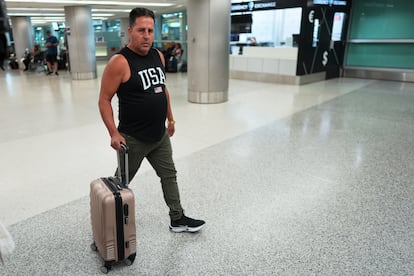
A man arrives from Cuba at Miami International Airport on Monday.
A man arrives from Cuba at Miami International Airport on Monday.Rebecca Blackwell (AP)

‘I hope the community is feeling this as yet another blow’

The travel restriction on Cubans and Venezuelans comes after the suspension of humanitarian parole and Temporary Protected Status (TPS), which had granted them certain benefits in the United States. Little by little, the U.S. government has stripped them of work permits, legal protections, and any form of assistance they previously had access to.

Cathy Camionero, a 54-year-old Venezuelan living in Virginia, believes that more than a measure to ensure “national security,” as Trump claims, this is a “racist action, meant to segregate and justify measures that don’t respect due process,” she says.

Camionero says that many, like her, won’t be able to welcome visiting relatives from Venezuela this year — relatives who typically attend their children’s graduations. “This is a time of vacations and graduations,” she says. “Many of us in this country wait for our loved ones, our parents, our grandparents, to come and witness the graduations of our children, who grew up here or graduated here. Now they can’t come celebrate with us.”

Still, she’s not surprised by this measure, because her community has been among the most battered since Trump came to power. “One day he takes one thing from us, the next day something else. He wants to deport Venezuelans without negotiating due process, yet at the same time he negotiates with [Venezuelan President] Nicolás Maduro. There’s a lot of inconsistency in this government,” she argues.

That’s why some feel this measure — like other anti-immigrant policies from the White House — feels like a betrayal of the communities that voted for Trump, who now feel the president has turned his back on them. Cuesta says it’s “yet another abandonment,” and “another betrayal.”

The Cuban-American community, to which Cuesta belongs, traditionally votes Republican, and “this president, since taking office, has done nothing but continue to marginalize the most vulnerable segments of the Cuban American family — that is, those who are still in Cuba or those who have arrived in recent years.”

“It’s yet another demonstration of how, in this white supremacist order, any alternative subject who demonstrates otherness — and that’s the case in Cuba, even if they don’t want to admit it — will be marginalized and basically put at a disadvantage,” the academic says. “I hope the community is experiencing it for what it is, as another blow to the possibility of reinventing ourselves in exile.”

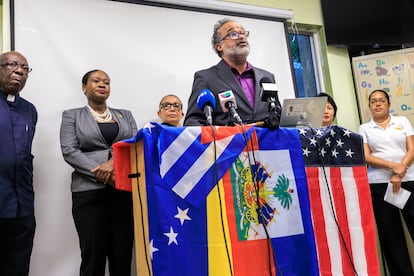
Members of migrant advocacy organizations hold a press conference following the announcement of the travel ban on citizens of Haiti, Cuba, and Venezuela, on June 6 in Miami.
Members of migrant advocacy organizations hold a press conference following the announcement of the travel ban on citizens of Haiti, Cuba, and Venezuela, on June 6 in Miami.CRISTOBAL HERRERA-ULASHKEVICH (EFE)

An ‘arbitrary and profoundly cruel’ measure

The decision to ban and restrict travel from a dozen countries apparently came after an attack by an Egyptian citizen on a group advocating for the release of hostages in Gaza. Although Egypt is not on the list of restricted countries, the incident was enough for Trump to once again lash out at those trying to come to the United States. “We don’t want them,” he said in a video announcing the new measure, which has thrown tourists, regular travelers, students, and family members into uncertainty. As a result, it’s been opposed by several groups and organizations.

“We’re talking about hundreds of thousands of U.S. citizens who won’t be able to see their grandparents, aunts, and uncles, no exceptions,” María José Espinosa, a foreign policy expert and executive director of the Center for Engagement and Advocacy in the Americas (CEDA), tells EL PAÍS. “These people have visas valid for five years. They are people with legal documentation, who have come to the country to visit their families or to participate in academic, commercial, and cultural exchanges.”

According to Espinosa, recent history shows that travel bans, such as those implemented under the Trump administration, “have not proven to be effective tools in preventing real threats of terrorism. Rather, they have isolated the United States and weakened its position in the world.” In addition to arguing the measure “arbitrary and profoundly cruel,” the CEDA director goes further, insisting that it is also legally confusing and “promotes chaos.”

“The proclamation states that those who already have visas will be able to keep them. A State Department spokesperson said that even if people already have a visa, they won’t be able to use it while the proclamation is in effect,” she says. “It’s curious that after so many years of preparing this proclamation, the final version is so confusing.”

Indeed, the measure has caused anxiety and confusion among many who were planning to travel to the U.S. soon. Although the announcement states that people with valid visas are exempt from the ban — as are permanent residents, athletes, and Afghan beneficiaries of the Special Immigrant Visa program — no one feels truly safe from the reach of Trump’s order.

“When news like this happens, it’s inevitable to feel concern and unease,” says a young Cuban woman who asked to remain anonymous and is about to start a PhD at the University of Pennsylvania. “I’ve always felt that anything could affect my entry into the United States. Nothing guarantees entry, even if you have an approved visa.”

Although she has been concerned about her future since the start of Trump’s second term, she says that now “the atmosphere feels more tense than usual.” “My status as a citizen of one of the countries included on this and other lists puts me in a position of absolute vulnerability and instability,” she insists.

Posted in The Blockade? | Leave a comment

Richmond, California calls for end to U.S. embargo

June 11, 2025 — Belly of the Beast

The Richmond City Council passed a resolution calling for an end to the U.S. embargo and the removal of Cuba from the U.S. government’s State Sponsors of Terrorism list. “The embargo creates obstacles,” said Richmond Mayor Eduardo Martinez. “When in Havana last year, I saw a magnificent city in disrepair, a city that could rival many other cities if it only had the capital to make those repairs…Like the Zionists in Israel, our nation is punishing the people of Cuba for a wrong they did not commit.” Several major U.S. cities have passed similar resolutions, including Boston, Chicago and Washington D.C.

Posted in The Blockade? | Leave a comment

In Miami, deportations are raising concerns among Cuban-Americans

“Ventanitas” are popular spots where Cuban-Americans and others in Miami gather for coffee and conversation.

Eva Marie Uzcategui/AFP/Getty Images

June 11, 2025 — NPR

Heard on All Things Considered By Greg Allen

In Florida, the growing number of immigrants being deported are raising concerns among some of President Trump’s most loyal voters: Cuban-Americans. Before last year’s election, more than two-thirds of Cuban-Americans in Miami-Dade County told pollsters they supported Trump. But the Trump administration’s recent actions on immigration are drawing criticism from Cuban-Americans and other Hispanics.

At a “ventanita,” a counter-service window at a restaurant in Miami’s Westchester neighborhood, customers gathered this week for Cuban coffee and conversation. Roger Schaefer, a second-generation Cuban-American calls himself “a Trump supporter 100%.” But he’s not comfortable with how the Trump administration is cracking down on people living here without legal status.

“I was on board with deporting any criminal, not so much people who come to work hard—roofers and construction guys. I’m not for deporting people without criminal records,” he said.

In Florida and around the country, Immigration and Customs Enforcement officers are detaining and beginning deportation proceedings against people with no criminal violations, in some cases arresting them at required routine check-ins with immigration authorities.

Those stories, which are being widely covered by Spanish and English-language media, are generating a lot of attention and talk in Miami-Dade County. It’s a place where nearly 7 out or 10 people are Hispanic and more than half of the residents came here from another country.

Jorge Pitta, whose parents came from Honduras and Uruguay, says he’s been following the stories and the debate closely.

“It’s rough because I’m Hispanic myself and I see my people being treated like this,” he says. “I’m in agreement with having to deport massively because a lot of illegals did come through. I just don’t like the way it’s being done.”

Like others at the ventanita, Pitta is critical of the protests in Los Angeles. He believes people are siding with immigrants who entered the country illegally over law enforcement authorities. But he’s not happy with the Trump administration’s approach.

“I voted for the guy because I like him,” he says. “I do think Trump also has his mistakes that he needs to address. Foreign policy is one. The way he’s handled this immigration is not good.”

Abel Delgado, who heads Miami-Dade County’s Democratic Hispanic Caucus, says the Trump administration has shocked the South Florida community by deporting people to countries run by authoritarian regimes.

“We didn’t deport people to Cuba on a regular basis before,” Delgado says. “That has changed. We didn’t think it was wise to send people back to Venezuela. Based on all the changes that President Trump is making, he must think that things are perfectly fine in Cuba and Venezuela.”

The concerns about deportations and policies such as the travel ban imposed on Haiti and the partial ban imposed on Cuba and Venezuela, may be denting Trump’s support among Hispanics in Florida, but many are doubtful it will have a lasting impact.

Ninoska Perez, a prominent Cuban-American talk show host in Miami says many who call into her daily radio show believe the immigration crackdown was overdue.

“I think President Trump has a mandate that was given to him is this election saying that he has to protect the borders. And this is one way to do it,” she says.

In the last week, some prominent Cuban-American elected officials have begun to express concerns about the administration’s actions. On social media, Florida Republican state senator Ileana Garcia posted a series of statements criticizing the Trump administration, singling out White House deputy chief of staff Stephen Miller, the architect of Trump’s immigration policy. Garcia, a long-time Trump supporter who founded Latinas for Trump called the deportations -quote- “unacceptable and inhumane.” She didn’t respond to interview requests.

Republican Congresswoman Maria Elvira Salazar, also from Miami, has expressed similar concerns about the crackdown, saying deportations of Cubans, Venezuelans and Nicaraguans have left her “heartbroken.” She says she and other Cuban-American members of Congress are meeting this week with Homeland Security Secretary Kristi Noem to discuss their concerns about people being deported to these countries.

Posted in The Blockade? | Leave a comment

Breaking Down Trump’s Travel Ban on Cuba

June 11, 2025 — Belly of the Beast

Trump proclaimed a travel ban last week that fully prohibits the entry to the U.S. of nationals from 12 countries and partially restricts nationals of seven other countries, including Cuba.

Cuba is on the partially restricted list along with Burundi, Laos, Sierra Leone, Togo, Turkmenistan and Venezuela. The fully restricted countries are: Afghanistan, Myanmar, Chad, the Republic of the Congo, Equatorial Guinea, Eritrea, Haiti, Iran, Libya, Somalia, Sudan and Yemen.

What this means for Cuba:

The ban prohibits Cuban nationals from entering the U.S. as immigrants with the exception of immediate family and individuals whose entry “would serve a United States national interest.” It also suspends the entry into the U.S. of nonimmigrants on B-1, B‑2, B-1/B-2, F, M, or J visas. These visa categories are used by people traveling to the U.S. for tourism, business, education and cultural and research exchanges.

The proclamation also orders consular officers to limit the length of time that a nonimmigrant visa is valid for nationals of Cuba “to the extent permitted by law.”

This is bad news for Cubans, but it could have been worse. Leaked reports weeks ago indicated Cuba would be on a “red list” that included the countries facing a total prohibition of travel.

Why it matters:

The travel ban drives a wedge between Cuban families on both sides of the Florida Straits. Fewer Cubans will be able to travel back and forth between the two countries, which could impact the flow of cash and goods coming to the island on planes — a lifeline for many Cuban households.

The travel ban is also one more blow to bilateral collaboration. During the Obama opening with Cuba, the two countries rapidly expanded cooperation in areas like science, the environment, sports and culture. Those mutually beneficial exchanges were greatly reduced under both Trump and Biden (see our article on how sanctions under Biden hindered biotech collaboration).

Will the travel ban slow migration?

There is no evidence the ban on Cuba will serve its stated purpose of protecting the United States from “foreign terrorists and other public safety threats.” Nor is there evidence it will hinder migration to the United States.

Ironically, U.S. sanctions and other punitive measures on Cuba under both Trump and Biden have fueled migration. Over the past five years, Cuba has experienced its biggest emigration wave in history. More than 10% of the population has left the island, with most people going to the U.S.

The (shaky) reasoning

The Trump administration provided the following reasons to justify the partial travel ban on Cuba:

  1. Cuba sponsors terrorism
  2. Cuba does not fully cooperate with the U.S. on law enforcement
  3. Cuba has historically refused to accept the deportation of its nationals from the U.S.
  4. Non-immigrant Cubans frequently overstay their visas

Let’s break these down…

1. Does Cuba sponsor terrorism? The “consensus position” for decades in the U.S. intelligence community is that Cuba does not sponsor terrorism. When the outgoing Biden administration started to remove Cuba from the U.S. government’s State Sponsors of Terrorism (SSOT) list in January, a State Department spokesperson confirmed there was “no credible evidence” to support the designation. The irony is Cuba has long been a victim of terrorist attacks carried out by Cuban Americans operating from U.S. soil. One such group, Omega 7, was once considered by the FBI to be the most dangerous terrorist organization in the United States. Some of these terrorists and their financial backers in the U.S. had ties to disgraced former Senator Bob Menendez, a longtime ally of Joe Biden (see more in our documentary Hardliner on the Hudson). Fellow Cuban-American hardliner Marco Rubio helped ensure Cuba would remain on the SSOT list after he was named secretary of state. The designation has had a devastating impact on Cuba’s economy, cutting the island off from international trade, banking, credit and investment.

2. Does Cuba not fully cooperate in law enforcement efforts? Cuba has a long history of cooperating with the U.S. on law enforcement issues even when relations between the two countries have been tense. For example, the two countries have long worked together to stop drug trafficking (see our interview with a U.S. Coast Guard official about U.S.-Cuba cooperation on security matters). Biden took Cuba off the list of countries “not fully cooperating” on counterterrorism efforts – citing ongoing law enforcement cooperation, including on counterterrorism – only for Trump to reverse the decision.

video preview

3. Does Cuba not accept deportees? Cuba recently accepted a deportation flight of 130 people from the United States. It was the fifth deportation flight since the beginning of the year. Cuba has continued to receive monthly deportation flights in line with U.S.-Cuba migration accords, even though the Trump administration has abandoned the migration talks with Cuban authorities that had occurred regularly under Biden. In an interview with Politico, Senior Cuban diplomat Johana Tablada said that Marco Rubio’s State Department “is not interested in having conversations with Cuba,” and that she and Deputy Foreign Minister Carlos Fernández de Cossío were snubbed by U.S. officials when they visited Washington.

4. Overstay rates. Many Cubans do overstay their visas and end up living in the United States because U.S. law and policy makes doing so relatively easy. Cubans have historically enjoyed privileges no other immigrant community has in the United States thanks to the 1966 Cuban Adjustment Act, which allows Cubans who enter the U.S. legally to become U.S. residents a year and a day after their arrival. As a result, many Cubans who arrived in the U.S. through non-immigrant visas overstay because they know they have a legal pathway to residency as long as they remain in the U.S. for 366 days. Trump’s crackdown on non-immigrant travel during his first term further incentivized Cubans to overstay their visas since it became more difficult for them to come and go without first becoming U.S. residents.

Posted in The Blockade? | Leave a comment

LVEM 25E Electron Microscope to Boost Biotech Research in Cuba

LVEM 25E Installed in Cuba at the Center for Genetic Engineering and Biotechnology (CIGB).

WHO 13 Des Moines, Iowa

News provided by EIN Presswire Jun 10, 2025

LVEM 25E Installed in Cuba at the Center for Genetic Engineering and Biotechnology (CIGB).

Delong Instrument’s LVEM 25E, a compact low voltage electron microscope, has been installed at the Center for Genetic Engineering and Biotechnology (CIGB).MONTREAL, QUEBEC, CANADA, June 10, 2025 /EINPresswire.com/ — A significant development in Cuba’s biotechnology and pharmaceutical sectors has been marked by the installation of the LVEM 25E, a compact all-in-one low voltage electron microscope, at the Center for Genetic Engineering and Biotechnology (CIGB). This installation, made possible through the Probiocuba initiative, will strengthen diagnostic and analytical capabilities, crucial for advancing biotechnology and improving health outcomes in Cuba.

The LVEM 25E by Delong Instruments provides high-contrast Transmission Electron Microscopy (TEM), Scanning Electron Microscopy (SEM) Scanning Transmission Electron Microscopy (STEM), Electron Diffraction (ED) and Energy Dispersive Spectroscopy (EDS) all in a single device, making it an invaluable tool for research in the medical and biotechnology fields. The new microscope is set to advance diagnostic processes and support the development of essential medicines and medical technologies in Cuba. The LVEM 25E will improve the precision of scientific research, from protein quality control to sample analysis, enabling researchers meet global standards in medical development.

The LVEM 25E installation is part of the broader Probiocuba initiative, a collaboration between the United Nations Development Program (UNDP), BioCubaFarma (Cuban Biotechnology and Pharmaceutical Industries Group), and the Ministry of Finance and Prices (MFP), with financial support from the Central American Bank for Economic Integration (CABEI). Probiocuba aims to strengthen Cuba’s capacity to produce essential medicines and medical devices to treat critical diseases.

By fostering international collaborations and knowledge exchange, Probiocuba is helping Cuban scientists stay at the forefront of scientific innovation. This initiative is helping Cuba become a leader in biotechnology research, ultimately benefiting public health in Cuba and the wider region.

“The electron microscope allows for the analysis of biological science samples, preclinical and toxicological safety, and the conduct of clinical trials. It is also essential in the diagnosis of various pathologies in humans, animals, and plants,” says Dr. Viviana Falcón, senior specialist in microscopy and imaging biophysics at the CIGB, regarding the potential of the LVEM 25E.

Key Benefits of the LVEM 25E

The LVEM 25E is an all-in-one compact electron microscope that provides high-contrast biological imaging at the nanoscale, enabling researchers to study proteins, viruses, bacteria, and other pathogens. This is essential for advancing drug development, vaccine creation, and improving diagnostics. The microscope supports a deeper understanding of molecular interactions, which is vital for ensuring the safety and efficacy of pharmaceutical products.

The LVEM 25E is the ideal imaging device for applications in life sciences. Rapid sample exchange and enhanced automation make the LVEM 25E a practical and easy-to-use tool for routine imaging applications. The LVEM 25E provides well-contrasted and highly detailed images from samples prepared with standard preparation protocols and provides the option to obtain the same level of detail with reduced staining.

This tool is indispensable for preclinical safety assessments, toxicology studies, and clinical trials, enhancing the accuracy and reliability of research outcomes. Its compact, all-in-one design allows it to fit into smaller labs since it has lower facility requirements and less requires maintenance.

With the LVEM 25E microscope, Cuba is taking a significant step forward in scientific research and development. This collaboration will lead to improved healthcare outcomes and contribute to global health initiatives.

For more information contact us.

Jared Lapkovsky
Delong America
+1 866-335-6648
info@delongamerica.com
Visit us on social media:
LinkedIn
Instagram
Facebook
YouTube
X

Posted in Healthcare | Leave a comment

Anti-Cuban politicians’ complicity in US repression denounced

Havana, June 10 (Prensa Latina) Anti-Cuban politicians in the United States remain silent in the face of the wave of repression against migrants and journalists in Los Angeles, California, the island’s Foreign Minister, Bruno Rodríguez, denounced today.

In protests in #LosAngeles, we saw excessive use of force, the use of the #US National Guard, attacks on journalists, and violations of migrants’ rights. But so far, we have seen no condemnation of these actions by anti-Cuban politicians. Their hypocrisy is grave and sickening, the Foreign Minister charged in X.

The protests and the federal response continue to escalate today, with calls for demonstrations in Atlanta, Burlington, and New York under slogans such as “Out with ICE (Immigration and Customs Enforcement)” and “Stop the deportations.”

Thousands of people took to the streets to express their opposition to the immigration policies of the Donald Trump administration, which the day before ordered the deployment of 2,000 additional National Guard members and some 700 Pentagon Marines.

Amid the vandalism and the use of force to quell demands for fair treatment of migrants, the president’s rhetoric is directed at the governor of that western state, Gavin Newsom, and the city’s mayor, Karen Bass, whom he calls incompetent.

“The situation in Los Angeles looks very bad. SEND IN THE MILITARY!!!” Trump wrote on his own social media platform, threatening to “deploy military everywhere. We will not let this happen to our Country. We will not let our Country be torn apart.”

For his part, Newsom sued the Republican administration for “deploying a state’s National Guard without consulting the governor of that state is illegal and immoral.”

mem/lld

Posted in Uncategorized | Leave a comment