Aug 15, 2024 #littleleaguebaseball#bellyofthebeastcuba#littleleagueworldseriesMeet the Santa Clara Bombardiers, Cuba’s top little league baseball team. They won Cuba’s title this year and will be the second team to represent the island at the Little World Series 2024 in Williamsport, Pennsylvania, following Bayamo’s appearance last year.
Havana, Dec 9 (Prensa Latina) Cuba is holding the International Conference “Cuba 2024 Decade of Afro-Descendants” at the Havana-based Conference Center and other venues from this Monday to December 13.
Themed “Equality, Equity, and Social Justice,” the event’s first two days will be held in this meeting institution with panels leading to the National Program against Racism and Racial Discrimination and its 12 sub-programs.
The International Conference will find new stages where delegates can meet with the inhabitants and enjoy music from genres such as rumba, jazz, and son.
Other visits will include the Museum of Literacy, an elementary school, a special education school at the Havana-based Ciudad Libertad school complex, the “Enrique Jose Varona” Center for the Study of Educational Sciences, and the Cintio Vitier Community Project, focused on plastic arts.
The organizing committee noted that participants would visit the Quintin Bandera Cultural Center in Old Havana and the Rebel Slave Museum in Matanzas province.
Music, lectures, and book launching in Calle de Madera in Havana’s historic center, among other initiatives, characterize an event dedicated to defending the rights of Afro-descendants, recognizing their contributions, and preserving their cultural heritage.
Dec 3 (Belly of the Beast) Cuban pianist Dayramir González considers himself an ambassador for Cuban music in the U.S. He has kept close ties to Cuba’s cultural life since moving to the U.S. in 2010… and he has been criticized in the U.S. for it. Yet, every year, he returns to his country for the Jazz Plaza Festival. “I have a responsibility to the amazing education I received in Cuba.”
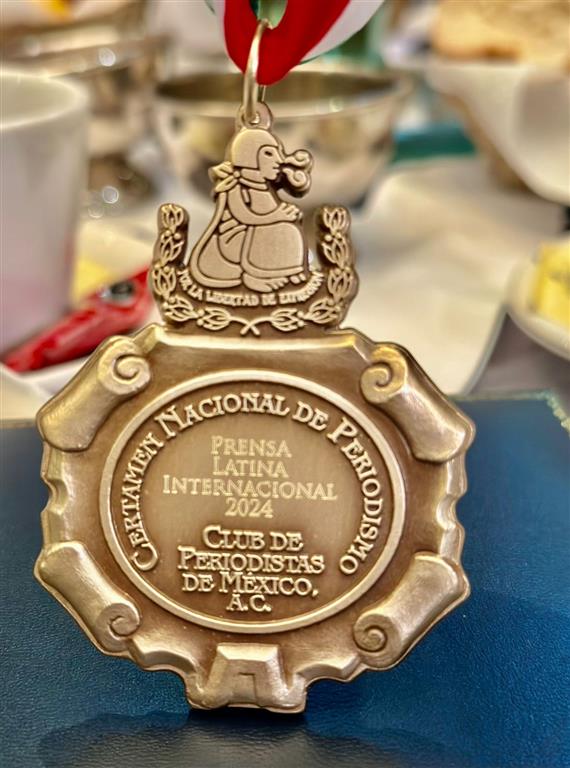
Mexico City, Dec 5 (Prensa Latina) The Club of Journalists of Mexico today awarded the international prize to the Latin American Information Agency Prensa Latina, which it recognized for offering a voice to oppressed peoples.
In presenting the medal and diploma to the first vice president of the news agency, Luisa María González, the organization recalled the birth of that media outlet in Cuba on June 16, 1959 and its struggle to “break the information siege and monopoly of the large transnational corporations.”
“We are very excited and grateful to receive an award of this kind for the work that Prensa Latina has been doing for more than 65 years, but if this award also comes from professional colleagues and from Mexico, a country so beloved and admired by Cuba, it takes on a very special dimension,” said González.
He considered the award to be an incentive for the media to continue “doing the journalism that has characterized it for more than six decades: professional, objective, always committed to the truth, to the dissemination of just causes and the struggles of the peoples of Latin America and other continents.”
Prensa Latina, with a total of 35 correspondent offices, is currently present in practically all Latin American countries, as well as in the United States (Washington and the headquarters of the United Nations), Africa, Asia and the main capitals of Europe.
During the ceremony held at the Club de Periodistas in this capital, awards were also given to professionals, programs and media outlets, including the national La Jornada and Channel 22, and the international Sputnik and Russia Today.
On behalf of the government and President Claudia Sheinbaum, the political advisor of the Social Communication Coordination of the Presidency of the Republic, José Alfonso Suárez del Real, expressed congratulations to each of the 57 winners in the 72nd edition of the contest.
He singled out the country’s current administration as one that firmly believes in and shares the interests of responsible freedom of expression.
Every year, the Club of Journalists of Mexico and the Antonio Sáenz de Miera Fieytal Foundation organize the National Journalism Contest, founded in 1952.
Havana, December 8 (Radio Habana Cuba) — “Caribbean nations will always be able to count on Cuba,” President Miguel Díaz-Canel said on Sunday, recalling this date in 1972 that marked the beginning of diplomatic relations with a group of countries in that region.
The president quoted on the social network X the historical leader of the Cuban revolutionary process, Fidel Castro, who in 1998 stated that “we believe in the strength of a united Caribbean. We are convinced that together we will overcome the great challenges that await us.”
The fraternal ties of the Caribbean island and the 14 Caribbean states, members of Caricom, were recalled by the Cuban president and other officials of his government, in activities celebrating the 52nd anniversary of the establishment of political ties.
On the occasion of the celebration, Díaz-Canel received last Friday, at the Palace of the Revolution (headquarters of the Government), the 14 ambassadors of the countries that make up Caricom. “We met to embrace each other,” said the president.
He also highlighted the ties of brotherhood with these nations, which, led by Barbados, Guyana, Jamaica and Trinidad Tobago, formalized, on that date, diplomatic relations with Cuba to break the diplomatic isolation imposed by the Government of the United States, since the beginning of the 1960s.
This fact shows the deep ties of brotherhood that unite us, and the continuity of the ideology and the work of our historical leaders, who forged the bases for the consolidation of our relations, framed in principles of solidarity, friendship, selflessness and gratitude, said the Cuban president on the occasion.
In the same vein, and through the social network itself, Foreign Minister Bruno Rodríguez ratified the solidarity position of the Cuban government and people with the Caribbean nations, which have always supported the island’s cause for the end of the US blockade of more than six decades.
The remaining Caribbean territories also developed ties of friendship and collaboration with Cuba, which led to the implementation of the Caricom-Cuba summit mechanism in 2002.
At that meeting, the subregional bloc and Havana agreed to establish December 8 as the date of celebration for the beginning of their ties.
Mexico City, Dec 8 (Prensa Latina) The Cuban ambassador to Mexico, Marcos Rodríguez, today thanked the governor of Chiapas, Eduardo Ramírez, for his recognition and wishes for the future implementation of the Yo Sí Puedo program, to lift half a million people out of illiteracy.
“We appreciate the kind words of Governor @ramirezlalo_ towards Cuba during his inauguration, as well as the recognition and wishes for the future implementation of the Yo Sí Puedo program, to lift half a million Chiapas residents out of illiteracy,” he said on X.
Yes, I Can is a Cuban teaching method in which numbers are used to facilitate the learning process of reading and writing by associating numbers with letters, and through which more than 10 million citizens in thirty countries have been taught to read and write.
The diplomat attended Ramírez’s inauguration on Sunday, wishing him success in his administration. He also reaffirmed the southern state’s willingness to strengthen its cooperation programs with the island.
During the ceremony, “we exchanged experiences with great friends who have helped strengthen the historic relations between Cuba and Mexico, and we reaffirm our commitment to continue promoting cooperation in all spheres,” added Rodriguez.
The day before, the ambassador held a meeting, which he described as fruitful, with Cuban doctors who provide their collaboration in various municipalities of Chiapas.
With them, “we discussed the state of cooperation, the altruistic work they do, concerns, and ongoing communication with the Brigade and @EmbaCuMex,” he wrote.
Washington, Dec 6 (Prensa Latina) More than 50 US officials, collectively representing millions of Americans, along with union leaders and solidarity organizations, urged President Joe Biden to remove Cuba from the list of state sponsors of terrorism.
The coalition issued a unified call for Biden to reverse the policies of Donald Trump’s first term (2017-2021) in the short time he has left in the White House.
“The embargo (blockade) and the SSOT (State Sponsor of Terrorism) designation are relics of a failed foreign policy,” said Vermont State Senator Tanya Vyhovsky in a statement published on the official page of the International Committee of the DSA (Democratic Socialists of America), promoter of the initiative.
“Sending aid to Cuba is not just an act of goodwill, it is a moral imperative. This is an opportunity for the United States to demonstrate leadership and compassion,” she added.
“By removing Cuba from the SSOT list and reversing Trump-era restrictions, we can pave the way for a more stable and humane relationship, as well as provide the Cuban people with a meaningful path to recovery and resilience following several natural disasters,” reads an excerpt from the letter.
The coalition highlighted the serious consequences of these restrictions, which have deprived Cuba of vital financial resources and deepened economic and humanitarian crises. These challenges were exacerbated by recent natural disasters, including hurricanes and earthquakes, which have left Cubans in urgent need of food, medicine, and medical supplies, the statement noted.
“American workers stand with the Cuban people in their fight for basic human needs,” said Taylor Walker, president of the Interns and Residents Committee of the Service Employees International Union (SEIU), who added that the policies of isolation and economic warfare “harm working families on both sides of the Florida Straits.”
The call to action came after the 32nd vote at the United Nations condemning the US blockade on Cuba and after a recent letter signed by House members Barbara Lee (California), Jim McGovern (Massachusetts), Gregory Meeks (New York) and Jon Castro (Texas) urging Biden to send humanitarian aid and remove Cuba from the list of state sponsors of terrorism.
For New York City Councilwoman Alexa Avilés, “it is time to prioritize diplomacy and compassion over decades of hostility.”
Santiago de Chile, Dec 6 (Prensa Latina) Cuba participated in Chile at the meeting of the board of directors of the Regional Conference on Women, which agreed to strengthen the institutional framework to advance towards gender equality, one of the challenges in Latin America today.
In declarations to Prensa Latina, Yaneidys Pérez, from the national secretariat of the Cuban Women Federation, stated that the meeting dealt with issues that must be addressed urgently.
She mentioned among them the labor and wage gaps, the burden of unpaid care work on women, gender-based violence and the situations of vulnerability suffered by some women and girls.
One of the purposes of the event at the headquarters of the Economic Commission for Latin America and the Caribbean (ECLAC) was to review the progress of the Beijing Declaration and Platform for Action, on the eve of the thirtieth anniversary of its adoption in 2025.
This is the broadest and most visionary program to achieve equity, empowerment of women and the realization of their human rights.
In the case of Cuba, the leader recalled that Article 43 of the Constitution provides a legal framework for the advancement of women, since the State promotes their integral development and social participation, ensures their sexual and reproductive rights and protects them from gender violence.
Havana, December 6 (Radio Habana Cuba) — The First Secretary of the Central Committee of the Communist Party of Cuba (PCC) and President of the Republic, Miguel Díaz-Canel received this Friday at the Palace of the Revolution, the ambassadors of the Caribbean Community (CARICOM) to celebrate the 52nd anniversary of the establishment of diplomatic relations between Cuba and Barbados, Guyana, Jamaica and Trinidad and Tobago (December 8).
“I reiterated our admiration and affection, and thanked them for their solidarity and support for the Cuban people,” the president said from his X account.
Díaz-Canel confirmed to the 14 representatives of the sister Caribbean islands the Cuban government’s willingness to continue expanding ties.
“The Caribbean can always count on the Cuban Revolution, and on the support, friendship and solidarity of our people,” he assured them.
The head of state conveyed to them a hug from Army General Raúl Castro Ruz, an admirer of the dignity of the Caribbean brothers. (Source: ACN)
Havana, December 5 (Radio Habana Cuba) — The National Electric System (SEN) is working today with all its equipment available, according to a notice from the Minister of Energy and Mines of Cuba, Vicente de la O Levy.
“The SEN has been restored,” he wrote on the social network X shortly before concluding this Wednesday night. All the units that were in the process of starting up entered the system, he assured.
De la O Levy clarified that “unit 1 of Felton, which already has a boiler on and will synchronize in the next few hours” has yet to be incorporated into the generation of electric energy.
The day before, at the beginning of the morning, there was a new disconnection of the System, after the Antonio Guiteras thermoelectric plant went out due to an automatic trip, as reported by the Ministry of Energy and Mines.
During the day, work to rehabilitate it progressed and before nightfall, the Santa Cruz 1, Guiteras and Felton units were ready to start up, with 400 megawatts more than those existing until then.
Likewise, the provinces of Pinar del Río and Holguín had been incorporated into the SEN, always according to official reports.
The SEN has suffered significant damage in recent months, including service outages, causing prolonged blackouts throughout the island.
Cuban authorities denounce the consequences in the sector of the economic, commercial and financial blockade imposed by the United States on the Caribbean country for more than six decades, a policy that has been intensified in recent years. (Source: Prensa Latina)