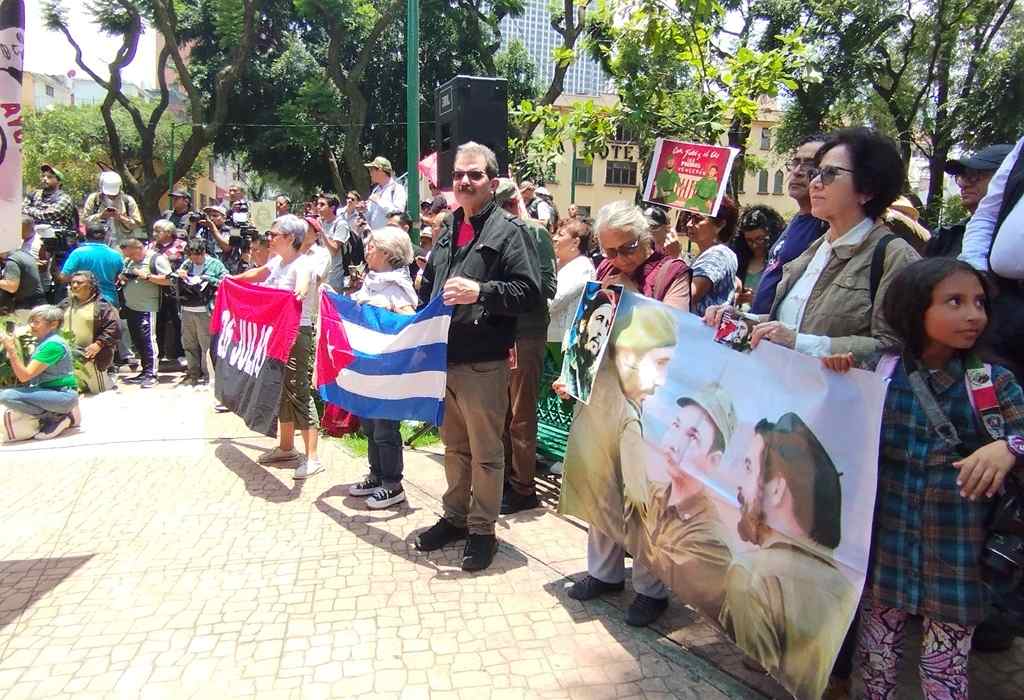
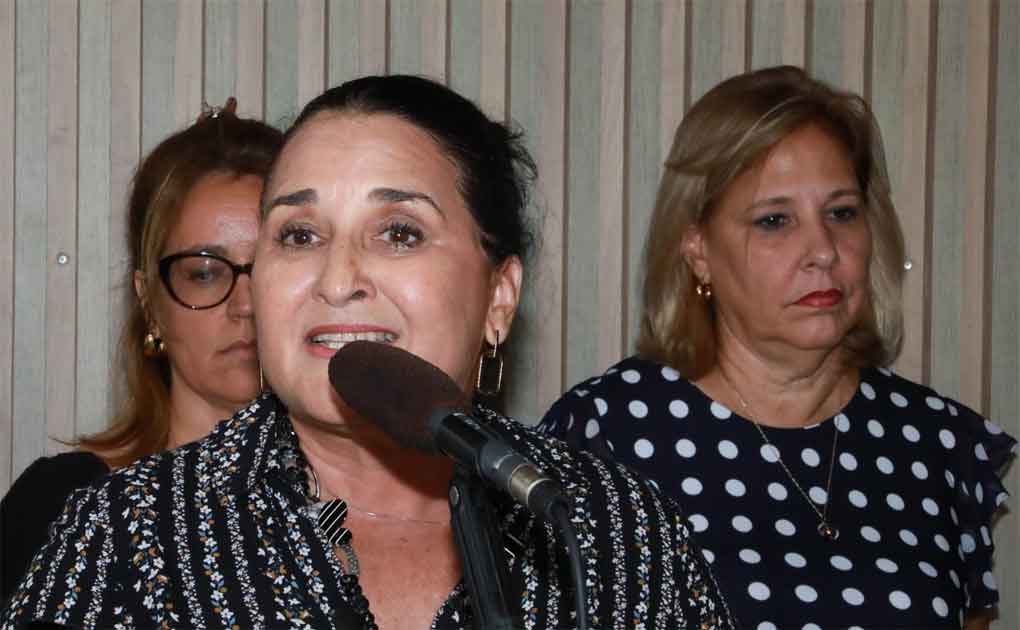
Mexico City, July 20 (Prensa Latina) Mexicans and Cubans living here today reaffirmed their support for the Caribbean country and demanded the return of statues of the historic leader of the Revolution, Fidel Castro, and Argentine guerrilla Ernesto Guevara, removed by a local mayor’s office.
At a ceremony in Tabacalera Park, where the sculptures were installed, diverse organizations, including the Mexican Movement of Solidarity with Cuba, the driving force behind the initiative, and the José Martí Association of Cubans Residing in Mexico, rejected the Cuauhtémoc City Hall’s decision.
The decision to remove the statues was made in recent days by the mayor of that district, Alessandra Rojo, who alleged that the monument lacked the required permits, an argument later denied.
Chanting “Fascism out of the Cuauhtémoc mayor’s office,” “This park belongs to Fidel, this park belongs to Che,” and “Yes to Cuba, no to Alessandra,” the protesters, who also included residents, political parties, and unions, demanded that the mayor be sanctioned.
In an interview with Prensa Latina, Luis Flores of Jóvenes por el Socialismo, the youth wing of the Popular Socialist Party of Mexico, considered Rojo’s decision evidence of his ignorance of the major social movements centered around Fidel and Che Guevara.
She also pointed to the right-wing orientation of the parties the mayor represents (Institutional Revolutionary Party and National Action), which seeks to attack left-wing and revolutionary movements to prevent public awareness.
“The reactionary attempt to erase the revolutionary memory of Commander Fidel and Ernesto Guevara has met with a similarly powerful response. Just as they want to erase it with a stroke of the pen, we are also here filling this plaza and vindicating them,” said Emiliano Jijón.
In a conversation with Prensa Latina, the member of the Mexican Communist Party defined the Cuban Revolution as a beacon that continues to shine in Latin America and the world, and rejected the continued existence of the economic, commercial, and financial blockade imposed on the island by the United States.
“We come here today because Fidel and Che Guevara represent the struggle of the peoples of the world, the fight against injustice and in favor of the people who have been trampled by nefarious governments always supported by the United States,” said federal representative María Magdalena Rosales.
Speaking at the demonstration, where Cuban flags and images of both figures were seen, the legislator for the ruling Morena party called for continued fighting for the statues to be reinstated and for demands that a similar incident not occur again.
The activists, who also expressed their proposal to name the park after Fidel Castro, called for a march to begin in the Cuauhtémoc borough of Cuba on July 26th, Cuba’s National Rebellion Day.
Last week, President Claudia Sheinbaum rejected Rojo’s decision, and the head of the capital’s government, Clara Brugada, announced that she would seek to recover the sculptures, which commemorate the first meeting between Che Guevara and Fidel Castro and are considered a symbol of friendship between Cuba and Mexico.
In recent years, foreign aid to Cuba has played a critical role in addressing poverty, economic instability and humanitarian need. Despite long-standing tensions with the United States (U.S.), international donors continue to support the Cuban people through targeted assistance in health, food security and disaster preparedness.
Cuba’s Economic Crisis
Cuba has a reputation for strong public services, especially in health care and education, but the country’s economic situation has sharply deteriorated. The pandemic, combined with tightened U.S. sanctions and a drop in tourism, has left millions struggling to access food, medicine and basic goods. According to the U.S. Department of Agriculture (USDA), about 4 million Cubans are food insecure and per forecasts, this number could rise without consistent aid.
The Role of Foreign Aid to Cuba
Although the U.S. does not provide direct bilateral aid, many countries and organizations continue to fund humanitarian programs aimed at reaching Cuba’s most vulnerable populations. Key contributors include the European Union (EU), Japan, Canada and multilateral agencies such as the United Nations (U.N.) and the Global Fund. Food insecurity remains a major concern. In recent years, the WFP distributed rice, beans and cooking oil to schoolchildren, elderly people and pregnant women in food-insecure regions. The organization’s work helps maintain basic nutrition during a time of severe economic stress.
Health care is another critical area. The United Nations International Children’s Emergency Fund (UNICEF) and the Global Fund support Cuba in its efforts to manage Human Immunodeficiency Virus (HIV), tuberculosis and other diseases, as well as improve child health outcomes through access to prenatal care and vaccines. Cuba is also one of the most climate-vulnerable nations in the Caribbean. Frequent hurricanes and coastal flooding displace thousands every year. The United Nations Development Programme (UNDP) projects focus on climate resilience, including reforestation, flood protection and renewable energy infrastructure.
Technical cooperation plays a quieter but important role. Japan, for instance, has funded solar panel projects and provided medical equipment, while Canadian aid supports small farming cooperatives and rural development. These efforts help build Cuba’s self-sufficiency.
Success Stories and Ongoing Challenges
Programs like the WFP’s school meal distribution have tangible results. More than 800,000 Cuban students receive daily meals that help improve both nutrition and classroom attendance. The integration of aid into public services allows for efficient delivery despite Cuba’s logistical challenges. Cuba’s centralized government, tight control over data and restrictions on nongovernmental organizations (NGOs) present obstacles. Aid agencies often face delays or limitations on how funding can be used. Additionally, shifting diplomatic relations, particularly with Western nations, sometimes disrupt long-term support.
The Path Forward
Cuba’s gradual economic reforms and ongoing engagement with international partners open up opportunities for more effective, community-led development. Continued investment in health, education, food security and climate resilience, delivered through international collaboration, offers a path forward. With sustained support from global partners and a focus on long-term development, Cuba can build greater resilience, reduce poverty and improve the well-being of its people in the years to come.
– Charlie Baker
Charlie is based in London, UK and focuses on Politics for The Borgen Project.
Mexico City, July 19 (Prensa Latina) Mexico City Mayor Clara Brugada announced today the decision to restore the statues of Fidel Castro, the historic leader of the Cuban Revolution, and Ernesto Guevara, the Argentine leader, removed by a local mayor’s office.
“We want to recover the sculptures that are currently in a warehouse. We want to recover them, these artistic sculptures, so we are respectfully going to ask the Cuauhtémoc mayor’s office to send us the sculptures or pick them up,” he stated during an event. The decision to remove the statues from a capital park was made by the mayor of that district, Alessandra Rojo, who cited questionable arguments, such as the fact that the monument lacked the required permits, despite having been in that location for years.
Brugada alluded this Saturday to doing everything legally required so that the city and federal governments can “have these sculptures in a symbolic, central location in the city,” which “commemorate a momentous event.”
The Encuentro Monument, by artist Óscar Ponzanelli, highlights the first meeting of these “two fundamental figures of the 20th century, whose legacy is part of the living memory of the peoples of Latin America,” Brugada said.
Both “also represent the self-determination of peoples, the spirit of sovereignty, which also unites us as two nations,” the speaker said, adding that their presence in public spaces is “an act of remembrance and respect for the history of the peoples of the Americas.”
He also emphasized that the monument is a symbol of the solidarity and universalist spirit of this capital, which throughout history has been a refuge, meeting point, and space for dialogue for people from all over the world.
“To the sister people of Cuba, we reiterate our full respect from Mexico City, our solidarity, and our deepest appreciation for their history, their dignity, and their struggles,” stated the head of the capital’s government.
In this regard, he highlighted the relationship between the people of Cuba and Mexico, marked by “fraternity, hospitality, and the shared defense of the ideals of sovereignty, social justice, and self-determination.”
“Mexico City will continue to be an open, supportive, and respectful space, where the struggle of the Cuban people is recognized as part of the Latin American memory that unites us,” he emphasized.
The city government stated yesterday that the removal of the sculptures from La Tabacalera Park violates established regulations, as it was not authorized by the Committee on Monuments and Artistic Works in Public Spaces.
Organizations such as the José Martí Association of Cuban Residents in Mexico, the Popular Socialist and Communist parties, and the Mexican Movement of Solidarity with Cuba expressed their outrage at the removal of the sculptures.
Activists have called for a demonstration tomorrow to demand the return of the statues.
July 19, 2025 — Islander News.com (Key Biscayne, Florida)
Everyone wants some cortadito–the band, that is. Miami’s very own Cuban folk group is releasing another single off their upcoming project, “Guajira En La Madrugada.”
The single was written by bassist Alberto Pantaleon’s father, Alberto Pantaleon Hernandez. It is the second written by the late Cuban composer, and features guest vocals by Havana’s ultra-talented Aymée Nuviola.
“Guajira” was recorded by Guillermo Rodriguez Bravo, and band co-founder and tresero Jose Elias, and mixed by Carlos “El Loco” Bedoya (Beyoncé), Enrique Iglesias).
“Aymeé is a great friend and has collaborated with the band for a few years. We always revel in the chance to work with her,” says Elias. “I’m delighted that she lent her superb vocals to this song, and we look forward to sharing the video with our fans. Our thanks to the wonderful team at Hoy Como Ayer for hosting the video shoot.”
It is described as “sublimely tropical,” threaded together by Nuviola’s smooth vocals and Roniel Vega’s steely trumpet. Pantaleon and percussionist Pacha Portuondo set the stage with their lively rhythmic bed over Elias’ unique tres, and Franklin Reytor’s arrangement blends perfectly under the “guajira, te quiero cantar mi tonada” chorus.
“Recording this song has been one of those experiences that one treasures profoundly,” says Nuviola. “Not just because of the level of artistry, the respect with which they play each note, and the authenticity they bring to their traditional Cuban music. For me, it was a privilege to put my little bit into a project that doesn’t just honor our past but gives life to our musical inheritance for the new generation.”
The group’s first two album singles “A Yemayá” (with Nestor Torres) and “Aqui Te Traigo Me Son” have been revered by critics and fans. Cortadiro was recently featured on NPR’s Alt Latino podcast, and is now getting ready for a regional east coast tour of various states, including New York, North Carolina, West Virginia, Florida, and more to be announced.
Mexico City, July 19 (Prensa Latina) Cubans and Mexicans celebrated the 72nd anniversary of the attack on the Moncada and Carlos Manuel de Céspedes barracks in the eastern part of the island on July 26, 1953, with a Grand Ball in this capital.
On that date, which commemorates the Day of National Rebellion, “the struggle for Cuba’s liberation began,” said the Caribbean country’s ambassador here, Marcos Rodríguez, expressing his satisfaction with Friday’s spectacle.
From the renowned Los Angeles Hall, Rodríguez highlighted the presence of the Mexican Movement of Solidarity with Cuba, organizer of the initiative, as well as other friends, federal deputies, and members of the diplomatic corps.
He emphasized that those attending “have come to join in greeting Cuba,” in showing solidarity and support for the Cuban Revolution, in addition to supporting Latin America, Mexico, and the friendship that unites the island and this North American country, which—he asserted—will be eternal.
For her part, Aline Pérez, of the Mexican Movement of Solidarity with Cuba, told Prensa Latina that this dance is organized every year in a traditional hall, and this time it will last six hours, from 7:00 p.m. on Friday until 1:00 a.m. on Saturday.
The funds raised are for solidarity, the activist stated, emphasizing the importance of supporting the island at a time when it is under attack from all sides, the economic blockade imposed by the United States is intensifying, and President Donald Trump’s measures are becoming more hostile.
At another point in the conversation, Pérez alluded to the assistance provided by Cuba in areas such as health, with the medical brigades that provide care to Mexican citizens.
The event, which included performances by groups such as Mexico’s La Necedad Orquesta and Cuba’s Son 14, was also attended by representatives from the embassies of Venezuela, Russia, and the Sahrawi Arab Democratic Republic, as well as diplomats from the island.
During the initiative, activists called for participation in a demonstration tomorrow to demand the return of the statues of the leader of the Cuban Revolution, Fidel Castro, and the Argentine Ernesto Guevara, which were recently removed by authorities in the Cuauhtémoc City Hall.
The decision to remove the statues was made by the mayor of that capital district, Alessandra Rojo, who cited questionable arguments, such as the fact that the monument lacked the required permits, despite having been in that location for years.
The Mexico City government announced yesterday that the removal of the sculptures from a capital park violates established regulations, as it was not authorized by the Committee on Monuments and Artistic Works in Public Spaces.
San José, July 18 (Prensa Latina) “Cuba is the beginning of many struggles and the end of all defeatism,” Spanish journalist Txema Sánchez said today in a commentary addressing a Costa Rican solidarity campaign with the island.
“Those who give us their best without asking for an answer are not dismissed. Those who gave us a cultural revolution and the hope of being free and dignified are respected,” added the producer of television programs for social media, in a commentary addressed to the solidarity crusade “An Embrace to Cuba,” led by award-winning Costa Rican journalist Rafael Ugalde.
The member of the Network of Intellectuals and Artists in Defense of Humanity also considered Cuba “the sister, the beacon, the guide, the revolutionary truth” in his text supporting the Costa Rican campaign coordinated with the Love for Cuba-Costa Rica Solidarity Movement.
Txema Sánchez compared the Cuban Revolution to “a comrade in struggle and in the trenches who is never surrendered. A beacon and a symbol of solidarity is never abandoned. Those who pave the way out are never forgotten. Those who give their lives and sacrifice themselves for the truth of all are never lied to.”
To Cuba, the sister, the beacon, the guide, the revolutionary truth, to our admired and beloved Cuba – he declared – we owe all that and much more.
“Long live Cuba and its permanent Revolution,” the Spanish journalist cheered. “Long live the heroic resistance of the Cuban people and their constitutional and legitimate government, for upholding a more humane way of life. Never abandon Cuba,” he urged. “More than ever, it needs our fraternity.”
The “A Hug to Cuba” campaign, which received Txema Sánchez’s comment, was launched the day before by journalist Ugalde, along with a call to his country and the rest of the world to defend the people and government of the Caribbean island.
The lawyer, former journalist for the University Weekly and former correspondent for Prensa Latina in Costa Rica, called for this crusade along with other supportive friends to condemn the US economic, commercial, and financial blockade against Havana and reject a July 11 motion against Cuba by the Costa Rican Congress.
“The idea, coordinated with local leaders of solidarity with that country, is for the people and friends of Cuba in all nations—be it Nicaragua, Guatemala, Colombia, the United States, and Spain—to be able to express our feelings against the infamy and lies leveled against them,” Ugalde explained to Prensa Latina.
“At the same time,” he added, “we express our admiration for the Cuban people and their Revolution, without any mediation other than the dictates of the conscience of young people, honest women, and men around the world.”
“My face is burning with shame,” Ugalde wrote in a recent article published in the Costa Rican online magazine Surcos, in which he criticizes “the 40 deputies of the Legislative Assembly who supported the motion against Cuba.”
The journalistic text praises “the Cuba of Fidel and Martí” and considers the tightening of the blockade and the constant attacks against the island “as part of the Zionism and Nazi-fascism promoted by the White House.”
Rafa Ugalde (1949), as he is well known in the local media, ratified his position against the document.
“I’ll start by clarifying,” he clarified, “that I had two options when reading the Legislative Assembly’s motion against the Cuban people, because it’s no secret that they’re having a tough time, due to the fierce blockade, intensified by the Nazi-fascist Trump administration.”
“Or I would remain silent, complicit and cowardly,” I told myself, “as political parties, trade unions, popular movements, intellectuals, and professionals, once unconditional defenders of the people and their just causes, have been doing until now.
“Or I raise my voice against the accomplices and cowards who, with their significant silence, attack Cuba and the peoples of the world, alongside those who fight for their freedom and independence.”
In his article, Ugalde criticized local organizations “that constitute a point of convergence for Zionists, defenders of the child killers in Gaza, great exponents of Nazi-style chauvinism, as well as the modern fascism strategically spread throughout Our America.”
Guess which rum brand you’ll be drinking at the Havana Club Museum in Havana, Cuba? Kevin Rozario
By Kevin Rozario, Contributor — Forbes — July 18, 2025
Havana has a colorful history; from its heyday as the playground of rich Americans and Europeans until the last mid-century, to a sanctioned state that the Trump administration considers a malicious actor—amply demonstrated by Cuba being relisted as a “state sponsor of terror” on January 31 through an executive order. This reversed a more lenient position from the former Biden government.
The island state, the largest by far in the Caribbean, maintains a vibrant arts and music scene in the capital. Amid regular electricity blackouts and half-empty shelves in stores and pharmacies, Havana’s residents are resilient. The glitzy glamour may have gone, but vintage style and a deep-rooted energy and vitality remain.
Moreover, despite being heavily sanctioned, Cuba continues to have prominence—even preeminence—on the world stage thanks to its renowned cigars. There is rising demand in China which has led to record sales, despite huge price rises in some regions.
The country’s other famous export—rum—is far more accessible, and the leading brand, Havana Club, has made its way onto retail shelves in 125 countries with one notable exception: the United States. Sanctions mean that the product is embargoed in one of the industry’s biggest markets, which accounts for about one-third of global rum sales.
Christian Barré: “Today’s footprint is mainly Western Europe, but we are expanding in the Americas: … MoreCyril Catan
Yet ‘el ron de Cuba’ has thrived globally. While its home market had been the revenue driver for many years—and Havana Club remains Cuba’s top-selling rum with a commanding 60% market share according to drinks analyst IWSR (2023 data)—today, exports are close to 80% of sales. Of 45 million bottles sold worldwide in 2024, 61% made their way into Europe, and 14% into Latin America and Canada.
In the U.S.—not that it matters to Havana Club—rum has “slipped into decline from 2022 to year-to-date,” said IWSR last November. The analyst noted: “Rum has seen mixed, but generally underwhelming, performance over the past few years in the U.S.” Previous years showed a pandemic ‘bump’ of 4% from 2019-2020 and 2% from 2020-2021, well below the 5% growth in the overall spirits business for both periods.
Forbes Daily: Join over 1 million Forbes Daily subscribers and get our best stories, exclusive reporting and essential analysis of the day’s news in your inbox every weekday.Email AddressSign Up
By signing up, you agree to receive this newsletter, other updates about Forbes and its affiliates’ offerings, our Terms of Service (including resolving disputes on an individual basis via arbitration), and you acknowledge our Privacy Statement. Forbes is protected by reCAPTCHA, and the Google Privacy Policy and Terms of Service apply.
Havana Club sails past tariffs
In these unpredictable days of Trump’s changing tariffs—which are very likely to raise prices—not having to deal with the U.S. is considered a blessing in some quarters of the drinks industry.
Companies are finding ways of mitigating potential downside effects, from halting imports to temporarily switching focus to alternative markets, which is the case for a string of drinks players including Netherlands-based Navy Island Rum, Macduff International, and Vancouver-based Mark Anthony Group.
Havana Club isn’t having to duck and dive. CEO, Christian Barré, can afford to take a more relaxed approach. He told me: “There is still no clear view on the road ahead for global spirits such as Scotch, tequila, cognac, and maybe Champagne.” A raft of tariffs is scheduled to arrive on August 1, but based on previous form, that could be a movable feast.
Earlier this year, Marten Lodewijks, president of IWSR US, said: “The Trump administration’s policies on tariffs will almost certainly be net negative for the U.S. alcohol market, with global implications likely to be more limited.” The analyst admitted that modeling the various potential scenarios is complicated by a number of unknowns such as the scope of tariffs, their duration, and the impact of retaliatory measures.
El Floridita in Havana is known as the ‘cradle of the daquiri’.MATTHIEU GARÇON
Barré said: “In this environment, the only thing you can do is make sure your product holds onto its brand values and heritage and build your brand’s image on this. You have to stay true to what you believe and defend and protect it.”
Cuban identity is deeply ingrained
Havana Club’s image is entwined with—and inseparable from—Cuba. The rum celebrates the country and its people, and it is very much reciprocated. Alongside the capital’s world famous Malecón, a sweeping seafront promenade that is a UNESCO world heritage site, and neo-classical or modernist casas such as Adela, Italia, and Pamela, to the music of Compay Segundo, Buena Vista Social Club, Beatriz Márquez, and acapella groups such as the Cuban Vocal Quartet; the island’s favorite rum has its own pioneering place among them.
In modern Havana, amid artists’ studios like that of Vicente Hernández, or the sculpture workshop of José Villa Soberón, “Havana Club is everywhere, like a national symbol,” said Barré proudly. The downtown Havana Club Museum is an indicator of the rum’s influence. It is ranked among the top places to visit in the city by Tripadvisor, and seeing visitors and locals break out into spontaneous salsa or Danzón is not unusual.
A rare gathering of all five of Havana Club’s esteemed maestros de ron at Casa Pamela in Vedado, … MoreKevin Rozario
But Havana Club hasn’t become an institution on its own. The state-owned brand formed a joint venture with what is now the drinks giant Pernod Ricard in 1993, setting the stage for international adventure. “The brand has always resonated, but the JV really gave it a push. In the export market, just before the deal, it was selling 200,000 cases and now it’s four million,” said the CEO.
The business is quite big for a Cuba JV at 550 people, and another 50 internationally, mainly in Paris. In 1993, there were just six staff, indicating the scale of international development in three decades—from exports to ‘friendly nations’ like the former Soviet bloc to 125 countries today. Cuba still commands a hefty 22% of global sales, and remains the biggest country market, followed by France, Britain, Germany, and China.
Keeping the Cuban spirit alive
Havana Club is a very much a powerhouse in Europe and Latin America. The upgraded positioning of expressions like Selección de Maestros and Tributo through the new Icónica branding revealed last year is expected to bring more consumers knocking at the door. The five lines in the range are limited on production volumes except for Selección, and the crowning glory is Máximo Extra Añejo (with just 1,000 bottles produced annually).
The smart move to split the range means that the core, everyday collection retains its Havana Club badge, while the higher end becomes Icónica by Havana Club. “It is a quality assurance, designed for aficionados looking to buy something different, unique, specific—and top quality,” Barré told me. To get that message across, Icónica concentrates on heritage and storytelling, with a focus on European markets to start with.
The Icónica rebrand has premium written all over it.Havana Club
Premiumization is the strongest growth lever for rum globally, with dark rum leading the premium segment. The share of premium-and-above dark rum rose from 11% in 2019 to 17% in 2024, while super-premium rums (aged 8+ years) are forecast to grow at 6% CAGR through 2028. Craft and aged rums are gaining traction among Millennials and Gen Z, who seek authenticity and complexity.
Back in Havana, whether it is in historic restaurants or bars like La Guarida and Floridita, or modern rooftop and arts/dance spaces like Sibarita and Fabrica de Arte Cubano, Havana Club is always prominently displayed, and frequently poured.
New rum markets and China’s potential
Naturally, Barré would love this scenario to play out across the globe. That takes time, so the rum continues its brand-building in earnest. “Today’s footprint is mainly Western Europe, but we are expanding in the Americas: Canada, Mexico, Chile, and Argentina. Also Eastern Europe and Asia.”
He noted some retail markets like Switzerland have become significant for the Icónica range. “In specialty stores, consumers are looking for really great products. Switzerland is big for Máximo, for example, and therefore gets a very good allocation.”
Barré is also bullish on China. While not a big rum market to date, it is growing for Havana Club. “Despite everything we hear about the difficulties in China around cognac and whisky, the Chinese remain focused on premium international brands like Havana Club, so things are going pretty well there; rum is a new option for consumers. It is still small, but growing very nicely,” he commented.
In China, people forget that many brands are still selling mainly into Tier 1 cities like Beijing and Shanghai, but Tiers 2 and 3 remain largely untapped, and most have far bigger populations than New York or Los Angeles. Five have populations above 10 million and 13, including Wuhan, have populations between 5-10 million. Across China, there are 65 cities with more than a million people compared to 14 in the United States (source: World Population Review).
Barré said: “Many consumers defend nationalism and drink local products like baijiu (白酒), but they are also very interested in new categories and new tastes and this is where rum is interesting because it is sweeter and is easy to mix, making it more accessible. For us, China is a great mid-to-long-term opportunity along with other Asian countries.”
In the first half of Pernod Ricard’s 2025 fiscal year, Havana Club was one of just three among 13 ‘strategic international brands’ to see any growth, even though it was only 1%. The other two were much bigger whisky houses: Ballantine’s and Chivas Regal. It seems that Barré’s split-range strategy to premiumize is working, and that the spirit of Cuba is all set to make waves globally.
Havana has a colorful history; from its heyday as the playground of rich Americans and Europeans until the last mid-century, to a sanctioned state that the Trump administration considers a malicious actor—amply demonstrated by Cuba being relisted as a “state sponsor of terror” on January 31 through an executive order. This reversed a more lenient position from the former Biden government.
The island state, the largest by far in the Caribbean, maintains a vibrant arts and music scene in the capital. Amid regular electricity blackouts and half-empty shelves in stores and pharmacies, Havana’s residents are resilient. The glitzy glamour may have gone, but vintage style and a deep-rooted energy and vitality remain.
Moreover, despite being heavily sanctioned, Cuba continues to have prominence—even preeminence—on the world stage thanks to its renowned cigars. There is rising demand in China which has led to record sales, despite huge price rises in some regions.
The country’s other famous export—rum—is far more accessible, and the leading brand, Havana Club, has made its way onto retail shelves in 125 countries with one notable exception: the United States. Sanctions mean that the product is embargoed in one of the industry’s biggest markets, which accounts for about one-third of global rum sales.
Christian Barré: “Today’s footprint is mainly Western Europe, but we are expanding in the Americas: … MoreCyril Catan
Yet ‘el ron de Cuba’ has thrived globally. While its home market had been the revenue driver for many years—and Havana Club remains Cuba’s top-selling rum with a commanding 60% market share according to drinks analyst IWSR (2023 data)—today, exports are close to 80% of sales. Of 45 million bottles sold worldwide in 2024, 61% made their way into Europe, and 14% into Latin America and Canada.
In the U.S.—not that it matters to Havana Club—rum has “slipped into decline from 2022 to year-to-date,” said IWSR last November. The analyst noted: “Rum has seen mixed, but generally underwhelming, performance over the past few years in the U.S.” Previous years showed a pandemic ‘bump’ of 4% from 2019-2020 and 2% from 2020-2021, well below the 5% growth in the overall spirits business for both periods.
Forbes Daily: Join over 1 million Forbes Daily subscribers and get our best stories, exclusive reporting and essential analysis of the day’s news in your inbox every weekday.Email AddressSign Up
By signing up, you agree to receive this newsletter, other updates about Forbes and its affiliates’ offerings, our Terms of Service (including resolving disputes on an individual basis via arbitration), and you acknowledge our Privacy Statement. Forbes is protected by reCAPTCHA, and the Google Privacy Policy and Terms of Service apply.
Havana Club sails past tariffs
In these unpredictable days of Trump’s changing tariffs—which are very likely to raise prices—not having to deal with the U.S. is considered a blessing in some quarters of the drinks industry.
Companies are finding ways of mitigating potential downside effects, from halting imports to temporarily switching focus to alternative markets, which is the case for a string of drinks players including Netherlands-based Navy Island Rum, Macduff International, and Vancouver-based Mark Anthony Group.
Havana Club isn’t having to duck and dive. CEO, Christian Barré, can afford to take a more relaxed approach. He told me: “There is still no clear view on the road ahead for global spirits such as Scotch, tequila, cognac, and maybe Champagne.” A raft of tariffs is scheduled to arrive on August 1, but based on previous form, that could be a movable feast.
Earlier this year, Marten Lodewijks, president of IWSR US, said: “The Trump administration’s policies on tariffs will almost certainly be net negative for the U.S. alcohol market, with global implications likely to be more limited.” The analyst admitted that modeling the various potential scenarios is complicated by a number of unknowns such as the scope of tariffs, their duration, and the impact of retaliatory measures.
El Floridita in Havana is known as the ‘cradle of the daquiri’.MATTHIEU GARÇON
Barré said: “In this environment, the only thing you can do is make sure your product holds onto its brand values and heritage and build your brand’s image on this. You have to stay true to what you believe and defend and protect it.”
Cuban identity is deeply ingrained
Havana Club’s image is entwined with—and inseparable from—Cuba. The rum celebrates the country and its people, and it is very much reciprocated. Alongside the capital’s world famous Malecón, a sweeping seafront promenade that is a UNESCO world heritage site, and neo-classical or modernist casas such as Adela, Italia, and Pamela, to the music of Compay Segundo, Buena Vista Social Club, Beatriz Márquez, and acapella groups such as the Cuban Vocal Quartet; the island’s favorite rum has its own pioneering place among them.
In modern Havana, amid artists’ studios like that of Vicente Hernández, or the sculpture workshop of José Villa Soberón, “Havana Club is everywhere, like a national symbol,” said Barré proudly. The downtown Havana Club Museum is an indicator of the rum’s influence. It is ranked among the top places to visit in the city by Tripadvisor, and seeing visitors and locals break out into spontaneous salsa or Danzón is not unusual.
A rare gathering of all five of Havana Club’s esteemed maestros de ron at Casa Pamela in Vedado, … MoreKevin Rozario
But Havana Club hasn’t become an institution on its own. The state-owned brand formed a joint venture with what is now the drinks giant Pernod Ricard in 1993, setting the stage for international adventure. “The brand has always resonated, but the JV really gave it a push. In the export market, just before the deal, it was selling 200,000 cases and now it’s four million,” said the CEO.
The business is quite big for a Cuba JV at 550 people, and another 50 internationally, mainly in Paris. In 1993, there were just six staff, indicating the scale of international development in three decades—from exports to ‘friendly nations’ like the former Soviet bloc to 125 countries today. Cuba still commands a hefty 22% of global sales, and remains the biggest country market, followed by France, Britain, Germany, and China.
Keeping the Cuban spirit alive
Havana Club is a very much a powerhouse in Europe and Latin America. The upgraded positioning of expressions like Selección de Maestros and Tributo through the new Icónica branding revealed last year is expected to bring more consumers knocking at the door. The five lines in the range are limited on production volumes except for Selección, and the crowning glory is Máximo Extra Añejo (with just 1,000 bottles produced annually).
The smart move to split the range means that the core, everyday collection retains its Havana Club badge, while the higher end becomes Icónica by Havana Club. “It is a quality assurance, designed for aficionados looking to buy something different, unique, specific—and top quality,” Barré told me. To get that message across, Icónica concentrates on heritage and storytelling, with a focus on European markets to start with.
The Icónica rebrand has premium written all over it.Havana Club
Premiumization is the strongest growth lever for rum globally, with dark rum leading the premium segment. The share of premium-and-above dark rum rose from 11% in 2019 to 17% in 2024, while super-premium rums (aged 8+ years) are forecast to grow at 6% CAGR through 2028. Craft and aged rums are gaining traction among Millennials and Gen Z, who seek authenticity and complexity.
Back in Havana, whether it is in historic restaurants or bars like La Guarida and Floridita, or modern rooftop and arts/dance spaces like Sibarita and Fabrica de Arte Cubano, Havana Club is always prominently displayed, and frequently poured.
New rum markets and China’s potential
Naturally, Barré would love this scenario to play out across the globe. That takes time, so the rum continues its brand-building in earnest. “Today’s footprint is mainly Western Europe, but we are expanding in the Americas: Canada, Mexico, Chile, and Argentina. Also Eastern Europe and Asia.”
He noted some retail markets like Switzerland have become significant for the Icónica range. “In specialty stores, consumers are looking for really great products. Switzerland is big for Máximo, for example, and therefore gets a very good allocation.”
Barré is also bullish on China. While not a big rum market to date, it is growing for Havana Club. “Despite everything we hear about the difficulties in China around cognac and whisky, the Chinese remain focused on premium international brands like Havana Club, so things are going pretty well there; rum is a new option for consumers. It is still small, but growing very nicely,” he commented.
In China, people forget that many brands are still selling mainly into Tier 1 cities like Beijing and Shanghai, but Tiers 2 and 3 remain largely untapped, and most have far bigger populations than New York or Los Angeles. Five have populations above 10 million and 13, including Wuhan, have populations between 5-10 million. Across China, there are 65 cities with more than a million people compared to 14 in the United States (source: World Population Review).
Barré said: “Many consumers defend nationalism and drink local products like baijiu (白酒), but they are also very interested in new categories and new tastes and this is where rum is interesting because it is sweeter and is easy to mix, making it more accessible. For us, China is a great mid-to-long-term opportunity along with other Asian countries.”
In the first half of Pernod Ricard’s 2025 fiscal year, Havana Club was one of just three among 13 ‘strategic international brands’ to see any growth, even though it was only 1%. The other two were much bigger whisky houses: Ballantine’s and Chivas Regal. It seems that Barré’s split-range strategy to premiumize is working, and that the spirit of Cuba is all set to make waves globally.
Havana has a colorful history; from its heyday as the playground of rich Americans and Europeans until the last mid-century, to a sanctioned state that the Trump administration considers a malicious actor—amply demonstrated by Cuba being relisted as a “state sponsor of terror” on January 31 through an executive order. This reversed a more lenient position from the former Biden government.
The island state, the largest by far in the Caribbean, maintains a vibrant arts and music scene in the capital. Amid regular electricity blackouts and half-empty shelves in stores and pharmacies, Havana’s residents are resilient. The glitzy glamour may have gone, but vintage style and a deep-rooted energy and vitality remain.
Moreover, despite being heavily sanctioned, Cuba continues to have prominence—even preeminence—on the world stage thanks to its renowned cigars. There is rising demand in China which has led to record sales, despite huge price rises in some regions.
The country’s other famous export—rum—is far more accessible, and the leading brand, Havana Club, has made its way onto retail shelves in 125 countries with one notable exception: the United States. Sanctions mean that the product is embargoed in one of the industry’s biggest markets, which accounts for about one-third of global rum sales.
Christian Barré: “Today’s footprint is mainly Western Europe, but we are expanding in the Americas: … MoreCyril Catan
Yet ‘el ron de Cuba’ has thrived globally. While its home market had been the revenue driver for many years—and Havana Club remains Cuba’s top-selling rum with a commanding 60% market share according to drinks analyst IWSR (2023 data)—today, exports are close to 80% of sales. Of 45 million bottles sold worldwide in 2024, 61% made their way into Europe, and 14% into Latin America and Canada.
In the U.S.—not that it matters to Havana Club—rum has “slipped into decline from 2022 to year-to-date,” said IWSR last November. The analyst noted: “Rum has seen mixed, but generally underwhelming, performance over the past few years in the U.S.” Previous years showed a pandemic ‘bump’ of 4% from 2019-2020 and 2% from 2020-2021, well below the 5% growth in the overall spirits business for both periods.
Forbes Daily: Join over 1 million Forbes Daily subscribers and get our best stories, exclusive reporting and essential analysis of the day’s news in your inbox every weekday.Email AddressSign Up
By signing up, you agree to receive this newsletter, other updates about Forbes and its affiliates’ offerings, our Terms of Service (including resolving disputes on an individual basis via arbitration), and you acknowledge our Privacy Statement. Forbes is protected by reCAPTCHA, and the Google Privacy Policy and Terms of Service apply.
Havana Club sails past tariffs
In these unpredictable days of Trump’s changing tariffs—which are very likely to raise prices—not having to deal with the U.S. is considered a blessing in some quarters of the drinks industry.
Companies are finding ways of mitigating potential downside effects, from halting imports to temporarily switching focus to alternative markets, which is the case for a string of drinks players including Netherlands-based Navy Island Rum, Macduff International, and Vancouver-based Mark Anthony Group.
Havana Club isn’t having to duck and dive. CEO, Christian Barré, can afford to take a more relaxed approach. He told me: “There is still no clear view on the road ahead for global spirits such as Scotch, tequila, cognac, and maybe Champagne.” A raft of tariffs is scheduled to arrive on August 1, but based on previous form, that could be a movable feast.
Earlier this year, Marten Lodewijks, president of IWSR US, said: “The Trump administration’s policies on tariffs will almost certainly be net negative for the U.S. alcohol market, with global implications likely to be more limited.” The analyst admitted that modeling the various potential scenarios is complicated by a number of unknowns such as the scope of tariffs, their duration, and the impact of retaliatory measures.
El Floridita in Havana is known as the ‘cradle of the daquiri’.MATTHIEU GARÇON
Barré said: “In this environment, the only thing you can do is make sure your product holds onto its brand values and heritage and build your brand’s image on this. You have to stay true to what you believe and defend and protect it.”
Cuban identity is deeply ingrained
Havana Club’s image is entwined with—and inseparable from—Cuba. The rum celebrates the country and its people, and it is very much reciprocated. Alongside the capital’s world famous Malecón, a sweeping seafront promenade that is a UNESCO world heritage site, and neo-classical or modernist casas such as Adela, Italia, and Pamela, to the music of Compay Segundo, Buena Vista Social Club, Beatriz Márquez, and acapella groups such as the Cuban Vocal Quartet; the island’s favorite rum has its own pioneering place among them.
In modern Havana, amid artists’ studios like that of Vicente Hernández, or the sculpture workshop of José Villa Soberón, “Havana Club is everywhere, like a national symbol,” said Barré proudly. The downtown Havana Club Museum is an indicator of the rum’s influence. It is ranked among the top places to visit in the city by Tripadvisor, and seeing visitors and locals break out into spontaneous salsa or Danzón is not unusual.
A rare gathering of all five of Havana Club’s esteemed maestros de ron at Casa Pamela in Vedado, … MoreKevin Rozario
But Havana Club hasn’t become an institution on its own. The state-owned brand formed a joint venture with what is now the drinks giant Pernod Ricard in 1993, setting the stage for international adventure. “The brand has always resonated, but the JV really gave it a push. In the export market, just before the deal, it was selling 200,000 cases and now it’s four million,” said the CEO.
The business is quite big for a Cuba JV at 550 people, and another 50 internationally, mainly in Paris. In 1993, there were just six staff, indicating the scale of international development in three decades—from exports to ‘friendly nations’ like the former Soviet bloc to 125 countries today. Cuba still commands a hefty 22% of global sales, and remains the biggest country market, followed by France, Britain, Germany, and China.
Keeping the Cuban spirit alive
Havana Club is a very much a powerhouse in Europe and Latin America. The upgraded positioning of expressions like Selección de Maestros and Tributo through the new Icónica branding revealed last year is expected to bring more consumers knocking at the door. The five lines in the range are limited on production volumes except for Selección, and the crowning glory is Máximo Extra Añejo (with just 1,000 bottles produced annually).
The smart move to split the range means that the core, everyday collection retains its Havana Club badge, while the higher end becomes Icónica by Havana Club. “It is a quality assurance, designed for aficionados looking to buy something different, unique, specific—and top quality,” Barré told me. To get that message across, Icónica concentrates on heritage and storytelling, with a focus on European markets to start with.
The Icónica rebrand has premium written all over it.Havana Club
Premiumization is the strongest growth lever for rum globally, with dark rum leading the premium segment. The share of premium-and-above dark rum rose from 11% in 2019 to 17% in 2024, while super-premium rums (aged 8+ years) are forecast to grow at 6% CAGR through 2028. Craft and aged rums are gaining traction among Millennials and Gen Z, who seek authenticity and complexity.
Back in Havana, whether it is in historic restaurants or bars like La Guarida and Floridita, or modern rooftop and arts/dance spaces like Sibarita and Fabrica de Arte Cubano, Havana Club is always prominently displayed, and frequently poured.
New rum markets and China’s potential
Naturally, Barré would love this scenario to play out across the globe. That takes time, so the rum continues its brand-building in earnest. “Today’s footprint is mainly Western Europe, but we are expanding in the Americas: Canada, Mexico, Chile, and Argentina. Also Eastern Europe and Asia.”
He noted some retail markets like Switzerland have become significant for the Icónica range. “In specialty stores, consumers are looking for really great products. Switzerland is big for Máximo, for example, and therefore gets a very good allocation.”
Barré is also bullish on China. While not a big rum market to date, it is growing for Havana Club. “Despite everything we hear about the difficulties in China around cognac and whisky, the Chinese remain focused on premium international brands like Havana Club, so things are going pretty well there; rum is a new option for consumers. It is still small, but growing very nicely,” he commented.
In China, people forget that many brands are still selling mainly into Tier 1 cities like Beijing and Shanghai, but Tiers 2 and 3 remain largely untapped, and most have far bigger populations than New York or Los Angeles. Five have populations above 10 million and 13, including Wuhan, have populations between 5-10 million. Across China, there are 65 cities with more than a million people compared to 14 in the United States (source: World Population Review).
Barré said: “Many consumers defend nationalism and drink local products like baijiu (白酒), but they are also very interested in new categories and new tastes and this is where rum is interesting because it is sweeter and is easy to mix, making it more accessible. For us, China is a great mid-to-long-term opportunity along with other Asian countries.”
In the first half of Pernod Ricard’s 2025 fiscal year, Havana Club was one of just three among 13 ‘strategic international brands’ to see any growth, even though it was only 1%. The other two were much bigger whisky houses: Ballantine’s and Chivas Regal. It seems that Barré’s split-range strategy to premiumize is working, and that the spirit of Cuba is all set to make waves globally.
In your news outlet you pretend to cover what is happening in Cuba and instead platform hate, lies and recycle lies, and sanitize U.S. aggression.
You quote Rep. Maria Elvira Salazar. You hand the mic to Rep. Carlos Gimenez. You publish stories about “human rights” But where are you when it comes to the devastating impact of U.S. policy on actual Cuban people?
You raise the voices of lawmakers who wrap themselves in Cuban flags and call themselves champions of the Cuban people while they are actually making the lives of Cubans hell on earth.
Where are the headlines about
Hospitals in Cuba going dark because fuel payments can’t be processed?
Cuban children going without antibiotics because banks are too afraid to process humanitarian donations?
Patients waiting months for pacemakers because no supplier will risk U.S. penalties?
These Cuban-American lawmakers didn’t just applaud Trump’s sanctions, they helped design them. From blocking remittances and restricting travel to lobbying to keep Cuba on the U.S. State Sponsors of Terrorism list, their influence has been central in hardening U.S. policy toward Cuba.
And they’ve turned Cuba policy into a sick loyalty test demanding harsher sanctions in exchange for their votes on budgets and backroom deals while the ones paying the price aren’t in D.C. They are families in Havana, Matanzas, and Santiago just trying to survive.
Now, thanks to their influence, Trump is delivering exactly what they demanded. A June 30 executive order that restores all 2017 restrictions, doubles down on travel and tourism bans, and relabels Cuba as a terrorism supporter.
And you gave it cover. You platformed the soundbites and ignored the consequences. You handed the megaphone to the enforcers and turned your back on the families they’re hurting.
So we’re launching a public teach-in.
Not because you asked. Because someone has to tell the truth.It’s time the media stopped serving violence and started reporting on its consequences. Let’s break down what U.S. policy really means for Cuban lives:
Sanctions don’t hurt the government. They hurt the people.
Sanctions block food, fuel, medicine, spare parts. Between March 2023 and February 2024, the U.S. blockade cost Cuba over $5.05 billion. That’s $14 million per day in losses. Even humanitarian donations are often stopped because banks, suppliers, and shipping companies fear U.S. penalties. This overcompliance creates a chilling effect that cuts off access to essential goods. The result: empty pharmacy shelves, hospital blackouts, and children left without care. These are not unintended consequences, they are built into the structure of the policy.
The State Sponsor of Terrorism (SSOT) designation is economic warfare.
Cuba’s place on the “State Sponsor of Terrorism” list cuts it off from the global banking system. After Trump put Cuba back on the list in 2021, over 400 banks severed ties. No payments for fuel. No wire transfers for medicine. Even donated antibiotics get trapped. This designation is not based on current evidence of terrorist activity, but it has real and devastating consequences for the Cuban population. It isolates the country economically, undermines healthcare and infrastructure, and blocks aid.
Remittances are an economic lifeline.
Before new restrictions were imposed under the Trump administration, Cuban-Americans sent over $3.5 billion a year to family members in Cuba, that’s nearly 13% of GDP. These funds covered essential expenses like food, medicine, rent, and caregiving. Now 1.5 million families are cut off. Using remittances as a tool of pressure does not target government elites. It punishes the very families U.S. officials claim to support.
Travel restrictions hurt Cuban families.
Tourism made up 10% of Cuba’s GDP, supporting over 500,000 jobs, many held by women and youth. Every blocked visa, canceled cruise, or banned flight translates into lost income for families who depend on tourism to survive. From taxi drivers and tour guides to private guesthouses and family-run restaurants, the economic fallout hits everyday people not government officials. Restricting travel to Cuba only undermines livelihoods and deepens hardship for those already facing economic strain.
U.S.-funded ‘Democracy’ Programs in Cuba continue a legacy of destabilization
For decades, the U.S. government has allocated millions of dollars annually through agencies like USAID (U.S. Agency for International Development) and the National Endowment for Democracy (NED) to fund regime change programs in Cuba. These funds are used to support opposition groups, dissident media, and political training initiatives, often without transparency or the consent of the Cuban people. While these programs are framed as promoting democracy or civil society, their stated objective is to undermine the Cuban government and influence domestic political outcomes, a practice that would be considered foreign interference or subversion if carried out by another country inside the United States.
Engagement works. Sanctions don’t.
During the period of normalization under the Obama administration (2014 – 2016), the U.S. eased restrictions on travel, remittances, and commercial engagement with Cuba. The results were immediate and measurable: families reunited, small private businesses expanded, internet access improved, and official bilateral dialogues were established on issues like environmental protection and law enforcement cooperation. This brief period of engagement demonstrated that constructive diplomacy, not economic punishment, was more effective at fostering change and improving life for the Cuban people. After more than 60 years of embargo, the evidence is clear: sanctions have failed to achieve their stated goals.
The blockade is a women’s issue.
According to Oxfam, 78% of Cuban women alive today have never known life without U.S. sanctions. These women disproportionately bear the burden of scarcity caused by restrictions on food, medicine, and essential goods. As primary caregivers, they are often the ones waiting in long lines for basic supplies, stretching household resources, and providing unpaid care for children, the elderly, and the sick. The emotional and physical toll of this daily survival work is immense. Any serious conversation about women’s rights must acknowledge how economic sanctions systematically undermine the well-being and dignity of Cuban women.
The world rejects the blockade. Year after year
In October 2024, the United Nations General Assembly voted 187-2 to condemn the U.S. economic blockade of Cuba, casting a near-unanimous verdict that reflected widespread global disapproval. Only the United States and Israel voted against the resolution. This marked yet another year in which the international community has overwhelmingly called for an end to the embargo, a vote that has become an annual rebuke of U.S. policy since 1992. If 187 countries agree your policy is cruel and outdated, maybe it’s time to listen.
The FORCE Act is a death sentence.
The FORCE Act (“Fighting Oppression until the Reign of Castro Ends”), introduced by Rep. María Elvira Salazar, aims to make Trump-era sanctions permanent by prohibiting any administration from removing Cuba from the SSOT list without Congressional approval. If enacted, the law would effectively lock in the most extreme measures of the embargo, banning aid, remittances, travel, and trade indefinitely. This would intensify Cuba’s isolation from the international financial system, deepening blackouts, medicine shortages, and family separation for years to come.
BTW. The “Reign of Castro”? Can someone tell them Fidel is dead and Raúl retired?
There is no “Castro reign.” What remains is a political talking point invoked to justify the continuation of policies that inflict real suffering on living people. By clinging to outdated rhetoric, U.S. lawmakers avoid accountability for the current crisis, which is driven not by Havana, but by Washington.
Havana, July 17 (Prensa Latina) Cuban Foreign Minister Bruno Rodríguez today defined the preservation of independence, the defense of the Revolution, and socialism as one of the priorities of Cuban foreign policy.
Rodríguez identified as a second priority for the country the search for options that will accelerate economic recovery, advance development, and address the fundamental problems that create suffering, hardship, shortages, and deprivation for Cuban families.
This was stated by the highest representative of Cuban diplomacy in a meeting with the press, in the context of the Fifth Ordinary Session of the National Assembly, which is meeting in this capital.
The foreign minister explained that the issue that fundamentally impacts the country’s progress and the well-being of its citizens is the blockade imposed by the United States for more than 60 years and Cuba’s presence on the list of alleged state sponsors of terrorism.
“Therefore, a very important foreign policy priority is precisely the search for options for exports, imports, investments, financial relations, and international cooperation in the development of our country’s external economy,” he added.
He emphasized that the deputies, when debating the country’s foreign policy guidelines, agreed that the sector’s priorities align with those of the National Assembly.
Rodríguez emphasized the importance of continuing and enhancing Cuba’s leadership in the international arena, in the Group of 77 and China, in the Non-Aligned Movement, in representing and promoting the interests of the countries of the South, as well as in its militant support for the legitimate and just causes of the peoples.
He also emphasized the importance of popular participation in the design and implementation of foreign policy and its development; “based on the principle that it is a revolutionary, popular foreign policy, (…), a revolution of the humble, with the humble, and for the humble.”
At the time, Johana Tablada, deputy director of the Foreign Ministry’s U.S. Directorate, emphasized that the Cuban people are the inspiration for the diplomats’ work.
It is the inspiration and the main mobilizer, the diplomat emphasized, “because when people around the world know what is happening, what they are doing to us, and how we continue working, that becomes the driving force of that solidarity, the driving force of the attitude of the countries that raise their hands to assist the people of Cuba.”
Havana, July 17 (Prensa Latina) Cuba called for an end to the Zionist genocide against the Palestinian people at the Hague Group meeting in Colombia.
The island’s Foreign Minister, Bruno Rodríguez, declared on the social network X that this participation expresses the “firm commitment to the just cause of #Palestine and the defense of its legitimate right to self-determination.”
“#Cuba, as part of the group, supported the proposal to coordinate actions to achieve tangible results and advance urgent measures to implement the immediate and permanent ceasefire in the #Gaza Strip and the withdrawal of the Israeli occupation forces,” he added.
The Hague Group meeting was attended by Francesca Albanese, United Nations Special Rapporteur on the situation of human rights in the occupied Palestinian territories.
Albanese, an Italian international lawyer, has been a leading voice in denouncing the Zionist genocide, and in her most recent report to the UN Human Rights Council, she singled out corporations for profiting from this phenomenon and questioned the passivity of Western governments.
The commitments adopted at that meeting include: preventing the supply or transfer of arms, ammunition, fuel, and military equipment to Israel; preventing the transit and docking of vessels in any port under its jurisdiction; reviewing public contracts to prevent support for the Israeli occupation; and ensuring accountability for serious crimes.
Likewise, Colombian civil society, in a statement, urgently called for governments to consolidate their commitment to implementing international humanitarian law.