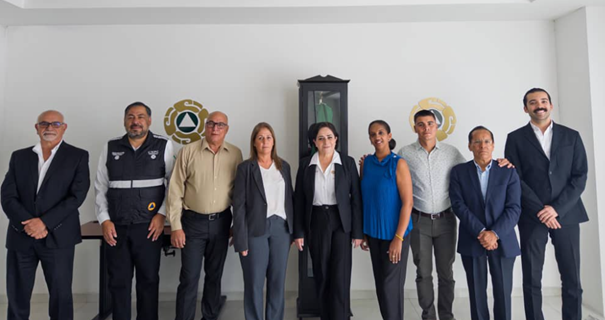
Cuban delegation from defense, meteorology & water agencies visited Mexico July 13-17 to enhance disaster risk cooperation. Meeting under CREWS initiative focused on sharing weather monitoring techniques & response strategies.
A Cuban delegation comprising representatives from the Estado Mayor Nacional de la Defensa Civil (EMNDC), the Institute of Meteorology (INSMET), the National Institute of Hydraulic Resources (INRH) recently visited Mexico to explore opportunities to collaborate on improving disaster risk reduction related to hydrometeorological hazards.
In Cuba, hydrometeorological risk management operates through close collaboration and direct information exchange between three key institutions: EMNDC, INSMET, and INDRHI. These organzations work collaboratively to enhance risk management services and reduce the impact of hydrometeorological events on vulnerable communities – a mission that has become increasingly critical as extreme hydrometeorological events intensify and weather patterns continue to shift.
From 13-17 July, a Cuban delegation met with Mexico’s National Civil Protection Coordination (CNPC) and the National Civil Protection Communications and Operations Center (CENACOM). Organized through the CREWS Accelerated Support Window for Cuba, the meeting established new lines of cooperation, focused on transferring best practices and techniques for monitoring hydrometeorological conditions, and updating early response plans.
Cuba’s Civil Defense system operates through an integrated institutional network that connects multiple sectors including health, meteorology, water resources, transportation, energy, and communications. This comprehensive approach enables rapid activation of action protocols at the national level. The system’s primary strength lies in its territorial and community mobilization capabilities, employing a preventive approach that has significantly reduced vulnerability to hurricanes, torrential rains, and droughts.
To maximize preparedness and response capabilities, and improve key impact reduction indicators, Cuba continues to seek opportunities for international cooperation. The country aims to facilitate knowledge and best practice transfers while adopting new technologies that will enhance efficiency in disaster risk management.
Rio de Janeiro, Brazil, Jul 7 (Prensa Latina) Cuban President Miguel Diaz-Canel denounced the consequences of the coercive measures imposed by the United States on the construction of the Caribbean country’s social and development projects.
“The blockade is an act of aggression, whose offensively extraterritorial implementation harms the sovereignty of all states,” the Cuban president stated on Sunday while speaking at the 17th BRICS Summit panel on “Strengthening Multilateralism, Economic, and Financial Affairs, and Artificial Intelligence.”
Diaz-Canel remembered that in recent days, the US Government approved a new package of measures, through a Presidential Memorandum, aimed at stifling the country’s economy.
“No other country has had to build its social and development project under the prolonged, cruel, and systematic application of an economic, commercial, and financial siege by the greatest power in history,” he noted.
The Cuban head of State underscored that unilateral listings and certifications, based on criteria he described as unfounded, such as Washington’s designation of Cuba as a state sponsor of terrorism, have no space in the 21st century.
The United States has no moral authority or international mandate to certify Cuba or any other country, he said.
To face common challenges, Diaz-Canel emphasized, humanity urgently needs solidarity, respect for differences, dialogue, cooperation, and integration.
“Present and future generations have the right to live in a world of peace and security, where social justice, respect for cultural, ethnic, and religious diversity, and democratic access to science and technology prevail,” he reflected in his speech.
Montevideo, July 27 (Prensa Latina) The Communist Party of Uruguay reaffirmed Cuba’s right to independence and to build socialism, according to a statement by the Central Committee of that political group, released on the occasion of the commemoration of the 72nd anniversary of the assaults on Moncada and Carlos de Cespedes barracks.
The assaults (July 26, 1953) and the subsequent impact leave valuable lessons for those of us fighting for social emancipation, the statement states.
The Communist Party of Uruguay affirmed that respect for the sovereignty and self-determination of peoples includes the freedom to build another social system, as Cuba is doing despite the economic, financial, and commercial siege by the United States.
The declaration emphasizes that the triumph of the Cuban Revolution opened a historic stage of socialist construction, of achievements and conquests, and of permanent internationalist solidarity; therefore, they reaffirm the demand, which is shared by the vast majority of the world’s countries, for an end to the criminal U.S. commercial and financial blockade.
The Uruguayan communists demanded that the U.S. government remove Cuba from the unilateral list of state sponsors of terrorism; this is a falsehood and causes additional economic and financial harm to the Caribbean island, it denounces.
We reject the latest measures adopted by the Donald Trump administration, which further deepen the harassment and siege against Cuba, the text concludes.
Madrid, July 27 (Prensa Latina) More than a hundred people celebrated Cuba’s National Rebellion Day in Spain with a vibrant demonstration that marched through the heart of Madrid.
Representing the State Movement of Solidarity with Cuba (MESC), which brings together more than 60 organizations, slogans such as “Down with the US Blockade,” “Cease Hostility Against the Cuban People,” and “Long Live July 26th” were raised in the parade.
A Manifesto read at the end of the march near the Spanish Foreign Ministry highlighted the traditional demonstration to commemorate the 72nd anniversary of the Assault on the Cuban barracks of Moncada and Cespedes, on July 26, 1953, led by Fidel Castro.
The text, among other details, praised the social achievements of the Revolution, especially in areas such as healthcare, education, and culture, in addition to praising the Cuban democratic system.
It also noted that Cuba has been attacked by the United States, which has attempted to invade it; it has introduced agricultural pests and human diseases into its territory, thru the illegally occupied Guantanamo Bay base, and even by air.
It also referred to the injustice of the economic, financial, and commercial siege established by Washington for more than 60 years, to which were added the 242 measures tightening the blockade established by Donald Trump.
It also recalled that the Trump administration had once again included Cuba on the list of countries sponsoring terrorism, although it is, on the contrary, a victim of this scourge, “perpetrated with impunity from United States territory by the Cuban-American far right with the approval of the Yankee government.”
Detroit, USA, Nov 17 (Prensa Latina) Representatives of more than 70 organizations from the National Network on Cuba in the United States (NNOC) concluded the annual meeting of this broad coalition today with a call to lift the embargo on the Caribbean country.
For two days, activists from Michigan and others from South Carolina, Florida, Illinois, Massachusetts, New York, California, Tennessee, Virginia, and Washington, D.C., gathered in Detroit to discuss strategies for solidarity work toward 2025.
In its final statement, the NNOC celebrated the achievements in “strengthening solidarity with Cuba and advancing the broader struggle to support the removal of Cuba from the list of state sponsors of terrorism and to end the genocidal U.S. economic embargo against Cuba.”
For the coming year, the “goal is to continue our collaborative efforts with like-minded organizations,” the statement emphasized, emphasizing that its members will expand and diversify their networks to make the issue of the need to lift the embargo relevant at the local level.
The statement emphasized that to raise awareness, they will link “the impacts of the blockade to tangible costs, both material and physical, here in the United States; our goal is to make our message resonate with ordinary people, galvanizing broader support,” he emphasized.
At the meeting, it was revealed that the meeting on the International Conference on the Normalization of U.S.-Cuba Relations will be held next March and that the annual meeting of the NNOC will be held in November 2025 in South Carolina.
The day before, three more organizations joined the NNOC on the first day of discussions at the event: Levántate por Cuba (Chicago); Community Movement Builders (Detroit); and Diáspora Pa’lante (New Jersey).
The prelude to this event was the opening of the Latin American News Agency Prensa Latina’s photography exhibition “65 Years Serving the Truth,” which captures moments from the history of this Cuban media outlet, founded on June 16, 1959, at the initiative of Fidel Castro.
On her account on the social network X, the Chargé d’Affaires of the Cuban Embassy in the United States, Lianys Torres, expressed her gratitude for the numerous expressions of solidarity from the American people, whose voices have been raised strongly against the blockade and the inclusion of the island on the unilateral list of sponsors of terrorism.
CIEGO DE AVILA, Cuba, July 26 (ACN) “Cuba will not surrender because its people will not betray their history, nor the legacy of their heroes and martyrs, nor the trust and hope that you place in them and their example,” said Miguel Díaz-Canel Bermúdez, First Secretary of the Central Committee of the Communist Party of Cuba (PCC) and President of the Republic, in Ciego de Ávila, alongside solidarity groups with the Caribbean nation.
During a Solidarity Meeting held in the covered Giraldo Córdova Cardín Hall in this city, with the participation of 370 friends representing 23 countries—organized into eight solidarity projects from Latin America and the Caribbean, Africa, Europe, and the United States—the Cuban leader reaffirmed the will to resist and overcome the imperial siege. The event takes place in Ciego de Ávila as part of the commemorative activities for the 72nd anniversary of the assaults on the Moncada and Carlos Manuel de Céspedes barracks, for which the province is hosting the national central event.
Several voices spoke in favor of the Cuban Revolution, including that of Samira Addrey, a U.S. graduate of the Latin American School of Medicine (ELAM), who said that thanks to her profession and those who trained her, she not only learned to heal bodies but also to love those who suffer.
Addrey described the media and political campaigns by the U.S. government against Cuba’s medical cooperation abroad as “baseless and cowardly.”
For his part, Fabiano Salazar, a member of the Brazilian Movement of Solidarity with Cuba, demanded an end to the U.S. economic, commercial, and financial blockade against the island and its removal from the list of alleged state sponsors of terrorism.
“From revolutionary ethics, we are committed to Cuba and to fighting for its causes, which are the just causes of humanity,” said Oihana Vicente, a representative of Sortu, a Basque party.
Oihana explained how they work from their trenches to counteract the media war against Cuba and promote the truth about its people in Europe.
The Cuban Head of State, addressing those present, evoked the legacy of the historic leader of the Revolution, Fidel Castro, in how Cuba has withstood imperialist attacks, also thanks to global solidarity.
Regarding the country’s current situation, Díaz-Canel stated that U.S. policy of suffocating the island has intensified differently since Donald Trump’s first term, with measures including the activation of Title III of the Helms-Burton Act.
Nevertheless, the Cuban leader commented that a medium- and long-term strategy has been prepared to overcome the blockade, even if it worsens further.
During the meeting, several participants referred to the genocide being carried out by the Zionist entity of Israel against Palestine in the Gaza Strip and the need for the world to unite in a stronger response to these crimes. Cuba not only reaffirms its political anti-imperialism in international forums but also hosts young people from that Middle Eastern nation for medical training.
Accompanying the Cuban leader and friends from around the world were Roberto Morales Ojeda, Secretary of Organization of the PCC Central Committee; Bruno Rodríguez Parrilla, Minister of Foreign Affairs; Emilio Lozada García, Head of the International Relations Department of the PCC Central Committee; Fernando González Llort, President of ICAP; and Julio Gómez Casanova, First Secretary of the Party in the Cuban province.
Montevideo, July 25 (Prensa Latina) The Uruguay-Cuba Parliamentary Friendship Group was established in the South American country’s Parliament and pledges to work toward strengthening ties between the two countries.
Legislators from the main political parties make up the group, whose constitution was attended by the Speaker of the Chamber of Deputies, Sebastian Valdomir, and former President Ana Olivera.
Juan Canessa, nominated as the new Uruguayan ambassador to Cuba, was also present in the ceremony, together with Antonio Pardo, Cuba’s Charge d’Affaires in Montevideo, and the president of Parlatino, Rolando Gonzalez, who chairs the Cuba-Uruguay friendship group of his country’s National Assembly of People’s Power.
The Vice President of the Foreign Relations Committee of the Chamber of Deputies, Carlos Varela, urged strengthening relations between Cuba and Uruguay as heirs to the legacy left by Jose Marti as the South American country’s consul in New York.
Sebastian Valdomir proposed two topics of interest for the bilateral agenda: political coordination within the Community of Latin American and Caribbean States (CELAC), whose pro tempore presidency Uruguay will assume in 2026.
The other topic points at US relations following its threats against several Latin American and Caribbean countries and the strengthening of the blockade against Cuba.
In this regard, the president of Parlatino denounced Washington’s decision to include Cuba on the unilateral list of countries that sponsor terrorism as a pretext to carry out “a horrific financial suffocation.”
Cuba’s tourism industry had a tough time in the first half of 2024, with a 25% fall in international arrivals for the same period last year. This fall 327,799 fewer visitors — can be explained by a combination of decreased arrivals from important markets such as the United States, Europe and the Cuban diaspora. Canada is still the largest source of tourists, but has also experienced a decline. (10) In addition to the difficulties derived from the perennial nature of the administrative policies, the current economic crisis and global political strategies, sectorialism has made it even more difficult for the Cuban tourist industry to emerge with a strategic alternative to recover and expand to new national and international markets.
Cuba’s international tourism sector has faced a significant setback in the first half of this year, recording a 25% drop in the number of international visitors. From January to June, the island welcomed only 981,856 tourists, a decrease of 327,799 compared to the same period in 2023, according to the National Statistics and Information Office (ONEI).
Canada continues to be Cuba’s largest source of tourists, with 428,125 Canadians visiting the island. However, this figure represents only 75% of the total number of Canadian visitors in 2023, highlighting a noticeable decline in the Canadian market. While Canada maintains its lead as Cuba’s primary tourism market, the significant reduction in arrivals points to broader challenges facing Cuba’s tourism sector.
Several other key international markets also reported major declines. Russia, Germany, France, and Spain all saw considerable decreases in the number of tourists coming to Cuba. Of particular note is the United States, which experienced an 80.6% drop in its visitor numbers. The decline in U.S. tourism to Cuba, a trend that has been continuing for some time, underscores the complexities of political and economic factors influencing the flow of visitors between the two countries.
In addition to declines in these international markets, the number of visits from the Cuban diaspora also fell sharply. The Cuban community abroad contributed to a 77.6% reduction in visits, with 120,423 fewer tourists compared to last year. June saw a particularly low number of arrivals, with Cuba receiving only 119,513 visitors during the month. This drop represents a continuation of a difficult trend for Cuba’s tourism industry, which had already been struggling to maintain growth amid global and domestic economic challenges.
Despite these widespread declines, Colombia proved to be an exception, showing a 2.4% increase in the number of visitors. The country saw 338 additional Colombian tourists compared to the same period last year, offering a small but significant bright spot in an otherwise difficult first half of the year. Mexico and Argentina, on the other hand, also posted low figures, further adding to the strain on Cuba’s tourism industry.
The downturn in international visitors has been particularly impactful on Cuba’s economy, which has long relied on tourism as one of its primary sources of revenue. The sector, which has already faced numerous challenges due to the ongoing economic crisis, now finds itself in a precarious position as it attempts to recover from this significant drop in arrivals.
Efforts to revive Cuba’s tourism industry have become a priority, with a focus on improving connectivity between Cuba and its traditional tourist markets. Cuba’s government has emphasized the need to bolster its connections with countries such as Colombia, Mexico, and Brazil, where there is still potential for growth despite the overall declines in tourism numbers. In addition, Cuba is looking to expand its reach into emerging markets in Asia and the Middle East, seeking to diversify its tourist base and reduce its dependence on a few key markets.
The government also recognizes the importance of reactivating tourism from the Cuban diaspora, who traditionally contribute a significant share of visitors to the island. By reinforcing ties with the Cuban community abroad, Cuba aims to increase the flow of visitors and encourage them to return to their homeland, helping to sustain the tourism sector.
Looking ahead, the Cuban government is also exploring the potential for new tourism initiatives and partnerships aimed at attracting tourists from new regions. With the tourism sector facing a combination of economic pressures and declining arrivals from traditional markets, diversifying Cuba’s tourist base and investing in new infrastructure will be crucial for the sector’s long-term recovery.
The overall picture for Cuba’s tourism industry has been mixed in recent years. In 2022, the island welcomed 1.6 million tourists, a figure that increased to 2.4 million in 2023. However, the positive trend was short-lived, as the total number of visitors for 2024 dropped back to 2.2 million. This decline highlights the ongoing volatility and challenges Cuba faces as it tries to rebuild and sustain growth in its tourism sector.
Cuba’s tourism sector has faced a twenty-five percent drop in international arrivals in the first half of 2024, driven by declines in key markets like the United States and Europe, as well as ongoing economic challenges. Efforts are underway to revitalize the industry by strengthening traditional markets and exploring new regions.
Hopeful for a tourism recovery still, the Cuban government is persisting with a tourism push that it wants to make the pillar of the island’s economy. With a focus on the tightening of its traditional markets, penetration of new territories and improvements in the visiting experience, Cuba aims to lift tourism numbers out of the doldrums and remake an industry that has long been a mainstay of government finances.
Havana, July 25 (Prensa Latina) On the eve of the 72nd anniversary of the attacks on the barracks Moncada and Carlos Manuel de Cespedes, Cuba is experiencing intense preparations to commemorate a date that laid the foundation for the revolutionary triumph.
During these days, drives are taking place throughout the nation in honor of the national holiday, although the main event will take place this Saturday in the central province of Ciego de Avila.
The heroic action, which took place on July 26, 1953, had as its main objective to combat the evils of the dictatorship imposed on the island by Fulgencio Batista since the coup d’etat of March 10, 1952, and is considered the prelude to the struggles that led to the definitive triumph of the Cuban Revolution in January 1959.
Under the name of the Centennial Generation, in allusion to the 100th anniversary of the birth of Cuba’s National Hero, Jose Marti, in 1953, young revolutionaries led by the then-young lawyer Fidel Castro set out to promote an insurrectionary climate in the country, which would revive the Cuban people’s ideals of independence.
After the failure of the armed action, most of the participants were killed and those who survived were detained, but this unprecedented event awakened national consciousness and marked the beginning of the final stage of Cuba’s wars for independence.
The historic leader himself, Fidel Castro, expressed that the actions of July 26, 1953, constituted “a new path for the people; that it marked the beginning of a new conception of struggle, which in a not-so-distant time shattered the military dictatorship and created the conditions for the development of the Revolution.”
For this reason, this date in Cuba was baptized the “Day of National Rebellion,” and is celebrated annually to relive this epic feat and honor those who fell in that and subsequent struggles.
Havana, July 24 (Prensa Latina) Cuban Foreign Minister Bruno Rodríguez today described the U.S. State Department’s messages on digital networks as lies and disrespectful and irresponsible publications.
Rodríguez emphasized that the social media messages “demonstrate the frustration of anti-Cuban sectors in their inhumane aggression against the Cuban people.”
The head of Cuban diplomacy pointed out in X that these sectors, deprived of support from the vast majority of Americans, Cubans and the international community, are desperately seeking taxpayer funds to construct provocations and impose a course of unjustifiable bilateral confrontation.
In recent days, Cuban President Miguel Díaz-Canel denounced the United States government’s attempts to subdue Cuba with economic suffocation measures that are harming the population.
Since Donald Trump’s first term (2017-2021), the current Republican administration has sought to close all avenues for access to essential financing for the economy’s normal functioning, Díaz-Canel asserted before the National Assembly of People’s Power.
The Donald Trump administration publicly declared, in a presidential memorandum on National Security, its intention to intensify “the brutal siege combined with the unacceptable inclusion of Cuba on the list of alleged sponsors of terrorism.”
This hostility, the head of state emphasized, “reinforces the blockade policy to unprecedented levels and causes a multiplied impact of coercive measures on the economy and, by extension, on the Cuban population’s standard of living.”