
Bogotá, Aug 17 (Prensa Latina) While attending to dozens of patients in Cali, one of the cities hardest hit by a deadly earthquake, Colombian doctor Diana Hernández recounts how the importance that Cuba gives to life was engraved in her heart.
A graduate of the Latin American School of Medicine (ELAM) in 2012, this woman, born in Cali but a resident of Popayán by choice, passionately defends all the learning she received on the island as part of her training to become a health professional.
She kindly agreed to sacrifice some of her precious free time to answer my questions. She did so in the early morning hours when she had a few free minutes amidst the hustle and bustle that Cali is experiencing these days due to the earthquake that has already left a tragic toll of more than 130 dead in that city alone.
Although the chances of finding life are reduced, he tells me that hope has not yet been lost of rescuing those who may still be trapped.
“The solidarity has been endless, and in the first few days many who were near the sites where the buildings collapsed were willing to help, and it was also key to getting some people out at the beginning,” he says.
It also refers to the need for staff support to help sustain and build the city at a time when hundreds of damaged health centers are being reported.
“The hospital network was affected, the University Hospital was greatly affected, there are health centers on the hillsides, in certain parts of the city, that cannot operate where they were in the physical structure and have had to move to other places,” he says.
One question arises: how much of what was learned on the island applies to this context?
“Studying in Cuba undoubtedly gave me many possibilities and many dimensions; it taught me to build a solid scientific education, but above all a human one. It was a people who welcomed me with love, who accompanied me during those years, who taught me, but also who inspired me,” she recounts, moved.
“I experienced hurricanes when I was a student, seeing how the entire country mobilized and, above all, the importance of protecting life, that is something that stayed with me,” she confesses.
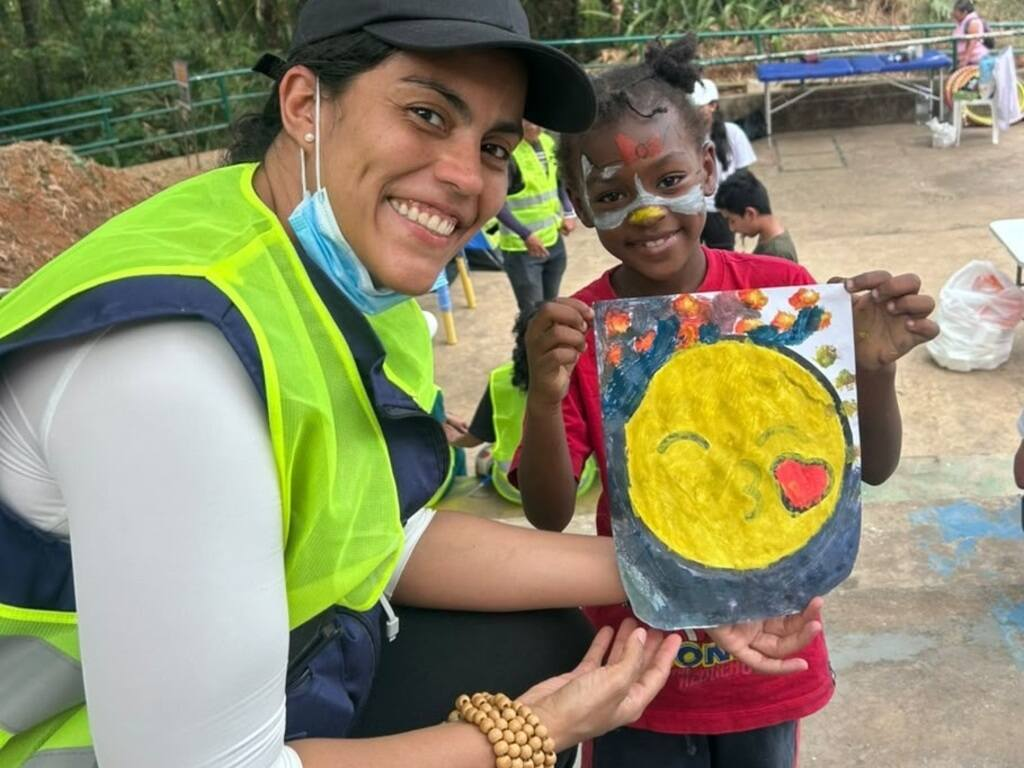
Hernández clarifies that she is not the only ELAM graduate who went to Cali to help the victims, and as proof, she sends me a photo where she is accompanied by two other doctors. She also emphasizes that there are several others in other regions of the country.
Since yesterday, news has been circulating that the Los Mambí-10 de Agosto Humanitarian Brigade, comprised of professionals trained on the island, has departed for Chocó, one of the poorest departments, while others are providing their services in Buenaventura and Pereira. The doctor is in Cali with a group of specialists who, she tells me, wanted to join in order to “amplify hope” and “provide the best possible support.”
Even though there are many things to tell, the memory of the island keeps creeping in.
“Wherever we arrive, they immediately know that we are Colombians who graduated in Cuba and—I know this happens to many people in many places—then they say: the Cuban doctors have arrived. That also reminds us of what Fidel [Castro] told us: that we were Cubans born abroad,” he acknowledges, his voice breaking.
Diana had no qualms about sharing with me personal decisions and experiences that also stemmed from the altruism she learned on the island.
She tells me how, once she graduated, she refused to do her social service in a town near the capital, which cost her a sanction, and instead went to the Colombian Massif, a large mountain system in the Andes where the Magdalena River originates.
He explains that everyone who studied in Cuba created an unbreakable network.
“Being part of ELAM connects us at heart (…) we all know that if we need something for ourselves or for the patients, we are there, and I think that is very valuable,” she says.
I asked him his opinion on a possible break in relations between his country and the island, and his response was emphatic.
“Behind the relations between states are families, communities, and decades of cooperation and solidarity. I am a testament to that solidarity. The doctors who are here—and not only doctors, because Cuba has trained many Colombians in different fields—that is something Colombia should not forget,” he emphasized.
Finally, he summarized in one sentence what he believes the largest island in the Caribbean represents for the world.
“Cuba is a heritage of the people,” asserted Colombian doctor Diana Hernández with conviction.
ode/ifs

